
Optimal Control of Marketing-Production Systems: The Power of Hedging Points
7665_Optimal control of a marketing-production system.
This paper presents a building-block model for the integrated scheduling of a marketing-production system, where demand is modeled as a controlled two-state Markov chain. The core methodology utilizes Hamilton-Jacobi-Bellman (HJB) equations to derive optimal policies for production and advertising rates, achieving a simple yet robust "Hedging Point" strategy.
TL;DR
In the volatile world of manufacturing, the friction between sales (marketing) and the factory floor (production) is a classic pain point. This paper provides a rigorous mathematical bridge, proving that the optimal synchronization of these two functions follows a surprisingly simple Hedging Point Policy. By solving HJB equations, the authors demonstrate exactly when to "push" marketing for more demand and how to adjust production levels to maintain an ideal inventory buffer.
The Motivating Conflict: Why Integrated Control?
Most manufacturing models treat "Demand" as an external, uncontrollable force—like the weather. However, in reality, firms spend millions on advertising to change that demand.
- The Conflict: Marketing wants to maximize volume; Production wants to minimize inventory costs and shortages.
- The Difficulty: Every dollar spent on a TV commercial increases the demand rate, but if the factory can't keep up, the firm incurs heavy shortage costs. Conversely, over-advertising while inventory is high creates wasteful expenditures.
The authors ask: What is the optimal threshold of inventory where advertising becomes profitable?
Methodology: HJB Equations and the Switching Function
The system is modeled with a single machine and a two-state Markov chain for demand ( to ). The state of the system is the inventory level , and the objective is to maximize profit (revenue minus inventory/shortage costs and advertising costs).
The HJB Framework
The authors utilize the Hamilton-Jacobi-Bellman (HJB) equations to determine the value function . The complexity lies in the Quasivariational Inequalities derived from the marketing decision: Where represents the "no-marketing" scenario and represents the "active-promotion" scenario.
The Insight: The Switching Function
The "physics" behind the math reveals a switching function .
- If : No advertising.
- If : Full advertising ().
Core Results: The Optimal Policy Landscape
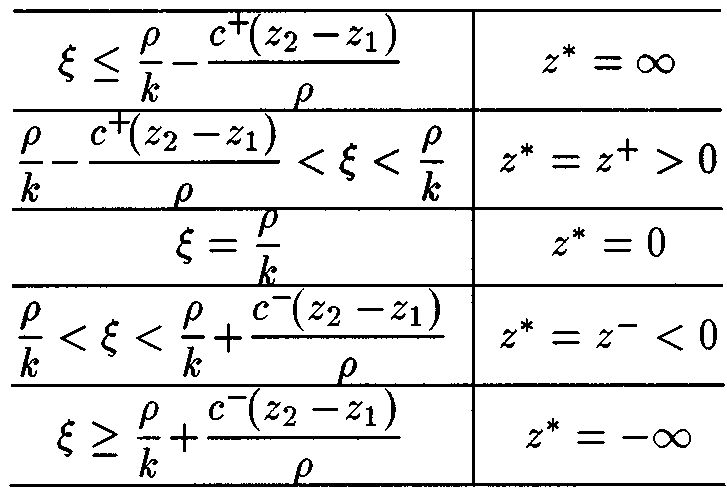
The paper categorizes the optimal behavior based on Marginal Revenue Rate ().
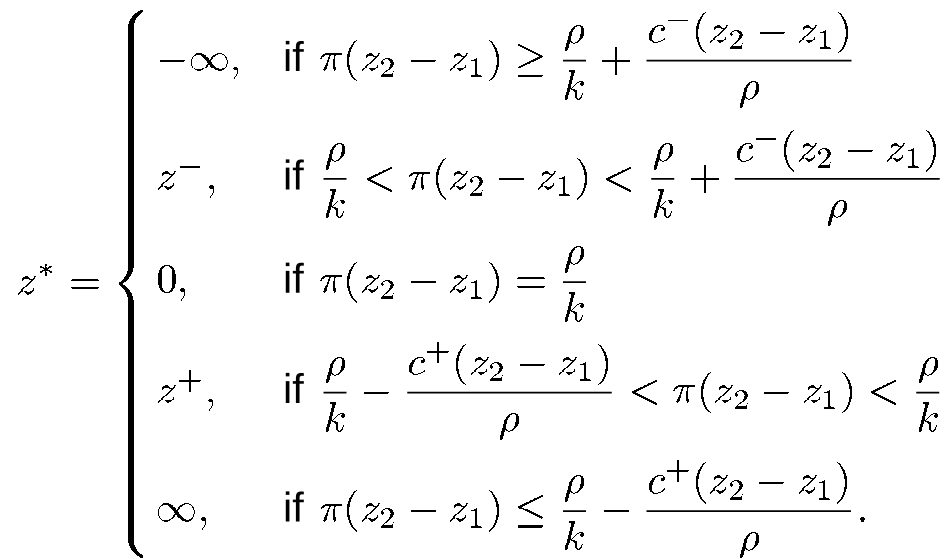
- Low Marginal Revenue: If the profit from a demand jump is lower than the advertising cost, the optimal policy is (Never Advertise).
- Moderate Revenue: The system maintains a positive hedging point ; advertising is used only when inventory is sufficient to meet the expected surge.
- High Revenue: If the revenue jump is massive, the system adopts (Advertise Constantly), regardless of shortages.
Production Logic
Regardless of marketing, the production rate remains a standard hedging point:
- Produce at if .
- Match demand if .
- Stop production if .
Critical Analysis & Conclusion
Why it works
The beauty of this research is the analytical tractability. By reducing a complex stochastic problem to a set of threshold equations, the authors provide a rulebook that plant managers can actually use. It captures the "physical intuition" that promotion acts as a buffer-filling mechanism.
Limitations & Future Work
- Absorbing State: The current model assumes demand only increases (Poisson-like). In reality, demand decays, requiring a circular Markov chain.
- Capacity Constraints: The model assumes a fixed machine capacity. Integrating machine failures (as seen in Akella and Kumar) with marketing control would be the next logical SOTA step.
Final Takeaway
For technical leaders, this paper proves that Integrated Marketing-Production (IMP) control isn't just a management theory—it's mathematically optimal. Implementing simple threshold-based triggers for promotion based on real-time inventory levels can significantly outperform decoupled strategies.