
Beyond Blind Cooperation: Optimizing Social-Aware Spectrum Sensing in Cognitive Radios
5876_Optimal Cooperator Set Selection in Social Cognitive Radio Networks.
This paper introduces a social-aware Cooperative Spectrum Sensing (CSS) framework for Cognitive Radio Networks (CRNs), where cooperation between Secondary Users (SUs) is modeled based on social ties. Using a multi-objective optimization approach solved via an Evolutionary Multiobjective Algorithm (EMOA), the proposed method optimizes both network throughput and sensing reliability (trust), achieving near-optimal performance in legitimate settings while outperforming traditional schemes by 16% under sensing attacks.
TL;DR
This research bridges the gap between the Wireless Connectivity Layer (WCL) and the Social Connectivity Layer (SCL) by modeling cooperation in Cognitive Radio Networks (CRNs) as a function of social ties. Rather than assuming all nodes are altruistic, the authors develop a Multi-Objective Optimization framework that balances raw throughput with a dynamic trust metric, effectively creating a "socially immune" network that resists common sensing attacks while maintaining high efficiency.
The "Altruism Gap" in Wireless Research
Most literature on Cooperative Spectrum Sensing (CSS) operates under a flawed assumption: if Node A asks Node B to sense the spectrum, Node B will comply 100% of the time. In reality, Secondary Users (SUs) are cognitive agents—often mobile devices with limited battery—that may refuse requests to save energy or act maliciously to hog bandwidth.
The authors argue that ignoring these social ties (friendship, kinship, or reputation) leads to a "phantom throughput" problem—a significant overestimation of what the network can actually deliver.
Methodology: The Social-Aware Framework
The paper proposes a dual-layer abstraction. While the WCL handles signal-to-noise ratios (SNR) and sensing times, the SCL governs the willingness to collaborate.
1. The Trust Metric
Each node maintains a local trust score () for its neighbors. This isn't just a static value; it is updated via a window-based evaluation of sensing consistency. If a neighbor reports a channel is empty but the requester experiences a collision with the Primary User (PU), the neighbor's trust score drops immediately.
2. Multi-Objective Optimization (MOP)
The core of the paper is a Pareto-maximization problem:
- Objective 1 (Throughput): Maximize the data rate relative to time spent sensing and reporting.
- Objective 2 (Trust): Maximize the minimum expected trust among selected cooperators.
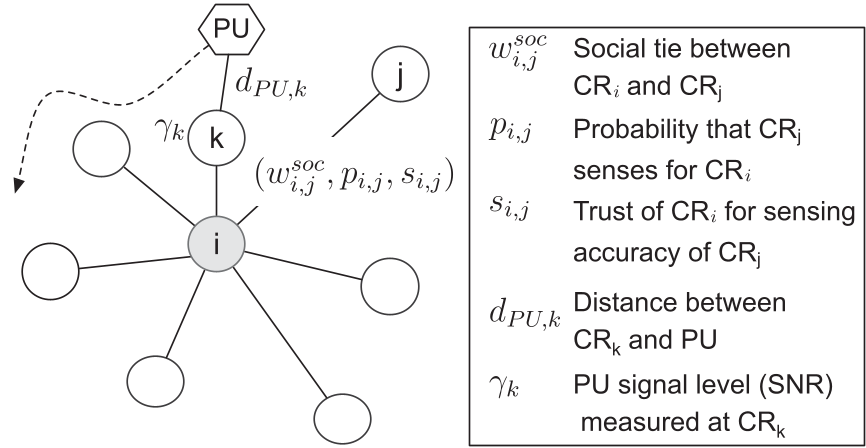 Figure 1: The Social CRN model showing the interaction between social ties, cooperation probability, and trust assessment.
To solve this non-convex, nonlinear binary problem, the authors employ an Evolutionary Multiobjective Algorithm (EMOA). This approach allows the network to find a "Pareto Front"—a set of optimal trade-offs where you can't increase throughput without compromising the trustworthiness of the sensing set.
Resilience Against Attacks
The "social" filter acts as a natural defense mechanism. The authors tested the framework against:
- SSDF (Spectrum Sensing Data Falsification): Attackers report the inverse of the truth.
- PUE (Primary User Emulation): Selfish nodes always report a "Busy" channel to keep it for themselves.
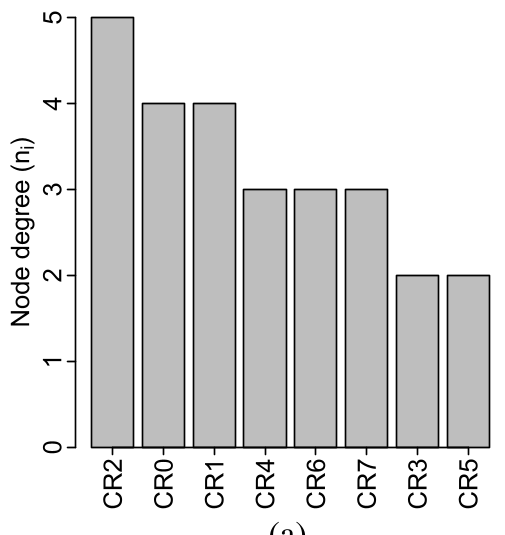 Figure 2: Performance comparison per CR. Note how EMOA (social-aware) maintains stable performance for neighbors of malicious nodes, while throughput-optimal schemes collapse.
The results are striking: In Scenario H (where a central, well-connected node turns malicious), the standard throughput-optimized scheme suffers a 21% drop in efficiency. The social-aware EMOA remains almost unbothered, with only a 1.5% decrease.
Evolutionary Insights: System vs. Peer Willingness
A standout feature of this research is the introduction of System Willingness. This allows a CR to function in "foreign" environments where no direct social ties exist. It prevents exploitation by tracking the ratio of accepted-to-received requests, ensuring that no single node is "bullied" into spending all its energy sensing for others.
Critical Analysis & Conclusion
Takeaway
The paper successfully proves that social context is not just a human nuance but a technical necessity for resilient CSS. By integrating trust into the optimization objective, networks become self-healing against Byzantine actors.
Limitations
- Scale: The EMOA is computationally expensive. While the authors proposed a heuristic for large networks, the "Pareto-perfect" solution remains limited to small neighborhoods (N ≤ 10).
- Mobility: The social ties are treated as relatively static; in highly mobile environments, the time-to-converge for trust metrics might lag behind the network topology changes.
Final Outlook
As we move toward 6G and the "Sharing Economy" of spectrum, models that account for the Social Connectivity Layer will be the only way to provide meaningful Performance Guarantees in decentralized networks.