
Optimal Crowdsourcing: Why "Winner-Takes-All" is More Than Just a Slogan
Optimal Crowdsourcing Contests
This paper establishes a theoretical framework for designing optimal crowdsourcing contests by modeling them as all-pay auctions where the principal's objective is to maximize the quality of the single best submission. The authors introduce a "maximum-payment virtual valuation" and demonstrate that the optimal contest is a winner-takes-all format with a specific quality reserve for most standard skill distributions.
TL;DR
In this seminal work, Chawla et al. provide the mathematical justification for why most crowdsourcing platforms (like Netflix or LogoDesign) give the entire prize to the top winner. By treating effort as a "bid" in an all-pay auction, the authors show that for most skill distributions, a winner-takes-all format with a minimum quality threshold (reserve) maximizes the quality of the best submission. Surprisingly, they also prove that crowdsourcing is never more than twice as "expensive" as traditional procurement in terms of wasted effort.
Background: Crowdsourcing as an All-Pay Auction
In a typical auction, only the winner pays. In crowdsourcing, everyone pays. Whether you are a data scientist competing for the Netflix Prize or a designer on 99designs, you must exert effort (the "payment") before knowing if you've won. This makes crowdsourcing an all-pay auction.
However, there is a catch. In a classic auction, the auctioneer wants to maximize the sum of payments (Revenue). In crowdsourcing, the principal usually only cares about the single best submission. This shift in objective from "Sum" to "Max" changes the fundamental "Virtual Valuation" math famously proposed by Myerson in 1981.
The Problem: The Inefficiency of Sunk Costs
The central tension in this paper is the comparison between Crowdsourcing and Conventional Procurement.
- Procurement: You hire one person; only they work. Efficiency is high, but you might miss the "hidden gem" in the crowd.
- Crowdsourcing: 100 people work; 99 efforts are "wasted."
The authors ask: How much do we lose by being "inefficient"? and How do we design the reward structure to minimize this loss?
Methodology: The Maximum-Payment Virtual Value
The authors define a new virtual valuation function, , which accounts for the competitive pressure among contestants.

Optimal Architecture
- Winner-Takes-All: For "regular" distributions (like Uniform or Normal), splitting the prize actually reduces the incentive for top-tier talent to exert maximum effort.
- The Reserve Price: The principal should set a "reserve quality." If no one beats this threshold, no reward is given. This forces contestants to work harder just to qualify.
- Ironing for Irregularity: If skills are distributed weirdly, the optimal contest might involve "forbidden bid intervals" where certain levels of effort are strategically avoided or result in tied rewards.
Experiments & Theoretical Bounds
The paper provides a rigorous "Utilization Ratio" to quantify the gap between the sum of efforts and the maximum effort.
Key Result: The Factor of 2 The authors prove that for any highest-bidder-wins contest with a reserve:
This implies that even in the "worst" case, the total effort wasted by losers is no more than the effort spent by the winner. This 2-approximation makes crowdsourcing a robust alternative to idealized procurement, especially when evaluating a "quote" is harder than evaluating a finished product.
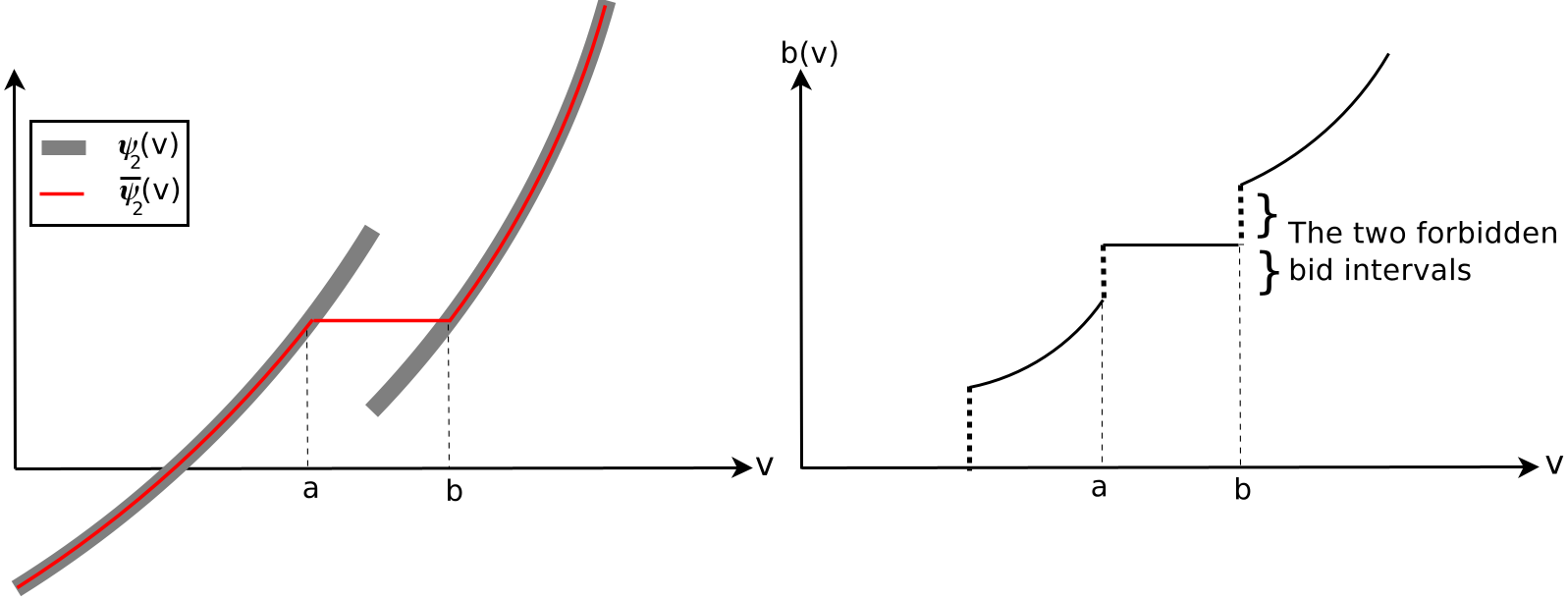 Figure 1: Comparison of Virtual Values and Ironing. Note how the ironed curve (dashed) handles irregularities in skill distributions.
Critical Insight: Distribution Independence
One of the most practical takeaways is the Prior-Independent Approximation. In the real world, a principal doesn't know the exact "skill distribution" of the internet. The authors show that simply inviting one more contestant is often more effective than perfectly optimizing the reserve price based on complex statistics.
Conclusion
This research bridges the gap between theoretical mechanism design and the practical reality of the gig economy. It tells us that:
- Winner-takes-all is not just about prestige; it’s mathematically optimal for driving peak quality.
- The "Waste" is bounded: While it feels inefficient to have 100 people work for one prize, the quality gain from the "top" performer justifies the system.
- Simplicity Wins: A simple high-bid-wins contest is remarkably close to the theoretical optimum, even if you don't have a PhD in economics to set the perfect rules.
Limitations: The model assumes agents are risk-neutral. In reality, designers or developers may be risk-averse, which might favor splitting rewards to encourage participation—a frontier for future research.