
PAGE-GA: Optimizing the Global Economy’s Response to Climate Change
Optimal GHG Emission Abatement and Aggregate Economic Damages of Global Warming
This paper presents a high-performance integrated assessment framework combining a compiled version of the PAGE09 model with Genetic Algorithms (GAs) to determine optimal regional Greenhouse Gas (GHG) abatement policies. The proposed method identifies emission paths that minimize combined global warming damages and abatement costs while respecting temperature rise constraints.
TL;DR
Climate change is an optimization problem where "waiting" is the most expensive variable. This research introduces a high-speed, compiled version of the PAGE09 Integrated Assessment Model (IAM), paired with a Genetic Algorithm (GA). By accelerating simulation speeds by 100x, the authors discover optimal regional emission paths that could save the global economy nearly $270 trillion compared to business-as-usual scenarios.
Background Positioning
In the landscape of climate science, IAMs like PAGE (Policy Analysis of the Greenhouse Effect) are the bridge between environmental physics and economic reality. This work is a systematic optimization breakthrough, moving from mere "scenario evaluation" to "optimal policy discovery" through computational engineering and metaheuristic search.
The "Speed" Problem and Research Motivation
Why haven't we optimized climate policies perfectly before? The answer lies in the Computational Bottleneck. Previous versions of PAGE were spreadsheet-based, requiring over a week to perform the millions of simulations needed for rigorous optimization under uncertainty.
The authors identify three core technical challenges:
- Complexity: Non-smooth equations and hysteresis (lag) in climate responses.
- Long Horizons: Decisions made in 2026 impact results in 2200, requiring dense time grids.
- Non-Convexity: Jumps in damage functions (disasters) create a landscape full of local optima where traditional calculus fails.
Methodology: The Compiled PAGE09 + GA Framework
The researchers re-implemented the entire PAGE09 logic in Fortran 77. This isn't just a programming exercise; it's a structural shift that reduced a 700-second simulation run to just 7 seconds, enabling the Genetic Algorithm to "evolve" policies through millions of iterations in mere hours.
The Optimization Pipeline
The GA operates on "chromosomes" representing regional emission percentages. A unique Constraint Operator was designed to ensure that the generated policies are realistic—preventing "ripple" patterns where emissions go up and down nonsensically.
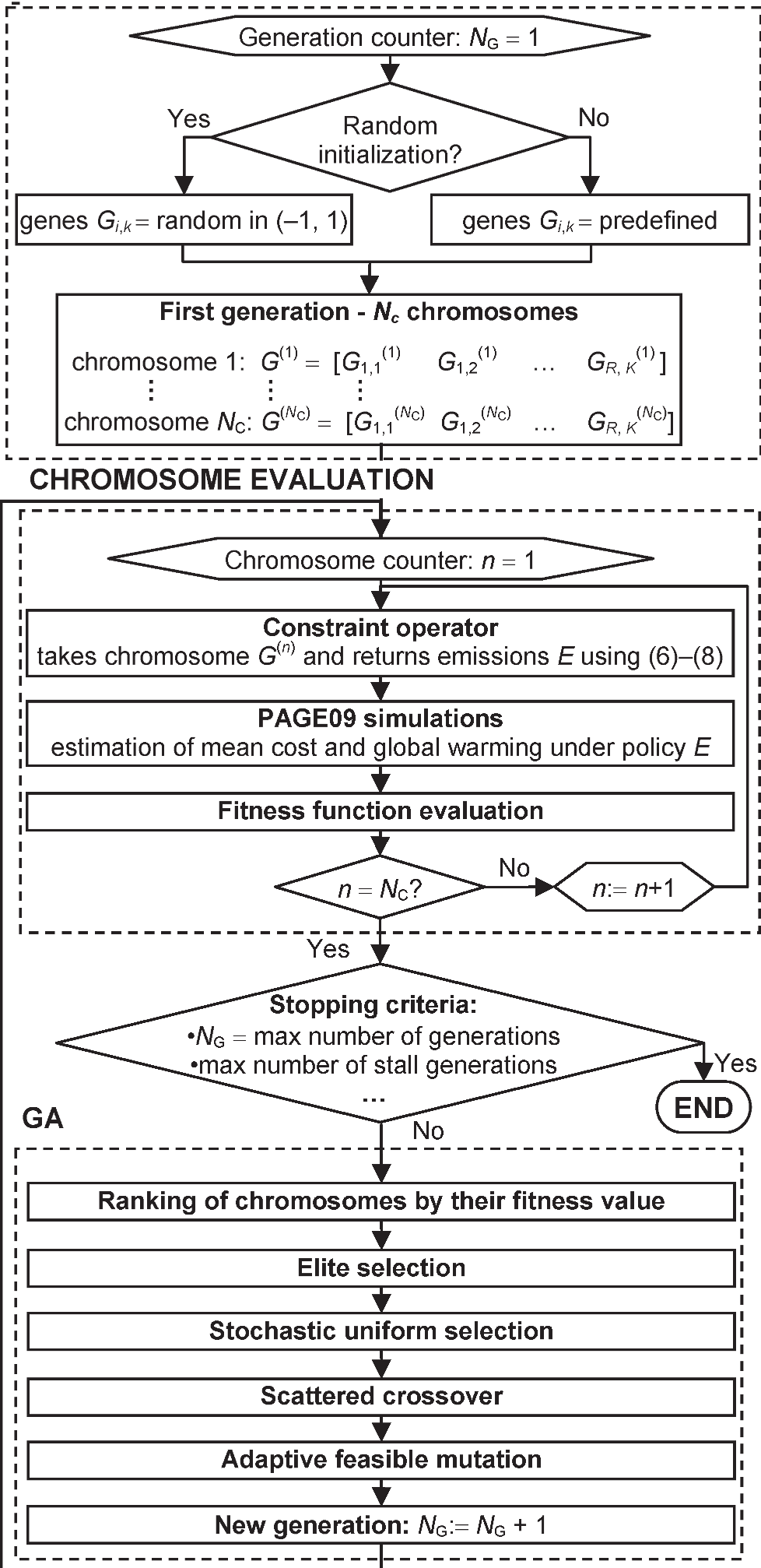 Figure 1: The integration of GA-based global search and regional emission mapping.
The objective function minimizes: Total Cost = Abatment Costs + Adaptation Costs + Economic Damages Subject to: Mean Temperature Rise (T_max) ≤ Threshold (e.g., 3.0°C)
Experiments and Crucial Results
The study compared three target scenarios (3°C, 3.5°C, 4°C) against a Business-As-Usual (BAU) path.
1. The Cost of Inaction
The data reveals a stark reality: The BAU scenario leads to a temperature rise of ~5.9°C by 2200, carrying a price tag of 576.99 trillion.
 Table 1: Mean Global Warming and Cost comparison between Optimal and BAU policies.
2. Regional Divergence
The model reveals that "Optimal" does not mean "Equal." Regions like the United States must pursue immediate, drastic cuts due to high per-capita emissions, while regions like Africa (AF) and India/SE Asia (IA) are allowed a slightly delayed abatement peak to balance economic development with global targets.
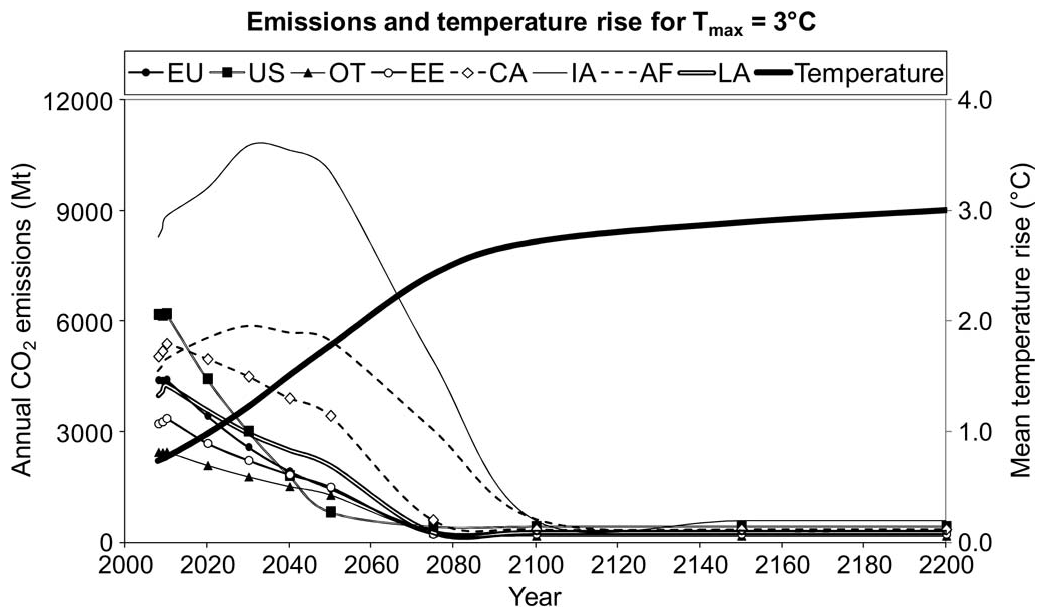 Figure 2: Optimal regional emission trajectories for a 3.0°C target. Note the immediate decline required for the US and EU.
Critical Insight & Conclusion
The most profound takeaway is the sensitivity of the global economy to the first decade of action. The GA consistently finds that delaying emission cuts increases total discounted costs significantly because abatement costs grow exponentially as the "carbon budget" shrinks, while climate damages compound over centuries.
Limitations: While the compiled PAGE09 is fast, it still relies on simplified representations of catastrophic "tipping points." Future work should focus on integrating more granular regional data and expanding the scope to non-CO2 gases (CH4, N2O) within the same high-speed GA framework.
The Bottom Line: Climate action is not just an environmental mandate; it is a fundamental requirement for global economic optimization.