
Optimal Incentive Design: Balancing Rewards and Cloud Costs in Multimedia Crowdsourcing
Optimal Incentive Design for Cloud-Enabled Multimedia Crowdsourcing
This paper proposes an optimal incentive mechanism for cloud-enabled multimedia crowdsourcing, facilitating a utility-maximization interaction between a crowdsourcer and individual smartphone contributors. The framework specifically addresses the high resource demands of multimedia (video/images) by integrating a generic cloud cost model and QoS constraints like jitter.
TL;DR
With the rise of platforms like Twitch and YouTube, multimedia crowdsourcing has become a cornerstone of modern digital service. However, processing high-definition video is expensive. This paper provides a mathematical framework for a cloud-enabled crowdsourcing scheme that jointly optimizes the reward given to smartphone contributors and the operational costs of the cloud, ensuring quality of service (QoS) and budget sustainability.
Background: Why Multimedia Crowdsourcing is Different
Traditional crowdsourcing (like text-based labeling) has low overhead. Multimedia is a different beast:
- Resource Hungry: High storage, high bandwidth, and intense CPU/GPU needs for transcoding.
- Heterogeneous: Every smartphone has a different camera (quality ) and different battery/energy costs ().
- The Cloud Factor: We don't just send data to a person; we send it through a cloud that charges based on usage.
The authors argue that we cannot design incentives for users without simultaneously considering what it costs to process their data in the cloud.
The Core Mechanism: Who Gets Paid and How Much?
The interaction follows a two-stage strategy:
- The Crowdsourcer: Announces a total reward .
- The Contributors: Calculate their optimal service duration to maximize their own utility (Reward minus Energy Cost).
The paper introduces an Eligibility Condition for contributors. Not everyone gets to play. A smartphone is only eligible if its cost factor is below a specific threshold determined by the quality of its peers:
Methodology & Architecture
The framework utilizes a cloud infrastructure to handle the "heavy lifting" (image segmentation, feature extraction, video coding).
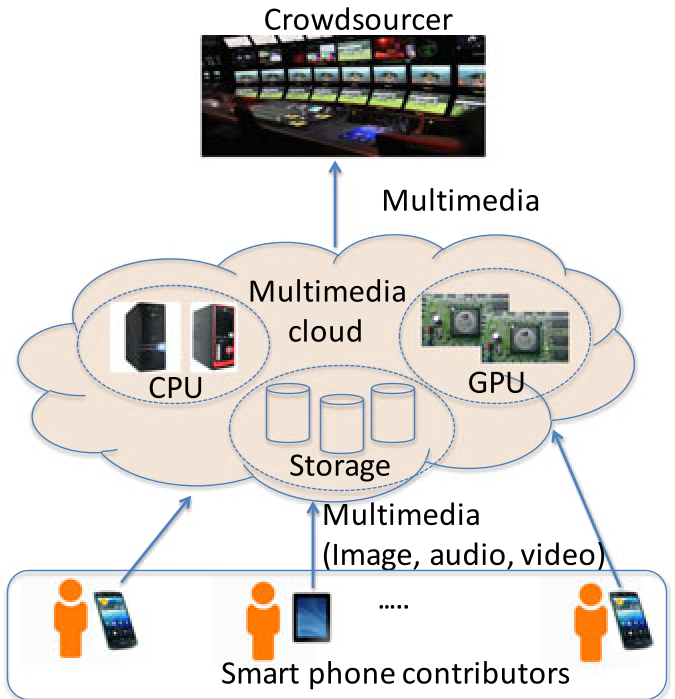 Fig 1: The communication flow between mobile devices, the cloud, and the crowdsourcer.
The researchers modeled the Cloud Cost () as a continuous non-decreasing function of the total data volume. This is a critical departure from previous models that treated the "middleman" as free.
Insights from Numerical Results
The study evaluated the model using both linear and logarithmic cloud cost functions. Several non-intuitive findings emerged:
- The Satiation Point: As the number of contributors () increases, the crowdsourcer doesn't keep increasing the reward indefinitely. Eventually, the gain from more data is outweighed by the rising cloud processing costs.
- Cost Sensitivity: If the average cost of participation (e.g., energy prices) goes up, the crowdsourcer must increase the reward to keep contributors engaged, but their overall utility drops significantly.
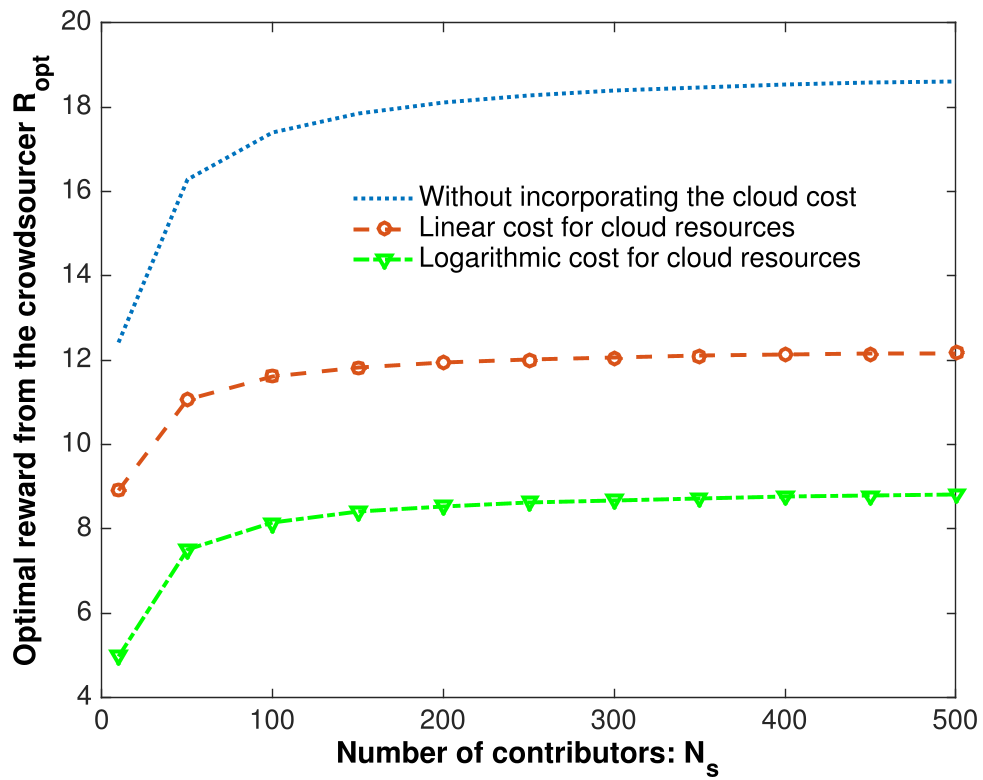 Fig 2: Optimal reward R with respect to the number of contributors Ns, showing the dampening effect of including cloud costs.
Conclusion & Future Outlook
This paper effectively bridges the gap between Incentive Theory and Systems Engineering. By proving the existence of a unique optimal reward in a cloud-enabled environment, it provides a blueprint for platforms that need to scale while managing high operational overhead.
Limitations: The current model assumes a single crowdsourcer. In reality, multiple crowdsourcers (e.g., TikTok vs. Instagram) compete for the same crowd. A multi-leader multi-follower game would be the next logical step in this research lineage.