
Optimal Influence Strategies: Why "influencing the influencers" isn't always the best move
Optimal Influence Strategies in Social Networks
This paper introduces a modeling framework based on the DeGroot learning model to determine the optimal investment strategy for a monopolist aiming to manipulate opinion formation in a social network. Using eigenvector centrality as a metric for influence, the authors demonstrate that firms should strategically target specific nodes to maximize the long-term consensus valuation of their product.
TL;DR
In a world dominated by social media word-of-mouth, a firm's marketing success depends on its ability to "hack" the network's consensus. This paper proves that while you should usually target the most central "influencers," if a marginal group has a particularly low opinion of your product, your resources are better spent converting them first to prevent "opinion rot" from spreading.
Context: The Firm as a Social Node
Standard economic models treat advertising as a "broadcast" signal. However, in platforms like Twitter or Facebook, a brand (like Ford or ASOS) acts as a participant. The researchers utilize the DeGroot Model, where agents reach a consensus by repeatedly taking weighted averages of their neighbors' opinions.
The core question: If you have $10,000 to spend on "influencing" via free samples or sponsorships, do you give it all to the person with the most followers, or spread it around?
Methodology: Eigenvector Centrality & Bounded Rationality
Unlike simple "degree centrality" (number of friends), this paper uses Eigenvector Centrality. The intuition: you are influential if you have influential friends. The researchers treat the firm as Agent 0 in a matrix , where they can pay to increase the weight that consumers place on the firm's (initially perfect) opinion.
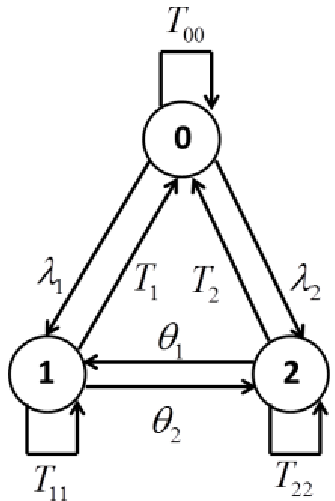 Fig 1: The interaction network between a firm (0) and two consumer clusters (1, 2).
Key Insights: Targeting the Most vs. Least Influential
1. The Influence Favoritism (Uniform Beliefs)
When everyone starts with the same neutral opinion of a product, the math is clear: Target the most influential node. By tilting the most central node toward your brand, you leverage their structural power to pull the rest of the network toward a higher consensus valuation.
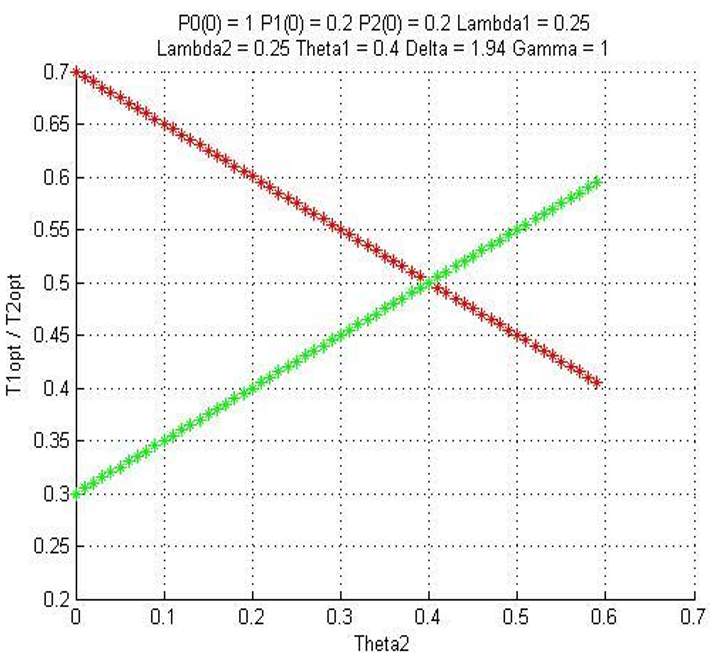 Fig 2: When , the firm shifts its budget to the more influential agent.
2. The Sentiment Pivot (Non-Uniform Beliefs)
The most striking finding (Proposition 4) occurs when initial opinions are diverse. If a "low-influence" consumer has a very low initial opinion, they act as a "consensus anchor," dragging down the network's final valuation. In this case, the firm should actually ignore the superstar influencer and spend resources converting the "critic" to neutralize their negative impact.
3. The Value of Asymmetry
The study finds that firm profits are actually minimized when social influence is perfectly balanced (equidistant).
- Why? In a balanced network, the firm must fight on two fronts.
- In a skewed network, the firm can "capture" the dominant node and largely ignore the rest.
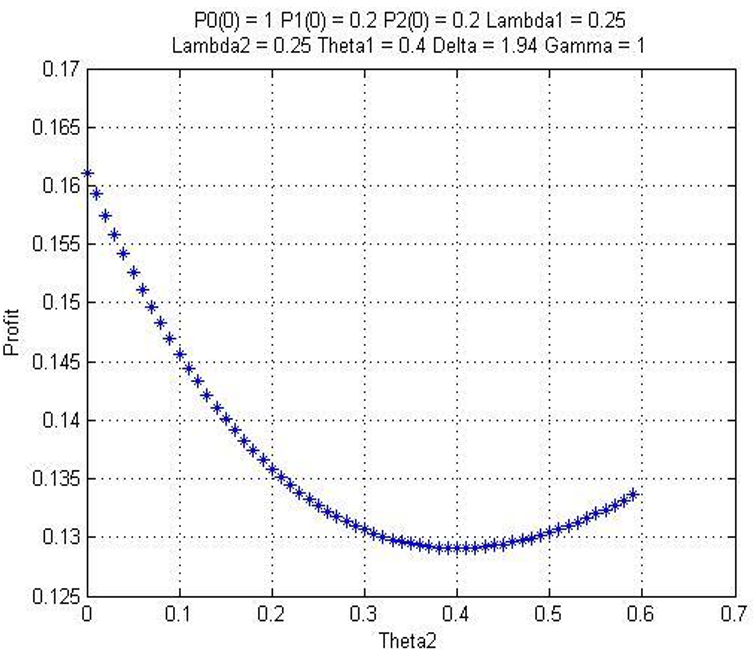 Fig 3: Firm profit hits a local minimum when the influence of both consumers is equal.
Detailed Results & Ablation
- Budget Sensitivity: Increasing the influence budget () follows a law of diminishing returns. If the cost of the campaign () is high, there is a clear "optimal" budget beyond which further spending actually hurts the bottom line (Fig 6).
- Market Size Convergence: Interestingly, the optimal allocation of influence resources is independent of the market size; the network structure itself is the primary driver of the strategy, not the number of units sold.
Critical Analysis & Conclusion
This work provides a rigorous mathematical backbone for "Buzz Marketing." It moves past the naive "Big Seed" vs. "Small Seed" debate by introducing initial sentiment as a decider.
Limitations:
- The model assumes a "Monopolist." In reality, competitors would also be investing to pull the consensus in the opposite direction.
- The network is static. In reality, people unfollow those whose opinions they find repulsive, leading to Echo Chambers.
The Takeaway: Before launching a social campaign, map the network's eigenvector centrality. If your product is polarizing, prioritize the "quiet critics" who might anchor the consensus; if the market is neutral, go straight for the "heavy hitters."