
Winning the War of Ideas: Optimal Investment Strategies in Competitive Social Networks
Optimal Investment Strategies for Competing Camps in a Social Network: A Broad Framework
This paper studies optimal investment strategies for two competing camps aiming to maximize their respective opinion adoption in a social network under the Friedkin-Johnsen model. The problem is formulated as a zero-sum game, identifying a decision parameter analogous to Katz centrality to derive optimal nodes for strategic targeting.
TL;DR
In a world of polarized opinions, how should competing organizations allocate their limited budgets to influence a population? This paper provides a rigorous mathematical framework using a zero-sum game version of the Friedkin-Johnsen model. It reveals that the "best" nodes to target aren't just the most popular ones, but those that maximize a specialized version of Katz Centrality.
Problem & Motivation
Current influence maximization studies often assume a "vacuum" where only one entity is trying to spread a message. In reality, every "Good Camp" (+) has a "Bad Camp" (-) fighting back (e.g., political elections, brand wars).
The authors identify three critical gaps in existing research:
- Diminishing Returns: Real influence isn't linear; the more you see an ad, the less impactful the next one becomes.
- Attention Limits: A human (node) has a finite capacity to process investment from both sides combined.
- Information Fog: Strategists rarely know exactly how much a person trusts their neighbor or a specific camp.
Methodology: The Strategic Framework
The core of the paper lies in the Extended Friedkin-Johnsen Model, where the steady-state opinion vector is derived as:
The researchers introduce a critical decision parameter , which acts as a weight for the influence power of node .
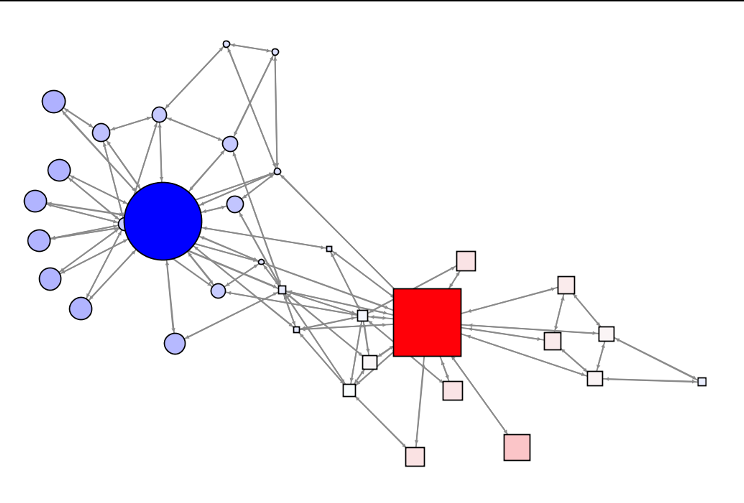 Fig 1: Visualization of the Karate Club dataset showing parameters (influence power) and (camp influence).
Key Mechanism: The Law of Concavity
When we assume influence follows a concave function (like ), the strategy shifts from concentrated (all-in on one node) to distributed (spreading the wealth). This serves as a mathematical proxy for "fairness," as more nodes receive attention when the marginal utility of a single "super-influencer" drops.
Experiments & Results
Testing on the NetHEPT (15k nodes) and Karate Club datasets, the authors uncovered several non-intuitive behaviors:
- The First-Mover Advantage: In a Stackelberg game with Coupled Constraints, the camp that acts first can "block" the opponent by filling up a node's attention capacity.
- Budget Skewness: A small increase in budget doesn't just lead to a linear increase in opinion; it often leads to a "winner-takes-most" outcome in terms of network-wide average opinion.
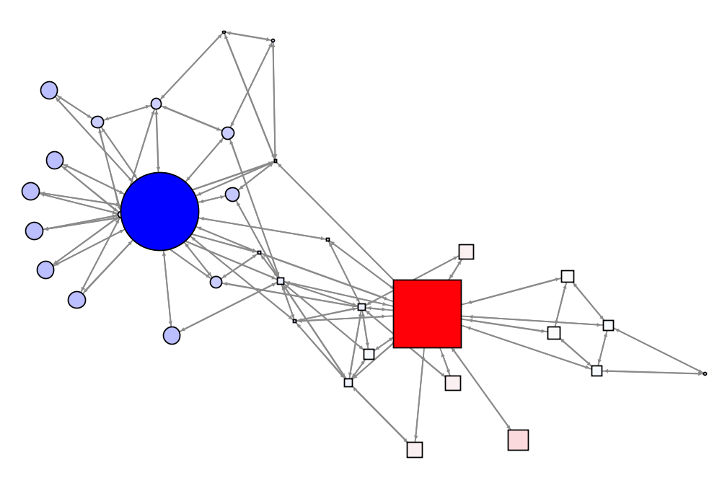 Fig 2: Temporal progression of opinions. Notice how the influence 'bleeds' from targeted nodes to the rest of the network over 4 time steps.
Dealing with Uncertainty
If the Good Camp doesn't know the exact trust weights in the network, they must use Robust Optimization. The simulation shows that under low uncertainty, you still target the top node. But as the "fog of war" thickens (high ), the optimal strategy is to hedge bets by distributing the budget across more nodes.
Critical Analysis & Conclusion
This paper elevates opinion dynamics from a simple propagation problem to a sophisticated Resource Allocation Game.
Takeaways:
- Katz matters: Your investment strategy should be proportional to a node's centrality multiplied by your specific influence over them.
- Concavity promotes fairness: If you want to see a "fairer" distribution of resources in a network, model the influence with diminishing returns.
- Move first or move smart: If attention is limited, being the first to campaign is a massive advantage.
Limitations: The model assumes a zero-sum game . In the real world, opinions are multidimensional (e.g., political views aren't just Left vs. Right). Future work needs to map these strategies onto a multidimensional opinion plane.