
Optimal MRP: Bridging Statistical Arbitrage Theory and Practical Leverage Constraints
Optimal Mean-Reverting Portfolio With Leverage Constraint for Statistical Arbitrage in Finance
This paper introduces a general optimization framework for designing an Optimal Mean-Reverting Portfolio (MRP) for statistical arbitrage. It proposes a multi-objective formulation that balances mean reversion strength and portfolio variance under a practical investment leverage constraint, achieving SOTA results in risk-adjusted returns (Sharpe Ratio).
TL;DR
Statistical arbitrage (StatArb) thrives on finding "spreads" that return to their mean. However, theoretical spreads often fail in the real world due to explosive leverage or microscopic profit margins. This paper presents a mathematically rigorous yet practically grounded framework to design portfolios that maximize mean reversion and variance simultaneously, all while staying within strict leverage limits.
Background: The Mean-Variance Conflict in Spreads
In pairs trading, you want two things:
- Fast Mean Reversion: The spread should cross its mean as often as possible to increase trading frequency.
- High Variance: When the spread deviates, it should deviate enough to cover transaction costs and generate meaningful profit.
Previous research often optimized one at the expense of the other, or used -norm constraints that don't translate to "dollars invested." This work effectively bridges this gap by treating MRP design as a constrained non-convex optimization problem.
Methodology: The SCA-MRP Framework
The core challenge lies in the objective function, which involves ratios of quadratic forms (e.g., Predictability or Portmanteau statistics) and a non-convex sparsity term for asset selection.
1. Objective Decomposition
The authors define the objective as: Where is the MR criterion, is the variance (often inverted or negated), and is the sparsity regularizer.
2. Successive Convex Approximation (SCA)
To solve this, the authors don't just linearize. They use a Successive Convex Approximation approach. By finding a "tight" surrogate function that majorizes the non-convex objective, they turn a nightmare optimization problem into a series of easy-to-solve Convex Quadratic Programs.
 The workflow from asset selection to out-of-sample trading execution.
3. Solving the Inner Subproblem
The subproblem involve an -norm constraint: . The authors propose three high-efficiency specialized solvers:
- ADMM: Good for general cases.
- M-ADMM (Majorized ADMM): Faster when the cointegration space has specific properties.
- MM (Majorization-Minimization): Extremely fast when assets are naturally stationary ().
Experimental Insights
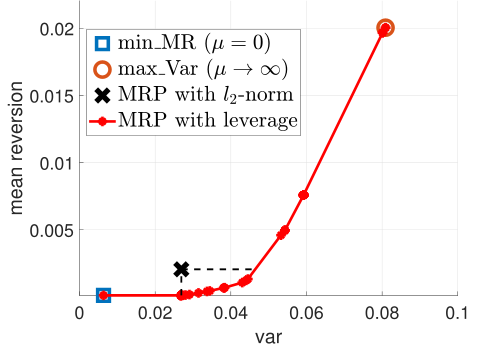
The paper highlights a critical "Pareto Frontier" between Mean Reversion and Variance. By tuning the hyperparameter , traders can choose between a spread that "zigs and zags" constantly (low variance) and one that "swings wide" (high profit potential).
 Real-market results showing the proposed MRP (blue) significantly outperforming the benchmark spreads in cumulative P&L and Sharpe Ratio.
Key Results:
- Convergence: The specialized SCA-MRP solvers are orders of magnitude faster than standard interior-point solvers like MOSEK.
- Practicality: Unlike previous models, this one never produces portfolios with "infinite" leverage, making it ready for production environments.
Critical Analysis & Conclusion
The true value of this work is the shift from "pure mathematics" to "constrained financial engineering." By replacing the abstract constraint with an leverage constraint, the authors force the optimization to respect the reality of a trader's capital.
Limitations: The model assumes that cointegration relationships are relatively stable over the trading horizon. In highly volatile or regimes-shifting markets, the "Optimal" weights found in-sample might degrade rapidly.
Future Outlook: Integrating this SCA framework with deep learning (e.g., using Neural Networks to predict the covariance matrices ) could represent the next frontier in AI-driven StatArb.