
Optimal Q&A Routing: Solving the Bottleneck of Human Expertise in Social Networks
Optimal Question Answering Routing in Dynamic Online Social Networks
The paper proposes an optimal Question Answering (Q&A) routing system for time-dependent social networks, utilizing a hybrid expertise model and a bottleneck Steiner tree algorithm. It achieves a 27% higher average response rate and a 60% reduction in maximal response time compared to state-of-the-art systems like iASK and SOS.
TL;DR
This research introduces a sophisticated Q&A routing framework designed for dynamic social networks like Facebook. By modeling user activity "windows" and combining semantic expertise with social influence, the system constructs an optimal multicast tree that avoids "bottleneck" users. The result is a dramatic 60% reduction in wait times and a significantly higher rate of successful answers compared to existing distributed Q&A methods.
The Temporal Pain Point: Why Social Q&A is Hard
Traditional search engines excel at factual queries but fail at non-factual questions—opinions, recommendations, or localized advice. While Social Q&A (routing questions to friends) fills this gap, it faces three critical hurdles:
- Diverse Schedules: Users in different time zones or professions aren't online at the same time.
- Activity Heterogeneity: Some users are "Internet-addicted" while others are casual, creating potential bottlenecks.
- The Information Overload vs. Silence Trade-off: Broadcasting to everyone causes spam; routing to too few results in zero answers.
Previous works like iASK and SOS attempted to use social referral chains, but they lacked a rigorous optimization mechanism to handle the "time-dependent" nature of the network.
Methodology: The Three-Stage Optimization Engine
The authors treat the Q&A problem as a Bounded Delay Bottleneck Steiner Tree problem. Their solution flow is split into three distinct phases:
1. Bottleneck Path Pruner (Temporal Alignment)
Instead of static edge weights, this stage calculates "active" edge delays. If two users' activity intervals don't overlap, the system adds a "waiting cost" until the next overlapping window. This ensures that the paths found are actually feasible in real-time.
2. Hybrid Expertise Matcher
The system doesn't just look for an "expert"; it looks for a central expert.
- Local Expertise: Uses TF-IDF similarity between the question keywords and the user's timeline posts.
- Global Expertise: Uses Eigenvector Centrality to determine user importance based on their connectivity.
- Hybrid Score: . This filtering ensures questions reach people who are both knowledgeable and influential.
3. Bottleneck Tree Generator
The system constructs a multicast tree that spans the most qualified answerers while specifically minimizing the maximum edge delay (the bottleneck).
 Figure 1: The proposed three-stage solution consisting of Pruning, Expertise Matching, and Tree Generation.
Experimental Results: Faster and More Reliable
The authors used Octoparse to scrape real Facebook data, creating a trace-driven simulation.
- Response Rate: The proposed system achieved a 92% response rate. In a sample run, it delivered a 100% response rate for 88% of all questions, dwarfing the 33-52% achieved by iASK/SOS.
- Latency: The average maximal response time dropped from 8.5 hours to 3.5 hours. By specifically targeting the "bottleneck" user, the system prevents the entire Q&A process from being held hostage by a single unresponsive node.
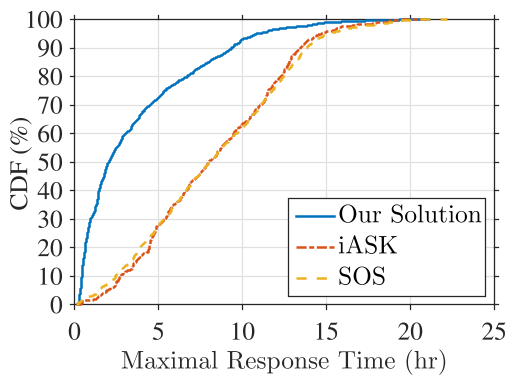 Figure 2: CDF of response rates showing the proposed system (blue) reaching 100% success much more frequently than baselines.
Critical Insight: Robustness Against Uncertainty
One of the most impressive findings is the system's performance under "imperfect predictability." In the real world, we can't always predict when a user will be online. Even when the predictability of user activity was reduced to 60%, the system still outperformed competitors by over 30% in terms of speed. This suggests the Bottleneck Steiner Tree approach is inherently more "forgiving" of temporal shifts than traditional shortest-path routing.
Conclusion & Future Outlook
This paper shifts the focus of Q&A routing from "who is the best expert" to "who is the best expert available right now who won't slow down the chain." While the dataset size (62 users) is a limitation, the linear complexity of the algorithms suggests it could scale to millions of users in a real-world implementation at Facebook or Quora. Future advancements could integrate deep learning based embedding for even more precise expertise matching.