
Optimal and Scalable Content Updates: Making Mobile Social Networks "Fresh"
Optimal and scalable distribution of content updates over a mobile social network
The paper investigates the optimal and scalable distribution of dynamic content (e.g., news, traffic) over Mobile Social Networks (MSNs). It characterizes the "freshness" of content through content age and proposes a framework where service providers optimize downlink rate allocation while users leverage opportunistic contacts to share updates, achieving a content age growth of only O(log n) even with fixed total bandwidth.
TL;DR
In a world of exploding mobile data, can we keep content "fresh" without infinitely increasing base station capacity? This paper proves that by combining opportunistic device-to-device (D2D) sharing with a mathematically optimized injection strategy, the "age" of information only grows logarithmically with the number of users. The secret sauce? The edge expansion of our social contact networks.
The Scalability Wall: Why Your News Is Getting Stale
Most content delivery systems treat users as isolated sinks. In such a model, if you have twice the users but the same bandwidth, everyone gets updates half as often. The content age grows linearly (). This is the "Scalability Wall."
The authors argue that we are ignoring a massive, free resource: Social Mobility. When two people meet in a hallway or a bus, they can sync their "newsfeeds" via Bluetooth or WiFi Direct. This turns a simple downlink problem into a complex epidemic dissemination problem. The challenge is: How should a provider allocate its limited bandwidth among users to make the whole network as fresh as possible?
Methodology: The Math of "Freshness"
The paper defines content freshness using the Age of Information (AoI): .
1. The Convexity Breakthrough
One might assume that finding the best allocation for different user utilities (some users want news instantly, others can wait) is a non-convex nightmare. However, the authors prove Theorem 1: Social welfare maximization in this setting is a convex problem.
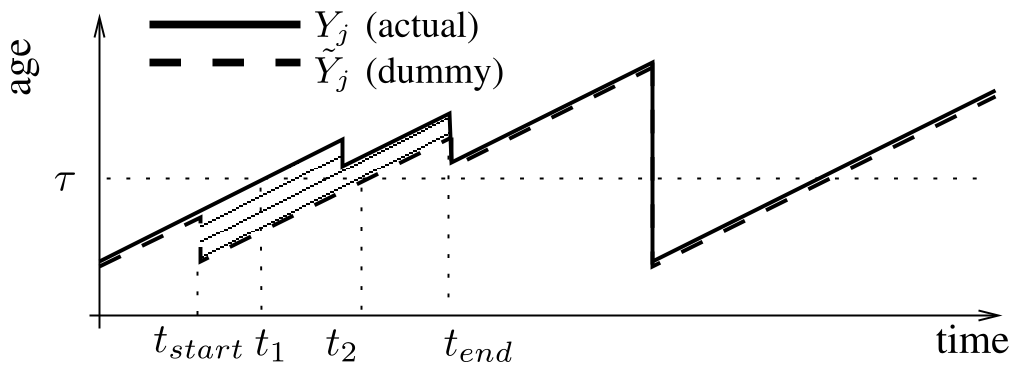 Fig 1: Illustration of the original vs. dummy process used for distributed gradient estimation.
2. Edge Expansion: The Magic Metric
The paper identifies Edge Expansion () as the fundamental property governing scalability. It measures how "well-connected" the social graph is. If a graph is an "expander" (meaning no matter how you split the users, there are many contacts between the two groups), the information spreads at lightning speed.
Key Insight: The "Social Hub" Paradox
Common intuition suggests we should push updates to the "social butterflies"—the people who stay in the center and meet everyone.
The authors' empirical study on the MIT Reality-Mining and Infocom06 datasets reveals a surprising transition:
- Low Bandwidth: The intuition holds. Direct updates to the "most central" user (the one with the fastest dissemination path).
- High Bandwidth: Uniform distribution becomes optimal.
- Intermediate Bandwidth: The "Hub" might receive zero direct updates. Why? Because a social hub is so well-connected that it will inevitably receive the latest update from its many neighbors anyway. Giving the hub a direct update is a waste of resources; it's better to feed the "starved" nodes on the periphery.
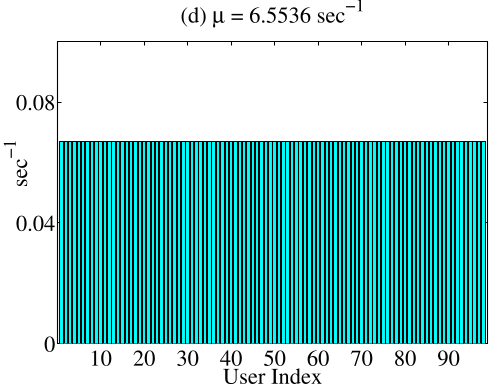 Fig 2: Optimal allocations under different bandwidth (μ). Note how in (c), the most social users (left side of x-axis) receive zero rate.
Real-World Performance
Using real mobility traces, the research shows that leveraging the social network can dramatically improve performance:
- Coverage: When updates are sparse (every 78 seconds), social sharing increases the percentage of "fresh" users from a measly 2.5% to 34%.
- Efficiency: The proposed algorithms consistently outperform "Heuristic-Prop" (proportional to contact rate) and "Heuristic-Skewed" (hub-only) methods.
Critical Perspective
While the paper provides a robust theoretical foundation for Mobile Social Networks, it assumes "Selfless Sharing." In the real world, battery life and privacy are major barriers to opportunistic sharing. Future work must integrate these incentives into the utility functions. Furthermore, while the scalability is impressive, it relies on the social graph being an expander—a property that holds for many human mobility patterns but might fail in highly segregated or sparse rural environments.
Conclusion
This work shifts the paradigm of content delivery from "Infrastructure-to-User" to "Infrastructure-to-Community." By identifying the link between graph edge expansion and content aging, it provides a blueprint for building massive, high-capacity update services that thrive on, rather than suffer from, user density.