
Optimal Scheduling in Cooperate-to-Join Cognitive Radio: A Mutual Benefit Paradigm
11234_Optimal Scheduling and Power Allocation in Cooperate-to-Join Cognitive Radio Networks.
This paper introduces optimal resource allocation and scheduling policies for "Cooperate-to-Join" Cognitive Radio Networks (CRNs) under a spectrum leasing model. It utilizes Lyapunov optimization to balance primary user (PU) performance guarantees with secondary user (SU) opportunistic access, demonstrating significant gains in both utility and energy efficiency through cooperative relaying.
TL;DR
In the evolving landscape of wireless networks, spectrum is a scarce resource. This paper shifts the narrative of Cognitive Radio Networks (CRNs) from "opportunistic interference avoidance" to a "Cooperate-to-Join" spectrum leasing model. By allowing Secondary Users (SUs) to relay Primary User (PU) data, the system achieves a win-win: PUs get enhanced reliability, and SUs earn the right to transmit. Using Lyapunov optimization, the authors provide a framework that optimizes scheduling, power, and long-term fairness.
Problem & Motivation: Beyond Spectrum Holes
The traditional "commons model" for CRNs treats SUs like scavengers, searching for "holes" in spectrum usage. This is inherently inefficient and unreliable for the SUs. The alternative, Spectrum Leasing, allows PUs to lease their licensed bands.
However, previous research often focused on simple one-to-one interactions. Real-world networks involve multiple users and time-varying channels. The core challenge is: How can we design a scheduler that guarantees the PU's Quality of Service (QoS) while maximizing the overall system utility and minimizing energy consumption?
Methodology: The "Levy" of Cooperation
The authors propose a time-slot splitting mechanism where a single slot is divided into three phases:
- Primary to Relay (PU -> SU): The PU sends data to the SU.
- Relay to Receiver (SU -> Destination): The SU relays the PU's message using a Decode-and-Forward (DF) scheme.
- Secondary to Receiver (SU -> Destination): The SU transmits its own data.
1. The Lyapunov Framework
To solve the complex constrained optimization problem, the authors transform performance constraints into Virtual Queues. If a PU's average rate drops below its requirement, the "debt" in its virtual queue grows, forcing the scheduler to prioritize it in the next slot.
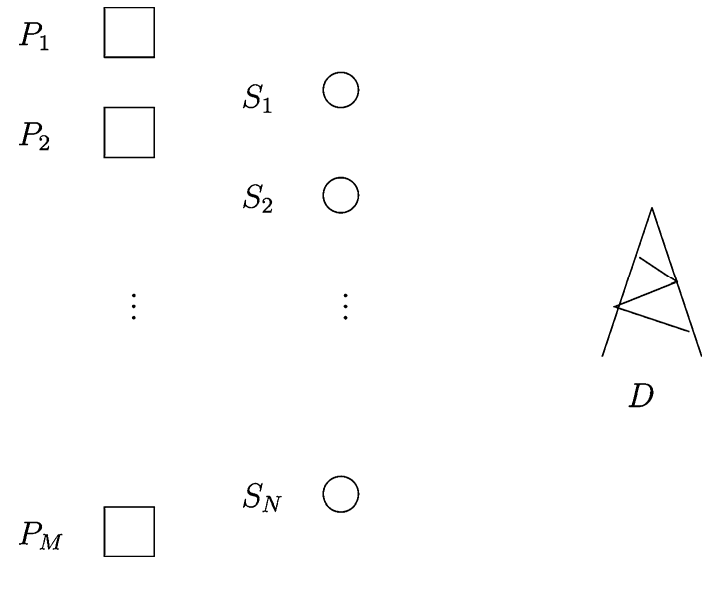 Figure 1: Cognitive Radio Network model and the tripartite time-slot structure enabling cooperation.
2. Immediate vs. Long-term Rewards
The paper distinguishes between:
- Immediate Rewards: Used when SUs are satisfied with any current access granted.
- Long-term Rewards ("Banking"): SUs are guaranteed a specific share of utility over time. This prevents SU "starvation" when channel conditions are consistently poor for cooperation.
Experiments & Results
The authors conducted extensive simulations comparing their cooperative policy against a non-cooperative baseline (where PUs transmit directly).
- Utility Gains: As shown in the simulation results, the sum utility increases significantly as the number of available SUs grows, because the scheduler has more "relay" candidates to exploit spatial diversity.
- Energy Efficiency: By jointly optimizing power, they proved that PUs can actually reduce their energy expenditure because the SU relays effectively shorten the required transmission distance.
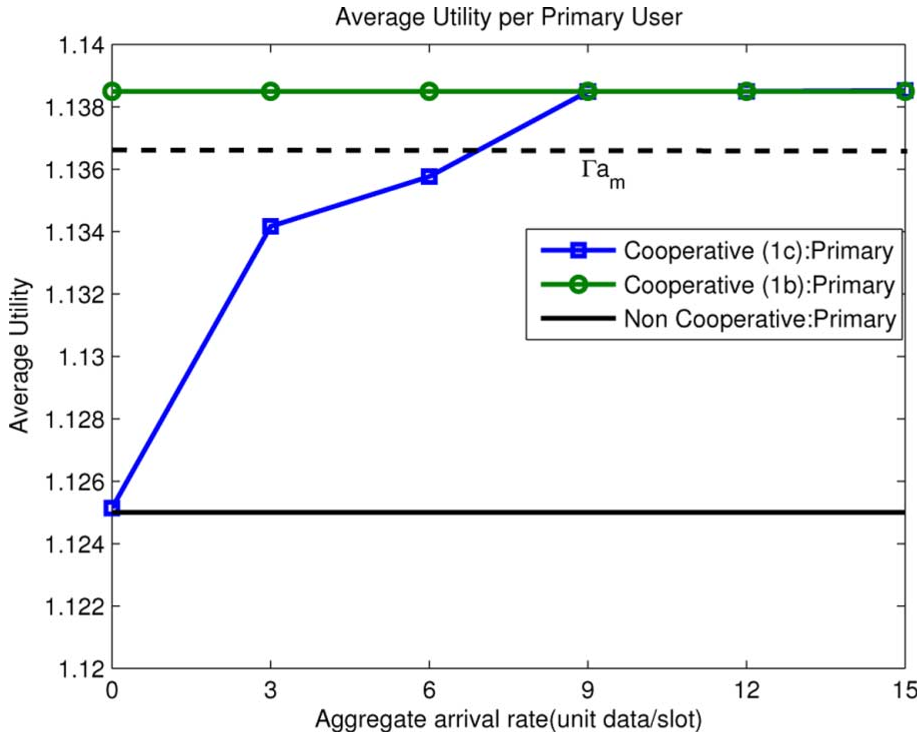 Figure 2: Average PU utility versus SU arrival rate, demonstrating that backlogged SUs provide more cooperation opportunities.
Critical Insight: The Price of Optimality
A key takeaway from the Lyapunov analysis is the [O(1/K), O(K)] tradeoff. By increasing a control parameter , the system performance can be pushed arbitrarily close to the theoretical optimum. However, this comes at the cost of larger virtual queue backlogs, which translates to slower convergence and potentially higher latency in adapting to channel statistics.
Conclusion
This work provides a rigorous mathematical foundation for cooperative spectrum leasing. It moves away from the "interference" mindset and toward a "service" mindset. By treating the secondary system as an infrastructure-enhancing relay, the primary system gains performance it couldn't achieve alone, creating a sustainable ecosystem for unlicensed spectrum access.
Future Directions: Integrating these policies with MIMO (Multiple-Input Multiple-Output) or Machine Learning to predict channel gains could further reduce the overhead of the central scheduler.