
The Line Extension Dilemma: Balancing Economies of Scale with Market Cannibalization
Optimal Selection of Line Extensions: Incorporating Operational, Financial, and Marketing Constraints
This paper addresses the "Line Extension Selection" problem, proposing a mixed-integer programming framework to optimize product variety while balancing operational sharing, demand cannibalization, and financial constraints. The authors develop efficient heuristics for budget-constrained and cardinality-constrained variants, achieving near-optimal solutions (optimality gap <0.2%) across large-scale industrial instances.
Executive Summary
In the hyper-competitive landscape of global markets, line extensions—variants of existing products like the iPhone "Pro" or "Air" models—are a double-edged sword. While they allow firms to capture diverse customer segments, they risk internal sales cannibalization and operational overhead.
TL;DR: This paper provides a rigorous mathematical framework to solve the "Optimal Selection of Line Extensions." By integrating operational labor costs, marketing cannibalization, and financial budget constraints, the authors develop heuristics that deliver near-perfect solutions where traditional industry rules-of-thumb fail.
Problem & Motivation: The Complexity Crisis
Why is selecting the "right" products so difficult? Most firms fall into one of two traps:
- The Engineering Trap: Focusing solely on component sharing and modularity, leading to "overload" where products are too similar.
- The Marketing Trap: Introducing every possible variant to capture niche demand, leading to astronomical development costs and budget depletion.
The authors identify a critical gap: Operational costs are non-linear. As production volume increases, labor costs typically drop due to the "Learning Curve." Existing models either oversimplify this as a linear cost or become computationally impossible to solve for thousands of product variants.
Methodology: Bridging Math and Intuition
The core of the paper lies in its treatment of the "Basic Line Extension Model" (Problem RS). The authors model the problem as a bipartite graph between Line Extensions and Components.
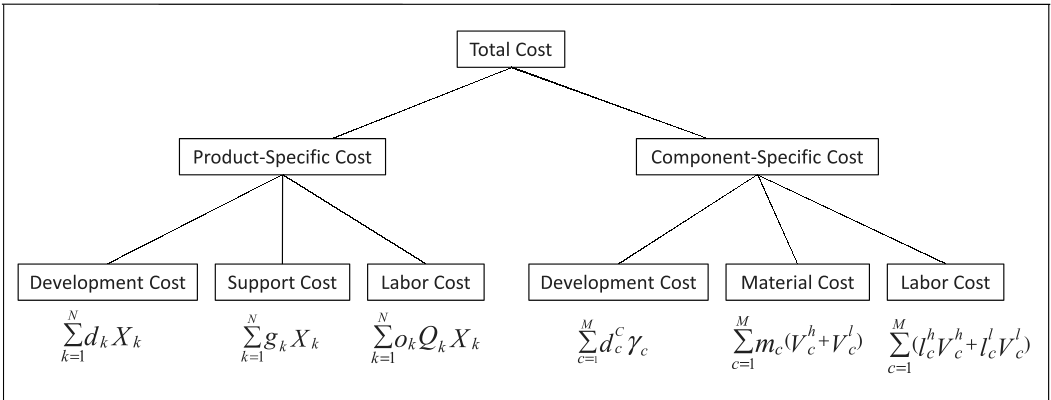
1. Cost Architecture
The model accounts for:
- Product-specific costs: Development, support, and labor.
- Component-specific costs: Material and a two-piece linear labor cost (higher cost for early volumes, lower cost after reaching a critical threshold ).
2. The Heuristic Magic (Hb and Hc)
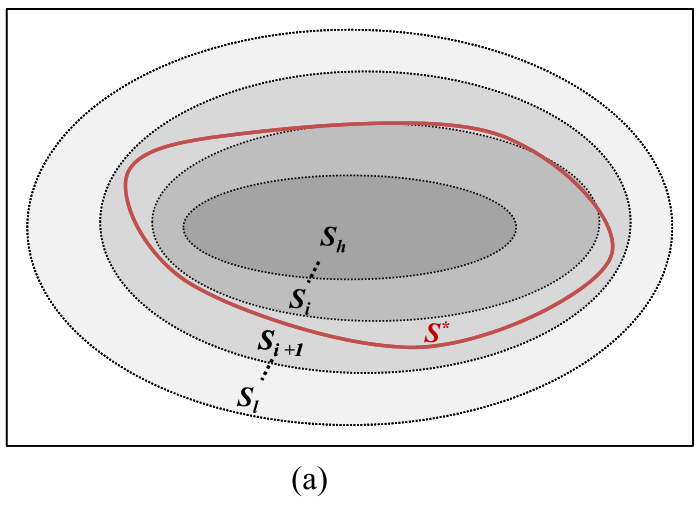
Since the problem is NP-complete (proven via a reduction from the Partition Problem), the authors propose a clever heuristic. They solve a series of simplified Linear Programming (LP) relaxations using convex combinations of labor costs. If the solution violates the budget () or cardinality () limits, they apply iterative REDUCE or IMPROVE procedures to find the "sweet spot."
Experiments & Results: Crushing the Status Quo
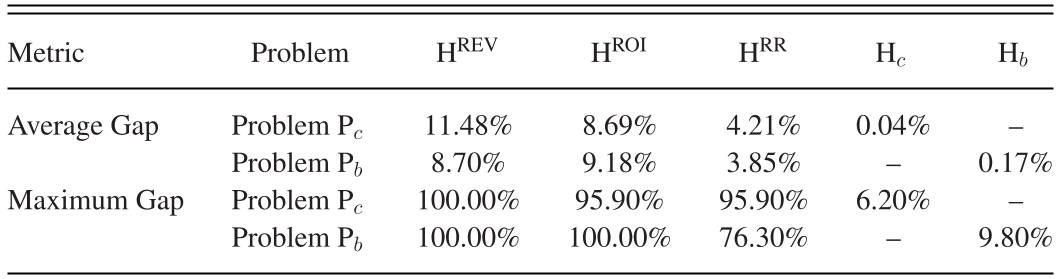
The researchers tested their approach against standard industry methods: HREV (ranking by revenue) and HROI (ranking by Return on Investment).
- Near-Optimality: While popular heuristics had gaps as high as 100%, the proposed Heuristic achieved an average optimality gap of only 0.04%.
- Value of Sharing: The heuristics excelled specifically when component commonality was high, as they could "see" the profit advantage of reaching the volume threshold across multiple products.
Managerial Insights: The "Knee-Joint" Effect
The study concludes with three vital takeaways for product managers:
- Investment vs. Logistics: In industries where pre-launch design costs are high (e.g., Electronics), firms should launch fewer products. In apparel, where post-launch costs dominate, more variety is better.
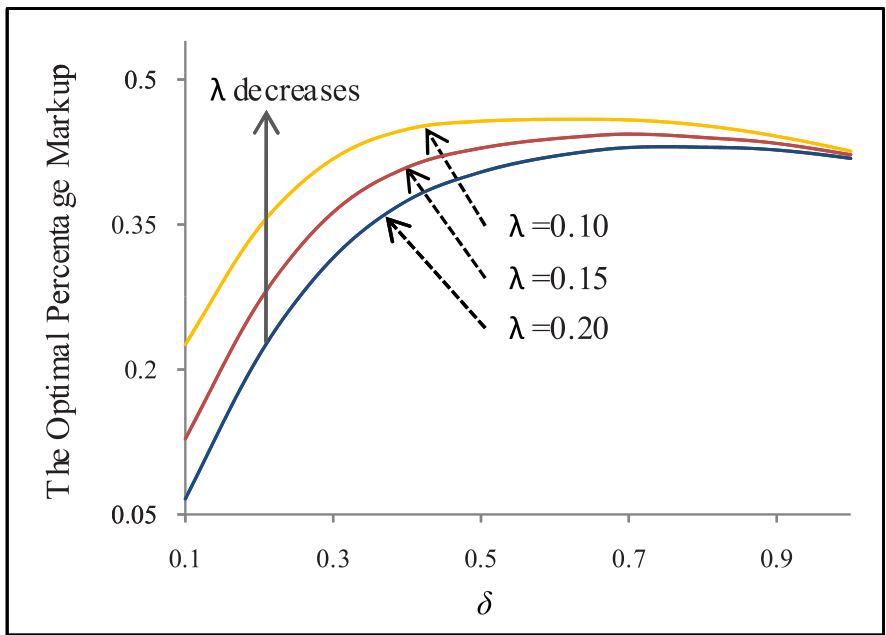
- The Sweet Spot: ROI follows a "knee-joint" curve. Increasing the budget or number of variants brings rapid gains initially, but hits a point of diminishing returns very quickly. Firms should aim for this "knee" to maximize efficiency.
- Supply Chain Synergy: If your product-component matrix is sparse, negotiate marginal discounts; if it is dense (high commonality), all-unit discounts are superior.
Local limitations & Future Work
The model currently assumes we know the cannibalization effects of existing products. A future frontier involves modeling cannibalization between the new line extensions themselves. This would further discourage "over-selection" of highly similar models.
Final Thoughts
This work transforms the "art" of product line management into a rigorous science. By leveraging the physical intuition of the learning curve and the mathematical efficiency of unimodular matrices, it provides a roadmap for firms to navigate the complex tradeoffs of variety.