
Optimal Smoothed Analysis: Solving the 25-Year Simplex Puzzle
Optimal Smoothed Analysis of the Simplex Method
This paper establishes the optimal smoothed complexity of the Simplex method by introducing a novel "semi-random shadow vertex" pivot rule. The authors prove that the expected number of pivot steps is , achieving a tight bound on the noise parameter that matches their newly established lower bound of up to polylogarithmic factors.
TL;DR
For decades, theoretical computer scientists have tried to explain why the Simplex method is fast in practice despite its exponential worst-case complexity. This paper provides the "final" answer in the framework of Smoothed Analysis: by using a semi-random shadow vertex rule, the algorithm achieves a pivot step complexity of . This dependence is proven to be optimal, matching a new lower bound.
The "Brittle" Structure of Worst-Case Scenarios
The Simplex method is a mathematical paradox. It is the workhorse of industrial optimization, yet for almost every pivot rule, there exists a "pathological" input (like the Klee-Minty cube) that makes it crawl at exponential speeds.
Smoothed Analysis, introduced by Spielman and Teng in 2001, argues that these pathological cases are "brittle." If you add a tiny bit of Gaussian noise () to any adversarial input, the expected running time becomes polynomial. However, early bounds were messy—Spielman and Teng originally proved a bound of . The quest since then has been to find the true sensitivity to noise.
The Insight: Semi-Randomness
Previous analyses focused on the Shadow Size of a polyhedron: how many vertices appear when you project a -dimensional shape onto a 2D plane. The problem was that the projection plane was usually fixed or determined by the problem data. If the noise was small, the plane could still easily become "nearly degenerate," causing the number of vertices on the shadow to explode.
The Methodology
Bach and Huiberts fix this by introducing a Semi-Random Shadow Plane. Instead of projecting onto a plane defined by two fixed objectives and , they project onto a plane spanned by the objective and a randomly sampled vector .
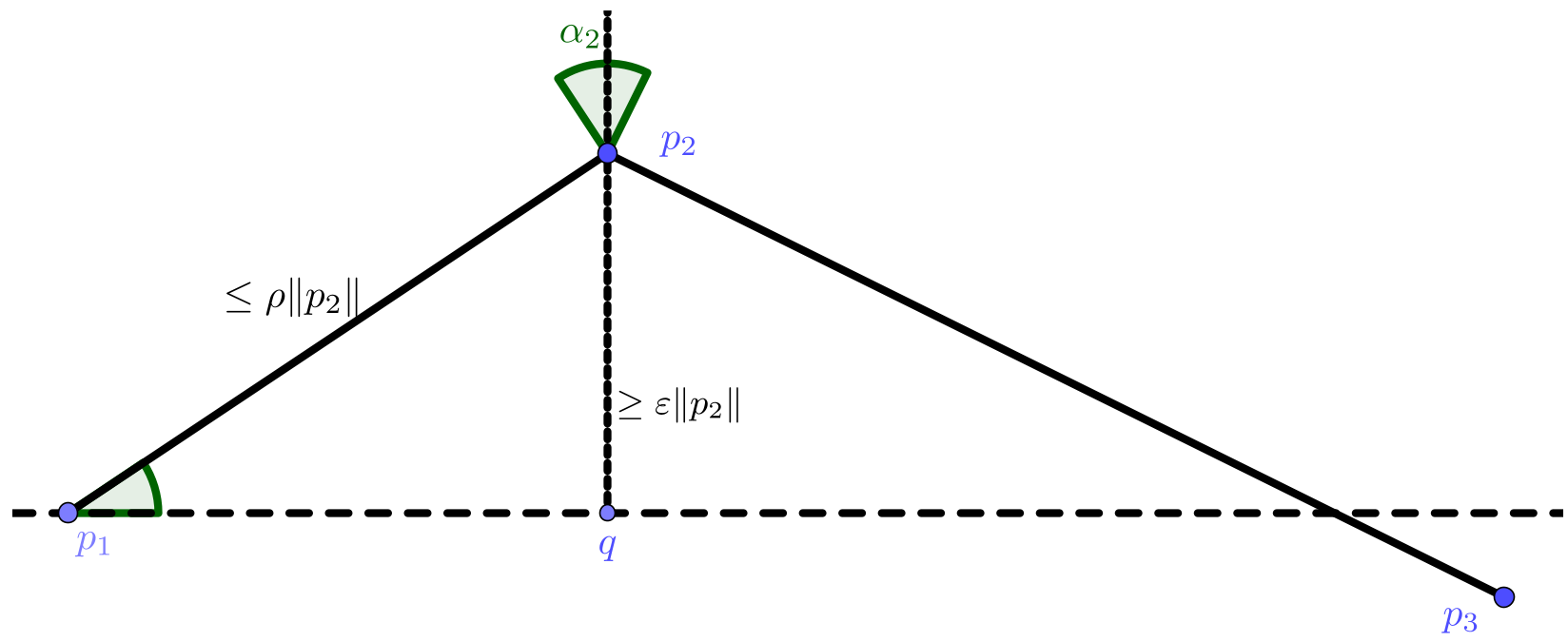 Figure 1: Lower bounding the exterior angle. By sampling randomly, the authors ensure that the "exterior angle" of the shadow polygon is large enough to prevent an excessive number of vertices.
By injecting randomness into the algorithm itself, the researchers ensure that the shadow path is "well-separated." They prove that any vertex on the shadow polygon must either have a "long edge" (taking up perimeter) or a "large exterior angle" (taking up angular space). Since the total perimeter and total angle () are limited, the number of vertices must be small.
Proving Optimality
The paper doesn't just improve the upper bound; it provides a matching Lower Bound. By constructing a set of unit vectors that are "-dense" (spread out everywhere on a sphere), they create a polyhedron that mimics a sphere.
| Method | Complexity (Noise Dependence) | Model |
|---|---|---|
| Spielman & Teng '01 | Fixed Shadow | |
| Deshpande & Spielman '05 | Fixed Shadow | |
| Huiberts, Lee, Zhang '23 | Fixed Shadow | |
| This Paper (2026) | Semi-Random Shadow | |
| Lower Bound (2026) | Diameter Bound |
This result shows that the term is a fundamental limit of the Simplex method's efficiency under noise.
Critical Analysis & Future Outlook
Contribution: This is a landmark theoretical result. It simplifies the algorithmic reduction used in smoothed analysis and provides a tight coordinate in the -notation landscape for Linear Programming.
Limitations: The lower bound requires an exponential number of constraints (). In many practical LPs, is much smaller, meaning the algorithm might perform even better than this "optimal" bound suggests. Furthermore, the analysis still assumes Gaussian noise, while real-world data might have structured or non-Gaussian perturbations.
Conclusion: This paper effectively closes the chapter on "noise dependence" in smoothed analysis of the Simplex method. The next frontier? Analyzing the algorithm "By-the-Book" using even more realistic input models that don't rely on Gaussian smoothening at all.