
Optimal State Management: Solving the Privacy-Utility Paradox in Social Networks
Optimal State Management of Data Sharing in Online Social Network (OSN) Services
This paper introduces a framework for managing data sharing in Online Social Networks (OSNs) by categorizing sharing behaviors into four distinct states: Optimal, Under-shared, Over-shared, and Hybrid. It leverages the Markov Decision Process (MDP) to help users mathematically determine the optimal number of personal items to share to maximize social rewards while minimizing privacy costs.
TL;DR
In the world of Online Social Networks (OSNs), we are constantly torn between sharing more to gain social "rewards" and sharing less to protect our "privacy." This paper moves beyond simple privacy toggles by introducing a Markov Decision Process (MDP) framework that calculates the mathematical "Optimal State" for sharing. It provides a blueprint for how OSN providers can help users find the perfect balance where reward is maximized and risk is mitigated.
The Core Conflict: Why We "Over-share" or "Under-share"
The authors identify a critical gap in current OSN designs: users don't know the "price" of their data. This leads to three problematic non-optimal states:
- Under-shared: You protect your privacy but gain no utility from the network (e.g., using a fake name).
- Over-shared: You get the social benefits, but your e-mail, location, and DOB are exposed to attackers.
- Hybrid: The worst of both worlds—you don't share what you intended, but you expose what you wanted to keep private.
The motivation is clear: social footprints are interdependent. A single leak (like a birthday post) can trigger a chain reaction of de-anonymization.
Methodology: Engineering the "Optimal State"
The researchers define the Optimal State simply: —where the Desired level of sharing exactly matches the Actual level.
The MDP Framework
To find this state, the paper models the user's journey as an MDP defined by a 5-tuple . The logic is built on a Trade-off Equation:
- Reward : Increases as you share more items (more friends, better networking).
- Cost : Increases as you share more items (higher probability of -Compromised states).
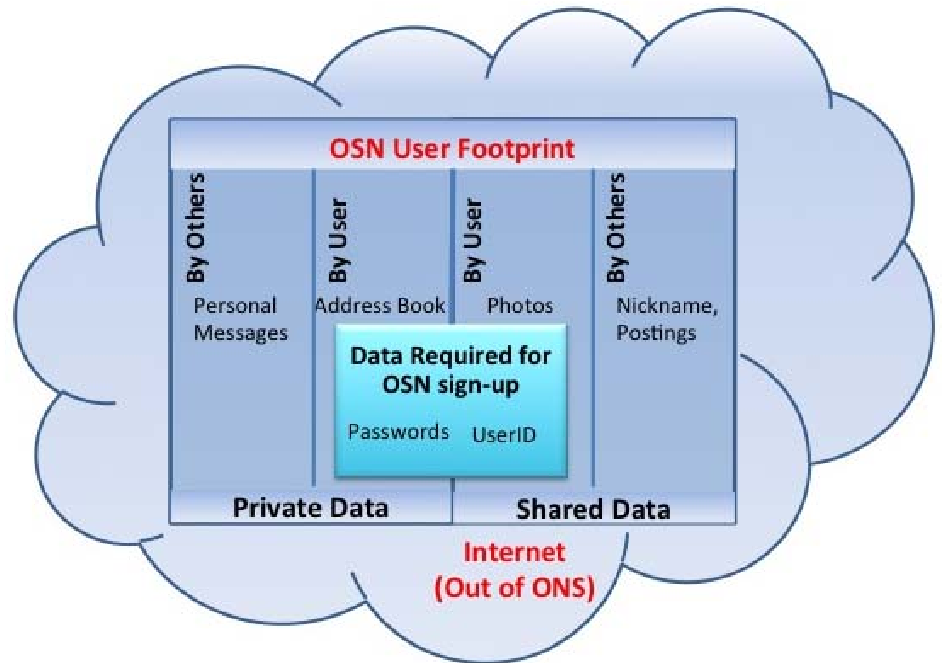 Figure 1: The architecture of an OSN footprint, distinguishing between private and shared data segments.
The model uses the Bellman Equation to factor in the probability of being "attacked" () and the probability of "recovering" from a breach (). By solving for , the system can tell the user exactly how many items are "safe" to share before the risk becomes too high.
State Transition Parameters
The paper categorizes why users move between states:
- Facilitating: Privilege delegation (e.g., giving Facebook access to your contacts).
- Detracting: Fear of privacy issues (often leading to fake profiles).
- Preventive: Auditing, reputation systems, and user-friendly privacy settings.
Experimental Insights: The "Tipping Point"
Through experimental simulation, the authors demonstrated that the payoff does not grow indefinitely with sharing.
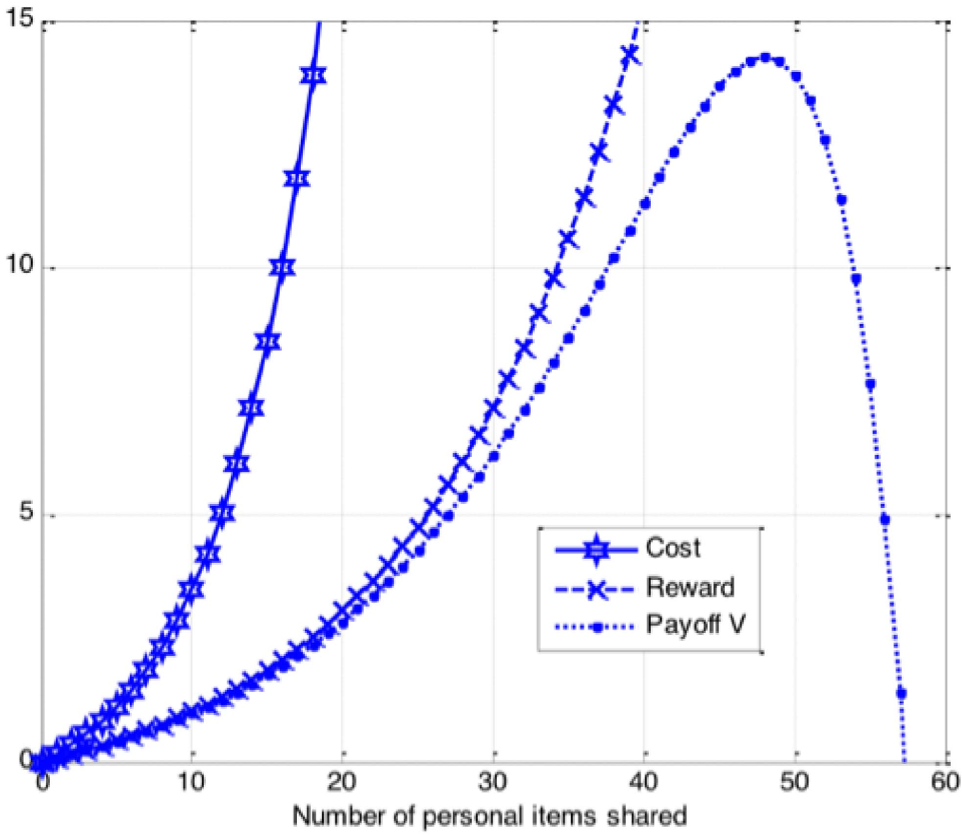 Figure 2: The simulation results showing the Payoff V peaking before crashing as the cost of compromise dominates.
In their scenario (where ), the payoff peaked at 48 items. Beyond this "Optimal Level," each additional piece of shared information acted as a liability rather than an asset, causing the total utility to plummet. This visualization provides empirical evidence that "more sharing" does not equal "more value."
Critical Analysis & Conclusion
Takeaways
The brilliance of this work lies in its formalization of intuition. We all feel that sharing too much is risky, but this paper provides the mathematical machinery to calculate that risk in real-time. By automating this in the background, OSN providers could move from "binary" privacy settings to "utility-optimized" recommendations.
Limitations & Future Work
- Data Homogeneity: The current model assumes all items (e.g., a photo vs. a SSN) have the same sensitivity. In reality, weightage must be applied.
- Sybil Attacks: The authors acknowledge that fake accounts (Sybil attacks) can manipulate reputation-based parts of the model.
- Dynamic Sensitivity: Future research needs to account for data interdependency—where sharing Item A makes Item B significantly more dangerous.
Ultimately, this research shifts the burden of privacy management from the "ordinary user" to an "informed algorithm," paving the way for more trustworthy social ecosystems.