
Optimal Task Recommendation in Spatial Crowdsourcing: Balancing Privacy and Profit
Optimal Task Recommendation for Spatial Crowdsourcing with Privacy Control
The paper proposes an optimization framework for task recommendation in Spatial Crowdsourcing (SC) that balances server rewards with worker privacy. It introduces a "Bisecting k-means with Threshold" (BCT) generalization mechanism and an optimal recommendation algorithm that accounts for localization errors to maximize SC-server revenue.
TL;DR
This research tackles the conflict between worker privacy and server efficiency in Spatial Crowdsourcing (SC). By introducing a Bisecting k-means with Threshold (BCT) generalization method and a reward-optimization algorithm that accounts for "location noise," the authors provide a framework where servers can still maximize their revenue even when they don't know exactly where their workers are.
The Core Conflict: Privacy vs. Utility
Spatial Crowdsourcing requires matching mobile workers to specific locations. In Server Assigned Tasks (SAT) mode, the server traditionally requires precise GPS data to optimize matching. However, this creates a massive privacy leak.
While previous works used techniques like -anonymity or Differential Privacy, they often ignored a critical secondary effect: Generalization Error. If a server thinks a worker is at point A (a cluster center) when they are actually at point B (the real location), the probability of that worker completing the task changes based on the distance error. This paper asks: How can a server recommend tasks to maximize its own reward when it only sees "fuzzy" locations?
Methodology: The Two-Step Optimization
1. BCT Generalization (The Privacy Guard)
The framework utilizes a Safe Third-Party (STP). Instead of raw GPS coordinates, the server receives cluster centers.
- The Innovation: Standard k-means requires a pre-defined . The authors' BCT algorithm instead uses a distance threshold .
- Logic: It repeatedly bisects clusters until every worker in a cluster is no further than from the center. This guarantees a bounded "Utility Error" while providing privacy.
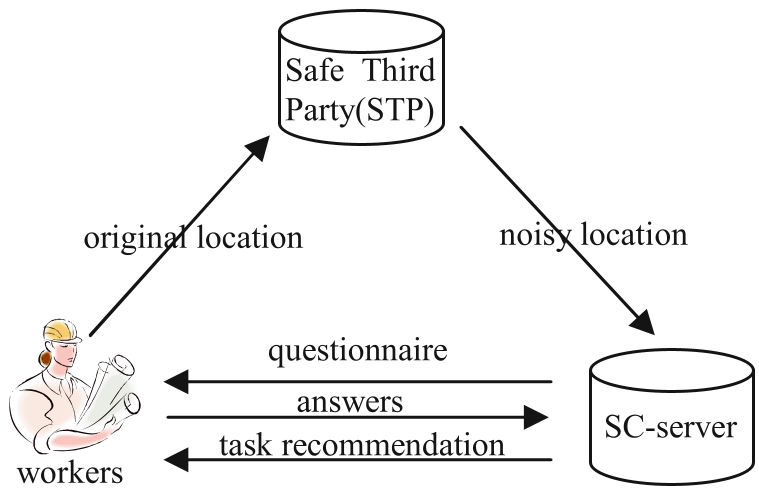
2. Error-Aware Task Recommendation
The SC-server calculates the Reward Attractiveness (RA)—the difference between the task's payout and the worker's minimum preference. The server then performs a two-stage calculation:
- Worst-Case Estimate: It identifies the number of workers needed to satisfy task requirements, assuming workers are at the furthest possible point within their cluster ().
- Best-Case Profit: It then simulates the best-case scenario () to calculate the maximum expected revenue.
- Final Step: It iterates through different reward levels to find the "sweet spot" that maximizes server profit.
Experimental Insights
Using a real-world check-in dataset from a city in Southern China, the study revealed several key findings:
- Higher Accuracy: The BCT method consistently outperformed hierarchical blurring (standard decimal-place rounding of coordinates) in maintaining data utility.
- The Game Theory Trade-off: As the privacy threshold increases:
- Workers gain better privacy.
- Workers often receive higher rewards because the server must "bribe" them to overcome the uncertainty of distance.
- The SC-server's net reward decreases.
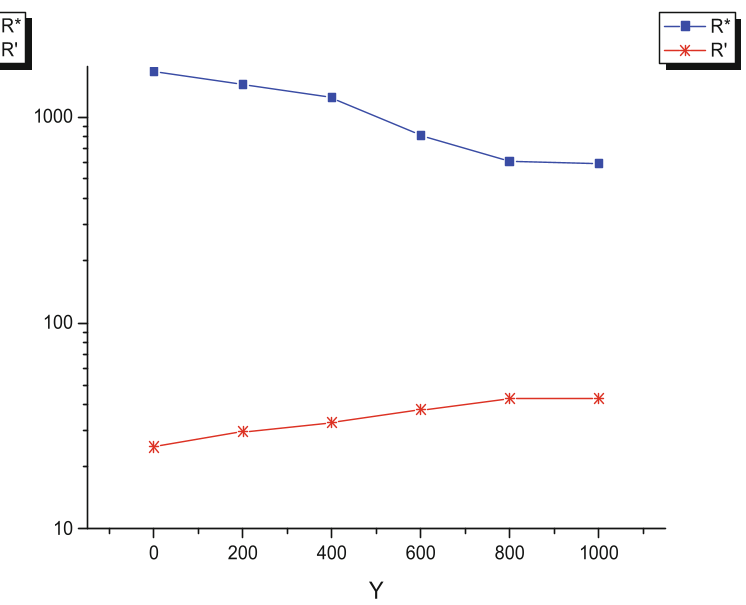 The figure shows that the BCT algorithm maintains significantly lower average error compared to baseline methods as the threshold scales.
Critical Analysis & Conclusion
The paper's strength lies in its probabilistic approach to error. Rather than treating blurred locations as "absolute," it acknowledges the range of uncertainty () and builds a recommendation engine around it.
Takeaways:
- Inductive Bias: The assumption that task completion probability is a staged function of distance allows for efficient computation but might oversimplify human behavior.
- Scalability: The BCT approach is more computationally efficient than standard k-means for large datasets because it avoids the need to iterate through various values.
Limitations: The current model assumes a worker accepts only one task at a time and ignores real-time traffic conditions. Future iterations could integrate Multi-Task Learning to model workers who traverse "routes" rather than single points.