
CATGAME: Overcoming the Integration Bottleneck in AI Pipelines with Game Theory
Optimizing AI Pipelines: A Game-Theoretic Cultural Algorithms Approach
The paper introduces CATGAME, a novel optimization framework for complex AI pipelines that enhances Cultural Algorithms (CA) with a game-theoretic Knowledge Distribution (KD) mechanism. By modeling the interaction between agents as a continuous-action version of the Iterated Prisoner's Dilemma, the method achieves superior system-level tuning in autonomous driving vision tasks compared to traditional competitive voting schemes.
TL;DR
Optimizing the complex pipelines behind autonomous driving is traditionally a manual "trial and error" nightmare. This paper presents CATGAME, a hybrid approach that combines Cultural Algorithms with Game Theory. By treating the distribution of optimization knowledge as a game of cooperation and competition (Iterated Prisoner's Dilemma), the authors achieved a 40% accuracy improvement in a real-world computer vision pipeline.
The Integration Challenge: More Than the Sum of Its Parts
In the automotive industry, Tier-1 suppliers provide "intelligent" subsystems (cameras, radar, planning modules) to OEMs. Each module comes with dozens of tunable parameters. The catch? Tuning the edge detector in the perception layer fundamentally changes the input for the line detector three steps down the road.
Current optimization techniques often use "Weighted Majority Win" (WTD) strategies—a winner-takes-all approach where the best-performing heuristic dominates the entire population. This leads to "Genetic Drift" where diversity is lost, and the system fails to find a global optimum in non-linear, complex environments.
Methodology: Evolution Meets Game Theory
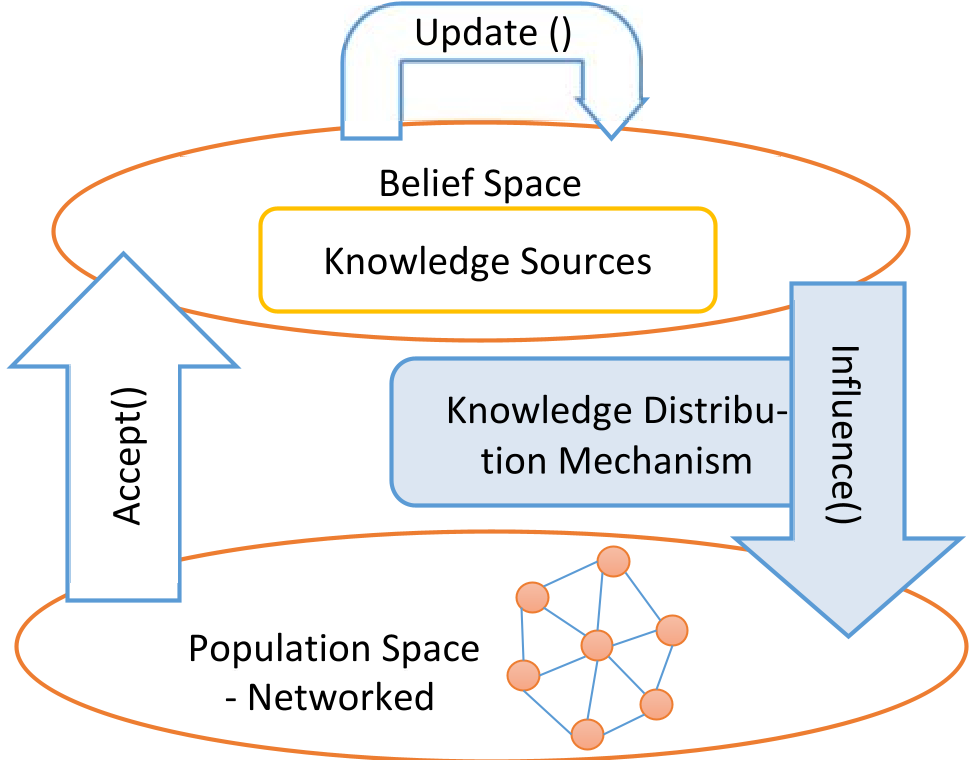
The authors leverage Cultural Algorithms (CA), which consist of two spaces:
- Population Space: The actual agents (parameters).
- Belief Space: A repository of "Knowledge Sources" (Situational, Normative, Topographical, etc.).
The breakthrough is the Influence Function. Instead of agents just voting on which knowledge is best, they play a game.
The Continuous-Action Iterated Prisoner’s Dilemma (IPD)
Instead of a simple "Cooperate" or "Defect" binary, CATGAME uses a Degree of Cooperation (DoC) ().
- Cooperation: x wants to adopt the values and beliefs of neighbor y.
- Defection: x retains its own beliefs.
The Outcome Function calculates "Mutual DoC" between neighbors. This allows an agent to have a Primary Knowledge Source while still being influenced by Secondary Knowledge Sources. This "hybridized" knowledge is what makes CATGAME resilient—it maintains both exploratory (finding new areas) and exploitative (fine-tuning current areas) behaviors simultaneously.
Experiments and Visual Evidence
The authors tested the theory on two fronts: one synthetic and one real-world.
1. The Cones World Benchmark
Using a complex "Cones World" landscape to simulate non-linear optimization problems, CATGAME reached solutions significantly faster than the WTD benchmark.
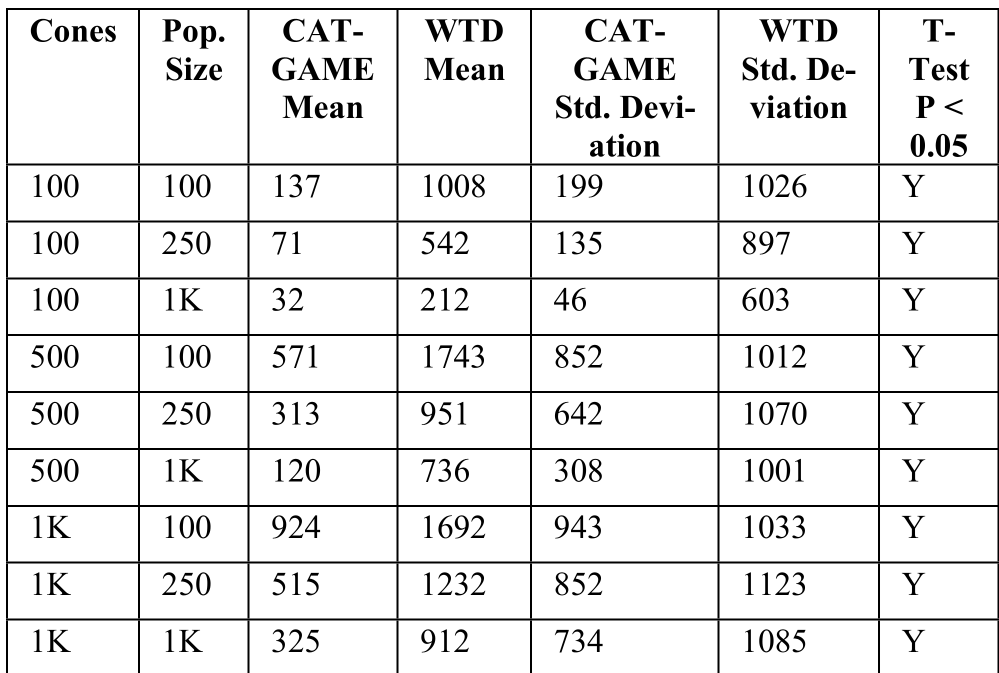
Crucially, CATGAME maintained a much more diverse "Social Fabric." While WTD usually saw one knowledge source (like Historical) take over the entire population, CATGAME kept a vibrant mix of knowledge types.
2. The Autonomous Vision Pipeline
The ultimate test was an OpenCV-based driving pipeline involving Canny edge detection, Hough Transforms, and color masking. 15 parameters had to be tuned to identify lane lines accurately.
 Figure: The pipeline significantly improves lane detection in difficult lighting and road conditions after CATGAME optimization.
The results were stark:
- Error Reduction: CATGAME reduced the Sum of Squared Error (SSE) by ~40%.
- Stability: The standard deviation was lower, meaning the algorithm was less likely to "crash" or produce wildly different results across runs.
Deep Insight: Why Cooperation Wins
The brilliance of CATGAME lies in its ability to avoid the "echo chamber" effect of traditional evolutionary algorithms. In WTD, the population converges on a single strategy too quickly, often getting stuck in a local minimum.
By using a game-theoretic payoff matrix, an agent that is currently performing well (exploiting) can still "cooperate" with a neighbor that is exploring a different part of the map. This creates a dynamic equilibrium—a state of constant, healthy tension that forces the AI pipeline to find the true global optimum.
Conclusion and Future Outlook
This work demonstrates that for AI systems composed of "intelligent parts," the integration is just as important as the parts themselves. As we move toward fully autonomous systems, the manual tuning of these pipelines will become impossible. CATGAME provides a blueprint for an automated "Chief Engineer" that uses game theory to balance the demands of every component in the stack.
Key Takeaways:
- Diversity is Performance: Maintaining multiple types of knowledge prevents premature convergence.
- Game Theory offers a control mechanism: It provides a mathematically sound way to manage information flow in social networks.
- Scalability: The framework is abstract enough to be applied to any staged AI pipeline, far beyond just computer vision.