
Optimizing Content Relay Policy: An MDP Approach to Mobile Social Networks
Optimizing content relay policy in publish-subscribe mobile social networks
The paper introduces an MDP-based optimization scheme for content relay policies in publish-subscribe mobile social networks. By modeling the relay's movement between providers and end-users as a Markovian process, the authors achieve a cost-minimal strategy for content acquisition and dissemination, outperforming standard greedy and location-aware baselines.
TL;DR
In the world of Publish-Subscribe Mobile Social Networks (MSNs), relay nodes are the unsung heroes that bridge the gap between content providers (publishers) and end users (subscribers). However, these relays are "self-interested" entities. This paper proposes a Markov Decision Process (MDP) framework that optimizes a relay's actions—deciding exactly when to buy content and when to push it to users—to maximize profit while minimizing storage delays.
Background & Motivation: The Self-Interested Relay
In opportunistic networks like VANETs, connectivity is intermittent. Relays (e.g., vehicles) must store-and-forward data. Prior literature often assumes these nodes are altruistic, but in reality, a relay incurs a payment to buy content from a provider and a delay cost for holding data in its buffer. It only earns revenue when it successfully delivers content to subscribers.
The technical challenge lies in the uncertainty:
- Content prices fluctuate over time.
- The number of accessible users in a location is stochastic.
- Buffer space is limited, and holding data too long is expensive.
Methodology: Mapping Complexity to MDP
The authors model the system using a composite state space :
- (Location): Distinguishes between provider zones and user zones.
- (Queue): The current buffer occupancy.
- (Number of Users): The potential "market size" at the current contact.
- (Price): The current unit cost offered by publishers.
Mathematical transitions are handled via Kronecker products to form a global transition matrix . The actions are simple: Idle (), Request (), or Transfer ().
The Reward Mechanism
The Direct Cost Function is the heart of the logic:
- In Provider Zone: Cost = Delay Cost + Purchase Price (if requesting).
- In User Zone: Cost = Delay Cost - Revenue from Users (if transferring).
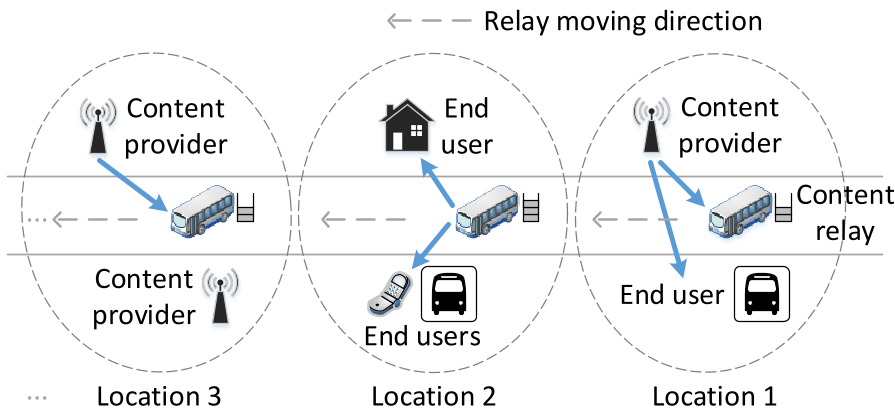 Fig 1: The interaction between publishers, mobile relays, and subscribers.
Experimental Insights: The Buffer Paradox
The study reveals a critical insight regarding Queue Capacity (Q). You might think "more buffer is better," but the MDP results show a "U-shaped" cost curve.
- Low Q: High costs because the relay can't store enough content to take advantage of high-density user zones.
- High Q: Costs rise again because the delay penalty (proportional to queue length) outweighs the marginal revenue of additional contents.
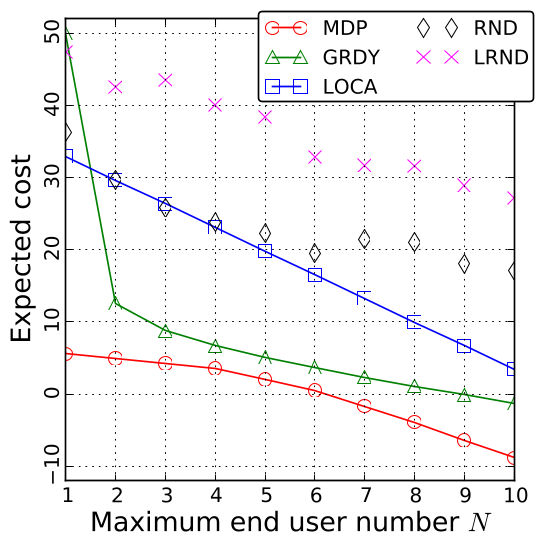 Fig 2: Comparison of Expected Cost, Delay, and Efficiency against baseline schemes.
Key Comparison vs. Baselines:
- Greedy (GRDY): Fails because it never wants to "buy" content (the immediate cost is always higher than staying idle). It lacks the multi-step foresight of MDP.
- Location-Aware (LOCA): Over-eager. It always buys and always transfers, leading to massive delay costs when the queue is full or prices are high.
- MDP (Proposed): Finds the "sweet spot," maintaining a relay efficiency of nearly 60% while keeping storage costs significantly lower than the LOCA scheme.
Critical Analysis & Conclusion
The beauty of this work lies in its stochastic foresight. By using the discount factor , the relay can "decide" to skip a high-priced content provider now, betting on the Markovian probability of finding a cheaper provider or a higher user density in the next few time slots.
Limitations: The current model assumes uniform content types. In reality, content has a "freshness" factor (Value of Information), where old data becomes worthless. Future extensions should incorporate Information Freshness (AoI) into the cost function.
Takeaway: For developers of decentralized social networks or vehicular clouds, this paper proves that "smart" relaying—aware of both economics and buffer physics—is 2-3x more efficient than hard-coded logic.