
Cost-Aware OSN Scaling: Efficiency Beyond Simple Replication
8260_Optimizing Cost for Online Social Networks on Geo-Distributed Clouds.
This paper introduces a cost-optimization framework for deploying Online Social Networks (OSNs) across geo-distributed clouds. It proposes a heuristic algorithm named "Role-Swap" that iteratively exchanges master and slave data replicas to minimize monetary costs (storage, intercloud traffic, and redistribution) while satisfying strict Quality of Service (QoS) and data availability constraints.
TL;DR
Deploying a global social network on clouds like AWS or Azure is a balancing act between low latency and high bills. This paper presents a novel optimization framework that treats monetary cost as a first-class citizen alongside QoS. By using a clever "Role-Swap" heuristic, the authors achieved up to 70% cost savings on Twitter-scale datasets while keeping user latency within strict bounds.
Background: The Hidden Costs of Cloud OSNs
When you scroll through your feed, your "Master Cloud" (the data center closest to you) needs to have your friends' data ready. If it doesn't, it has to fetch it from another region, incurring "Intercloud Traffic Costs." Most existing research focuses on reducing this traffic volume. However, cloud providers charge differently for storage, writes, and transfers. A strategy that minimizes the number of replicas might actually be more expensive if it places data in high-cost regions or triggers frequent expensive migrations.
The Core Insight: Role-Swapping
The authors observe that every user typically has one Master Replica (where they read/write) and several Slave Replicas (located where their friends are). Instead of the brute-force approach of moving data files across the globe—which is slow and expensive—the authors suggest swapping roles.
If a user's slave replica in Cloud B is more "cost-efficient" to be a master than the current master in Cloud A (due to cheaper storage or better social locality for their specific friend group), the system simply promotes the slave and demotes the master.
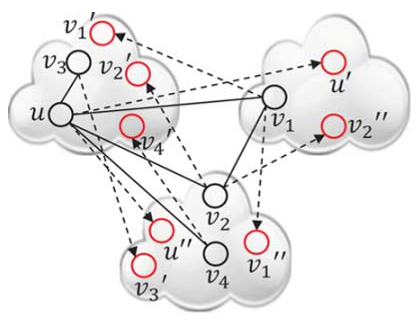 Fig 1: The Role-Swap process. Swapping master-slave identities can reduce costs while maintaining social locality.
Methodology: Balancing Three Dimensions
The paper formalizes a multi-objective optimization problem:
- Monetary Cost: Storage + Intercloud Traffic + Redistribution (the cost of the swap itself).
- QoS (Quality of Service): Defined as a vector where users' preferences for clouds (based on latency) are strictly honored.
- Data Availability: Ensuring a minimum number of replicas exists globally for fault tolerance.
The algorithm iterates through "Single Role-Swaps" and "Double Role-Swaps" (where two friends swap masters simultaneously) until it reaches a local optimum.
Experimental Results
The authors tested their approach using a massive Twitter dataset of 321,505 users mapped to 10 US cloud regions.
Key findings include:
- Vs. METIS/SPAR: While standard graph partitioners (METIS) or replica optimizers (SPAR) reduce traffic, they don't account for cloud billing. The Role-Swap algorithm beat them by 44-50% in total cost.
- Long-term Stability: Over a simulated 48-month period, the algorithm consistently saved over 40% in accumulated costs even after factoring in the overhead of moving data.
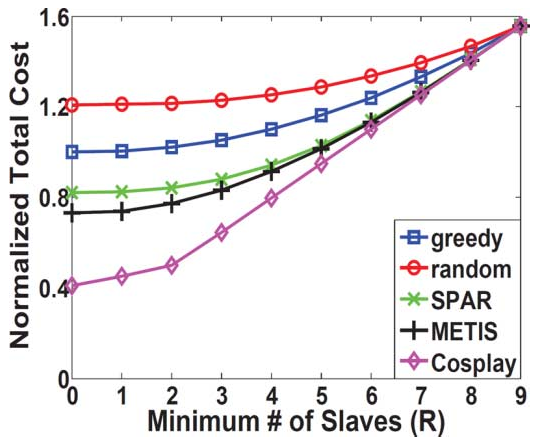 Fig 2: Total cost comparison showing the proposed algorithm's significant leads over random, greedy, and SPAR placements.
Critical Insight: The "Social Locality" Trap
One of the paper's most interesting takeaways is the visualization of QoS vs. Cost. Many OSN providers default to a "Greedy" placement (closest cloud = best). This research proves that you can move a user to their 2nd or 3rd most preferred cloud and save massive amounts of money with almost zero perceptible impact on user latency, provided their "social cluster" moves with them.
Conclusion & Future Outlook
This work highlights a shift from purely algorithmic optimization to "economic-aware" systems programming. As OSNs move toward more dynamic, decentralized infrastructures, the ability to dynamically "re-master" data based on real-time billing and social activity bursts will be a critical feature for any sustainable global platform.
Limitations: The model assumes "infinite" resources per cloud, which might not hold for smaller private clouds or specialized hardware instances. Future work could integrate "Capacity Constraints" into the Role-Swap logic.