
Cost Optimization for Online Social Networks on Geo-Distributed Clouds: A Role-Swap Approach
8260_Optimizing Cost for Online Social Networks on Geo-Distributed Clouds.
This paper addresses the cost optimization problem for dynamic online social networks (OSNs) deployed over geo-distributed clouds. It proposes a heuristic algorithm that uses iterative role-swaps between master and slave replicas to minimize storage, inter-cloud traffic, and redistribution costs while strictly meeting predefined QoS and data availability requirements. Evaluated on a large-scale real-world Twitter trace over 10 US clouds, the algorithm achieves up to 70% one-time cost reduction and over 40% cumulative cost reduction over 48 months, outperforming state-of-the-art methods including SPAR and METIS.
TL;DR
This paper tackles the problem of minimizing monetary costs (storage, traffic, and redistribution) when deploying an OSN across multiple geo-distributed clouds. It models cost, QoS (via user-cloud preference vectors), and data availability, then proposes a greedy heuristic that iteratively swaps the roles of master and slave replicas to reduce cost while respecting constraints. Experiments on a real Twitter dataset show up to 70% one-time cost reduction and over 40% cumulative savings over 48 months compared to state-of-the-art methods, with redistribution overhead consistently below 2% of monthly cost.
Position in the field: This work bridges the gap between replica placement optimization for OSNs and cloud cost-awareness. It extends the concept of social locality to geo-distributed clouds and introduces a practical algorithm that outperforms both graph partitioning (METIS) and replica-minimization (SPAR) approaches.
Problem & Motivation
Why is this hard?
Existing OSN deployment studies either ignore cloud pricing (e.g., SPAR, S-CLONE), ignore geo-distributed QoS (e.g., single-site optimizations), or disregard data availability. Graph partitioning algorithms (METIS) minimize inter-cloud traffic but cannot enforce social locality or user-specific cloud preferences. Moreover, real OSNs are dynamic—users join/leave and social relations evolve—so any optimizer must handle periodic re-optimization with low redistribution overhead.
Key Insight: The authors observe that swapping the roles of a user's master and slave replicas on different clouds can simultaneously reduce storage and traffic costs, while preserving the social locality requirement (a user's master cloud must host a replica of each neighbor). By intelligently selecting which swaps to perform, the algorithm can also respect QoS vectors (users prefer certain clouds) and data availability (minimum number of slave replicas).
Methodology
Modeling the Triad: Cost, QoS, and Data Availability
Cost Model:
- Storage cost per user per replica.
- Inter-cloud traffic cost for synchronizing slave replicas (due to social locality, only writes generate inter-cloud traffic).
- Redistribution cost incurred when moving data between clouds during re-optimization.
- The total cost per billing period is approximated as (\Psi \approx \Phi(G) + \Theta(G)), where (\Phi) is storage + traffic cost for the steady social graph (G), and (\Theta) is redistribution cost.
QoS Model:
- Each user has a sorted list of all clouds based on a metric (e.g., latency). The QoS of the entire OSN is a cumulative distribution vector (\vec{q}[k]) = fraction of users whose master replica lies in their top (k) preferred clouds.
- QoS requirement is defined by a lower bound (\vec{Q}_l) and upper bound (\vec{Q}_u).
Data Availability Model:
- Each user must maintain at least (R) slave replicas (excluding the master). Some slaves may also serve social locality.
The Algorithm: Role-Swap Heuristic
The algorithm operates in two phases: single role-swaps and double role-swaps.
Single Role-Swap:
- Randomly select a user (u).
- For each slave of (u) on cloud (j), check if swapping master (currently on cloud (i)) with that slave is feasible (QoS remains within bounds) and compute cost reduction using only local neighborhood information.
- Apply the swap with the largest positive reduction.
Double Role-Swap:
- Select a user (u) and a neighbor (v) whose master is on a different cloud.
- Consider swapping (u)'s master with (u)'s slave on (v)'s cloud, and simultaneously swapping (v)'s master with (v)'s slave on (u)'s cloud.
- If feasible and cost-reducing, apply both swaps.
The algorithm repeats these procedures until no further improvements or a max iteration count is reached.
Why only local computation?
A role-swap only affects the costs of the user undergoing the swap and its immediate neighbors. Therefore, the delta in total cost can be computed by inspecting a constant-degree neighborhood (OSNs typically enforce a friend limit), making each iteration (O(d)) where (d) is the average degree.
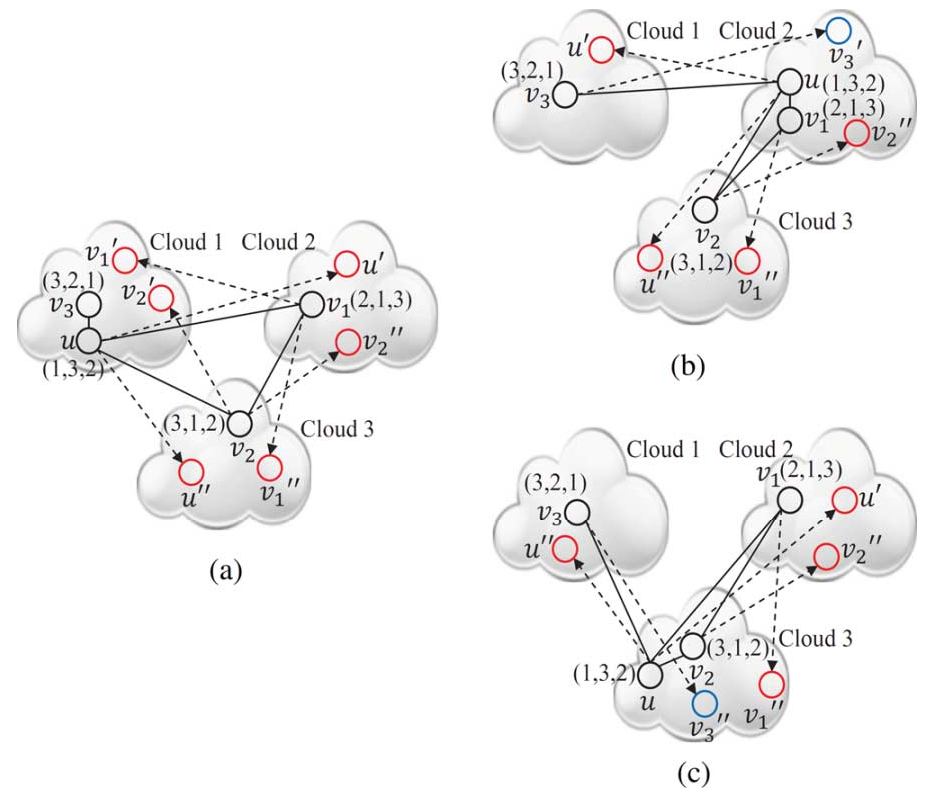
Figure: Example of a role-swap for user (u) between master cloud and slave cloud, reducing total replicas and traffic.
Experiments & Results
Dataset and Setup
- Real Twitter trace: 321,505 users, 3,437,409 social relations, 48 monthly snapshots (March 2006 – February 2010).
- 10 US clouds placed in cities (Seattle, Palo Alto, …). Clouds sorted for each user by geographic distance.
- Baselines: Greedy (nearest cloud), Random, SPAR (minimizes replicas), METIS (minimizes inter-partition traffic).
- Metrics: Normalized total cost (storage + traffic + redistribution), QoS compliance, and data availability.
One-Time Cost Reduction
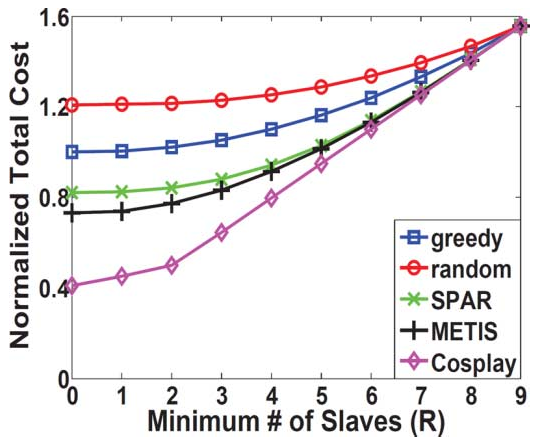
Figure: One-time total cost of placements. The proposed method reduces cost by 59% over greedy, 66% over random, 50% over SPAR, and 44% over METIS.
Key observations:
- The algorithm consistently outperforms all baselines across various (R) (minimum slaves) values.
- As (R) increases, the advantage shrinks because fewer slaves can be eliminated, but the algorithm still beats others.
Continuous Cost Reduction Over 48 Months
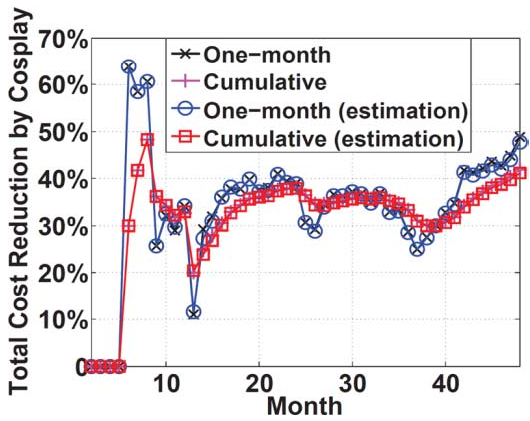
Figure: One-month and cumulative cost reduction vs greedy. The cumulative reduction exceeds 40% and closely tracks the ideal case using perfect future cost knowledge.
Ablation: The redistribution overhead never exceeds 2% of monthly cost, confirming the algorithm's efficiency. Maintenance cost (handling new users) is negligible, justifying the approximated cost model.
Critical Analysis & Conclusion
Takeaways
- Practical: The role-swap algorithm is simple to implement and yields significant savings without needing global graph partitioning.
- Robust: It adapts to cost estimation errors (EMWA predictions introduced <10% deviation from ideal).
- Generality: The vector QoS model allows fine-grained trade-offs between latency and cost.
Limitations
- Optimality gap: The algorithm only finds a local optimum; the NP-hardness of the global problem remains. However, on small-scale enumeration, the gap is at most 1.26× the optimal (with control).
- Assumes social locality: If an OSN does not exhibit strong social locality (e.g., many reads of non-friend content), the model would need extension.
- Static billing periods: Real clouds may have more granular pricing (hourly vs monthly), but the paper's per-month granularity matches typical long-running services.
Future Work
- Dynamic requirement changes: The paper sketches how to handle varying QoS/data availability bounds via additional migrations.
- Extension to other services: The role-swap concept could be applied to content delivery networks, multi-cloud databases, or edge computing where data placement must trade off cost and latency.
References
- Jiao et al., “Optimizing Cost for Online Social Networks on Geo-Distributed Clouds,” IEEE/ACM Trans. Netw., 2016.
- Pujol et al., “The little engine(s) that could: Scaling online social networks,” 2012.
- Karypis & Kumar, “METIS,” 1999.