
Stochastic Learning Games: Winning the Race Against Time in Social Networks
Optimizing Diffusion Time of the Content Through the Social Networks: Stochastic Learning Game
This paper introduces a competitive framework for optimizing content diffusion time in social networks using a Stochastic Learning Game. By employing a Minimax Q-Learning approach, the authors enable content generators to identify optimal relay neighbors based on connectivity and sharing quality to ensure information delivery before a validity deadline.
TL;DR
In the hyper-competitive attention economy, content has an expiration date. This paper presents a game-theoretic approach using Minimax Q-Learning to optimize the diffusion of time-sensitive information. By modeling the interaction between competing sources and their potential relay neighbors, the researchers provide a mathematical framework to maximize rewards before content becomes obsolete.
Contextual Positioning
Information diffusion research has traditionally focused on "Influence Maximization" (finding the most influential nodes). However, this paper shifts the focus toward Time-Critical Diffusion. It treats the social network not just as a static graph, but as a dynamic battlefield where two sources compete to reach buyers before a deadline.
Problem & Motivation: The Penalty of Delay
Why is this problem difficult?
- Temporal Validity: A hotel promotion is useless once the rooms are booked.
- Competition: If a competitor reaches a node first, the "interested user" is satisfied and removed from the market.
- Relay Uncertainty: Not every neighbor is a good relay. High connectivity (degree) doesn't always equal high sharing quality (relevance).
The authors' insight is to define a Time Threshold (). Beyond this point, the energy (cost) spent on diffusion yields negative utility, making "Not Diffuse" the optimal strategic move.
Methodology: The Minimax Q-Learning Framework
1. State Space & Modeling
The system identifies four primary states based on a neighbor's profile:
- Connectivity (): High vs. Low degree.
- Sharing Quality (): High vs. Low probability of sharing specific content types.
2. The Integrated Reward Function
The utility isn't just a flat fee; it is a vector-based reward that:
- Decreases as the delay increases (Time-decay).
- Increases with the fraction of interested users .
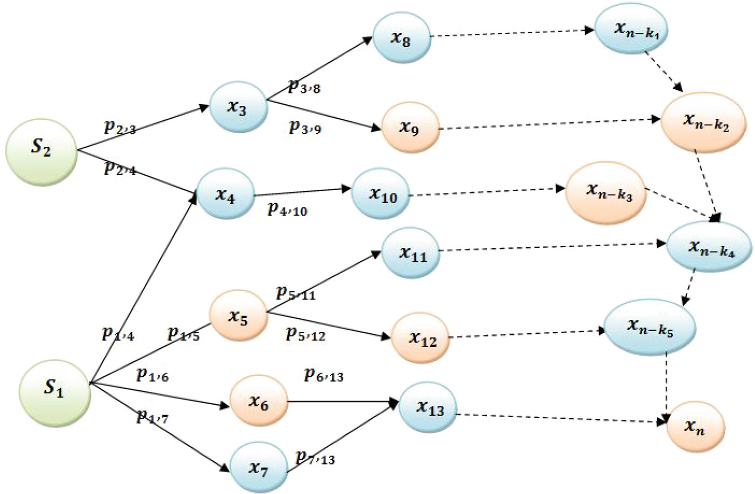 Note: The flow above illustrates the interaction between sources, intermediate relay neighbors, and the eventual receiver.
3. Minimax Q-Learning
To solve the zero-sum game, the authors use the Minimax Q-update: where is the value of the game at the next state, solved via Linear Programming. This ensures the source chooses an action that is robust against the competitor's best response.
Experiments & Results
The simulation (100 nodes, 24-hour validity) yielded several critical insights:
- State (High Degree, High Quality): Both players are incentivized to diffuse at "High Intensity." The "word-of-mouth" effect becomes viral here.
- The 12-Hour Pivot: For most content types, utility remained high initially but plummeted after the 12-hour mark, regardless of state, as it approached .
- Degree vs. Quality: Interestingly, in state (High Degree, Bad Quality), the source still achieves significant utility by diffusing with low intensity, proving that network position (centrality) can sometimes compensate for a lack of topical interest.
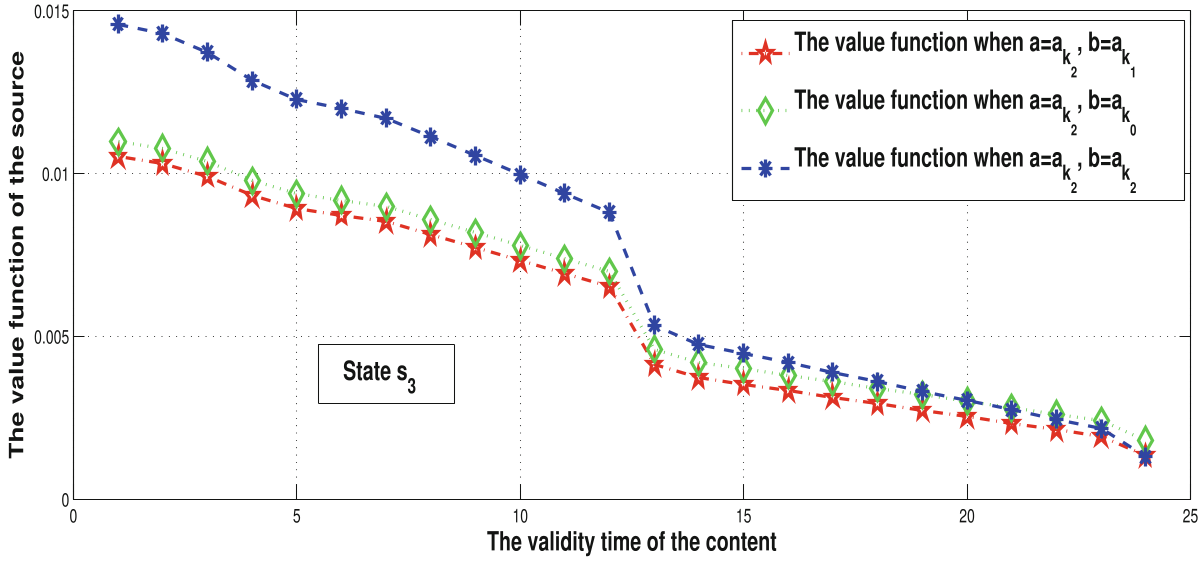 Fig: Utility vs. Content Validity showing the sharp decline as the deadline approaches.
Critical Analysis & Conclusion
Takeaway
The core contribution of this work is the formalization of the Stop-Diffusion Threshold. It provides a rigorous basis for companies to automate content boosting: if the calculated probability of arrival before is too low, the system should cease expenditures.
Limitations
- Zero-Sum Assumption: In many real-world social networks, two companies might actually increase the "market size" together (Positive-sum), which this model doesn't capture.
- Complexity: Linear programming at each Q-learning step may face scalability issues in massive networks with millions of nodes without further approximation.
Future Outlook
The authors suggest including Content Popularity as a dynamic variable. Integrating this with Deep Q-Networks (DQN) could allow this framework to handle the high-dimensional state spaces of modern platforms like X (Twitter) or TikTok.