
Machine Learning vs. Silicon Bugs: Optimizing Dynamic Trace Signal Selection
9935_Optimizing dynamic trace signal selection using machine learning and linear programming.
Summary
Problem
Method
Results
Takeaways
Abstract
This paper introduces a novel dynamic trace signal selection method for post-silicon validation, utilizing Unsupervised Learning (K-means), Supervised Learning (Decision Trees), and Integer Linear Programming (ILP). The approach, designed to enhance circuit observability, achieves significant SOTA improvements in detecting both permanent and transient faults across diverse benchmarks.
## TL;DR
Debugging a physical chip (Post-Silicon Validation) is like trying to find a needle in a haystack with a flashlight that can only show 1% of the hay at a time. This paper presents a dynamic "flashlight" that uses **Machine Learning (K-means and Decision Trees)** and **Integer Linear Programming (ILP)** to predict where a bug might hide based on the chip's current input, increasing transient fault detection by up to 50%.
## Problem & Motivation: The Observability Bottleneck
Once a chip is manufactured, engineers use **Trace Buffers** to record internal signal values. However, these buffers are extremely small—you can only monitor a handful of the thousands of registers on-chip.
Most traditional methods are **Static**: you pick a set of signals and stick with them. But bugs—especially **Transient Faults**—only appear under specific input conditions. Static selection often looks at the wrong place at the wrong time. Existing dynamic methods switch signals periodically, but this is a blind process that doesn't respect the internal logic state of the circuit.
## Methodology: The "Cluster-Optimize-Classify" Pipeline
The authors' core insight is that certain **internal states** are more likely to trigger specific sets of faults. If we can categorize these states, we can tailor our "observability" to match.
### 1. The Clustering Phase (Unsupervised Learning)
Instead of treating all chip iterations the same, they use **K-means clustering**. They group "in-states" (inputs + current register values) that have similar "Triggered Regions." If two states exert the same part of the circuit, they belong in the same cluster.
### 2. The Optimization Phase (ILP)
For each cluster, they need to pick the best signals to monitor. They use **Integer Linear Programming (ILP)** to solve a coverage problem: "Which subset of signals maximizes the probability of seeing a fault propagation?"
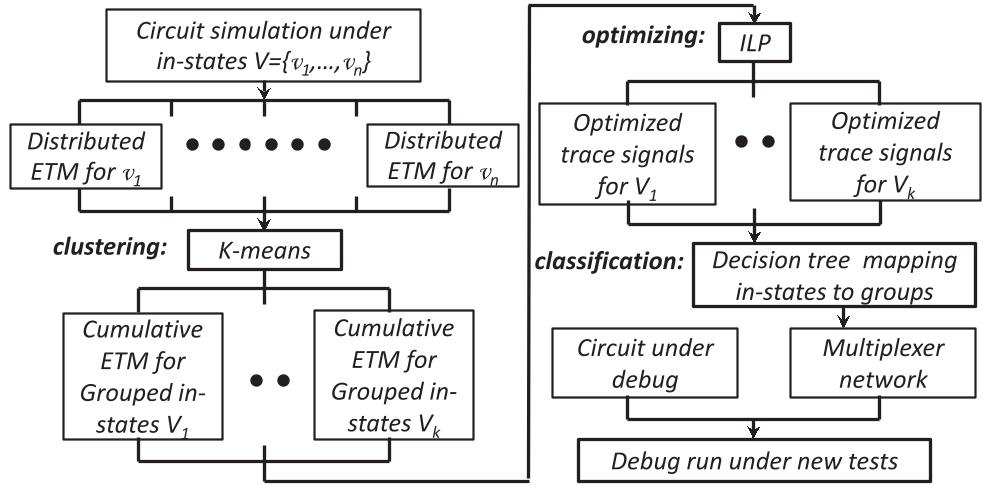
*Fig 1: The three-phase workflow: Clustering, Optimization, and Classification.*
### 3. The Classification Phase (Supervised Learning)
You can't run a K-means algorithm inside a chip in real-time. To solve this, the authors train a **Decision Tree**. This tree is converted into a simple **Multiplexer network** in hardware. As the chip runs, this hardware logic looks at the current inputs and instantly switches the trace signals to the most relevant group.
## Experiments & Results
The researchers tested their approach on 20 benchmarks, including Opencores and ITC’99 circuits.
### Key Findings:
- **Higher Sensitivity**: The ML-driven approach outperformed "Static" selection by **50%** in transient fault coverage.
- **Smart Switching**: Compared to "Periodic" switching (the previous dynamic SOTA), this state-aware method achieved **18% higher transient coverage**.
- **Permanent Fault Robustness**: By adding a constraint ($\xi$) to the ILP, they ensured that while chasing transient bugs, they didn't lose sight of permanent hardware failures.
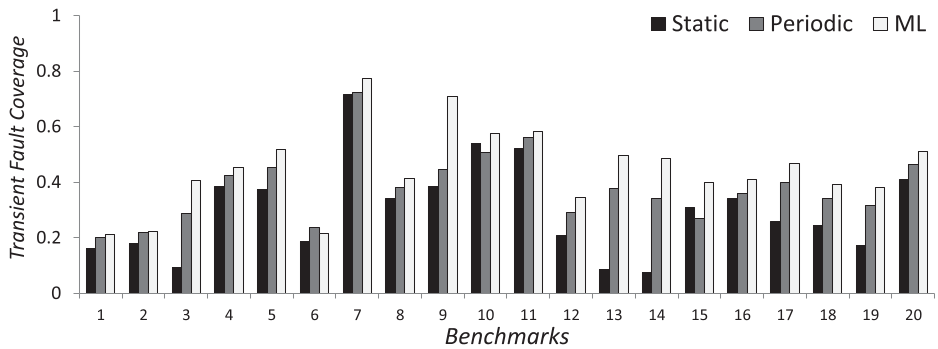
*Fig 2: Comparison of Transient Fault Coverage across 20 benchmarks. The ML-based method (blue) consistently dominates.*
## Critical Analysis & Conclusion
### Takeaway
The shift from "blindly switching" to "context-aware switching" is the game-changer here. By using gate-level design data and ML, the authors created a system that adapts to the chip's real-time workload.
### Limitations
- **Hardware Overhead**: Implementing the Decision Tree (multiplexer tree) costs area on the silicon. While the authors kept the tree height small (height of 5), very complex chips might require more area.
- **Random Simulation**: The initial clustering depends on simulations with random inputs; if the real-world workload is vastly different, the clusters might be sub-optimal.
### Future Outlook
This work paves the way for "Self-Debugging Silicon," where on-chip AI doesn't just process data but actively monitors its own health using predictive models.