
Beyond Hashing: Exploiting Overlapping Communities for OSN Data Placement
Optimizing Inter-server Communications by Exploiting Overlapping Communities in Online Social Networks
The paper proposes a novel data placement scheme for Online Social Networks (OSNs) that minimizes inter-server communication by integrating network partitioning and data replication. By modeling the problem as "Overlapping Community Detection," the authors develop a two-phase expansion algorithm that identifies dense user clusters to co-locate data, achieving significant traffic reduction while maintaining load balance.
TL;DR
Scaling Online Social Networks (OSNs) is a nightmare of inter-server chatter. This paper introduces a paradigm shift: instead of partitioning the graph and then "patching" it with replicas, it uses Overlapping Community Detection to optimize both simultaneously. By identifying natural clusters and treating overlaps as replicas, the system slashes communication costs while keeping server loads perfectly balanced.
The Scalability Wall: Why Hashing Fails
In the world of Facebook or Twitter, data is highly interdependent. When User A views User B's profile, the system must fetch B's data. If A and B are on different servers, you get Inter-server Traffic.
Traditional systems use Hashing for its simplicity and great load balancing. But hashing is "socially blind"—it scatters friends across the datacenter, maximizing traffic. Existing fixes like METIS (Partitioning) or SPAR (Aggressive Replication) only solve half the puzzle. Partitioning minimizes cuts but ignores the power of replicas; aggressive replication kills read traffic but creates a storm of "Write Traffic" to keep replicas synced.
The Insight: Replicas as Community Overlaps
The authors suggest that users aren't just points on a map; they live in communities. A community is a group of users who interact frequently.
The breakthrough here is the use of Overlapping Communities. In this model:
- A Community = A Server.
- An Overlap = A Data Replica. If a user belongs to Community A and B, their data is replicated on Server A and B.
The Methodology
The authors define a User Value based on interaction frequency (Read/Write rates) and a Membership Degree to measure how "tightly" a user fits into a specific server cluster.
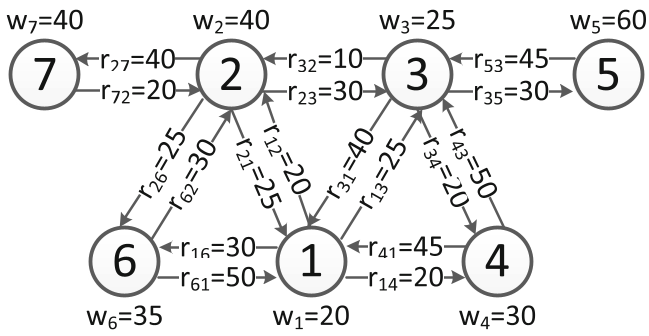
The algorithm follows two critical phases:
- Initial Detection: It identifies "Seed Users" (the most active ones) and builds small, tight cores around them.
- Expansion: It greedily adds neighboring users to these communities, but only if . Meaning, the bandwidth saved on "Reads" must outweigh the bandwidth spent on "Write synchronization."
Performance: Winning the Trade-off
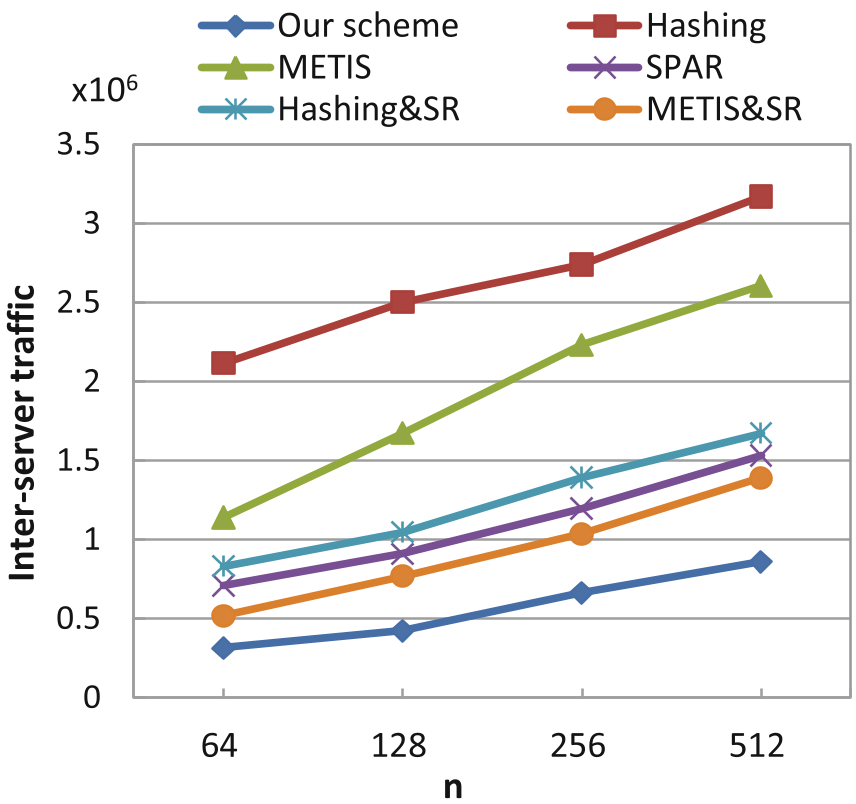
The researchers tested their approach against 128 servers using real Facebook crawl data.
1. Superior Traffic Reduction
As the number of servers increases, the "random" nature of other algorithms causes their traffic to spike. The proposed scheme (shown as the bottom line in Fig. 3) stays consistently efficient because it keeps the most active "sub-graphs" co-located.
2. The Replication Sweet Spot
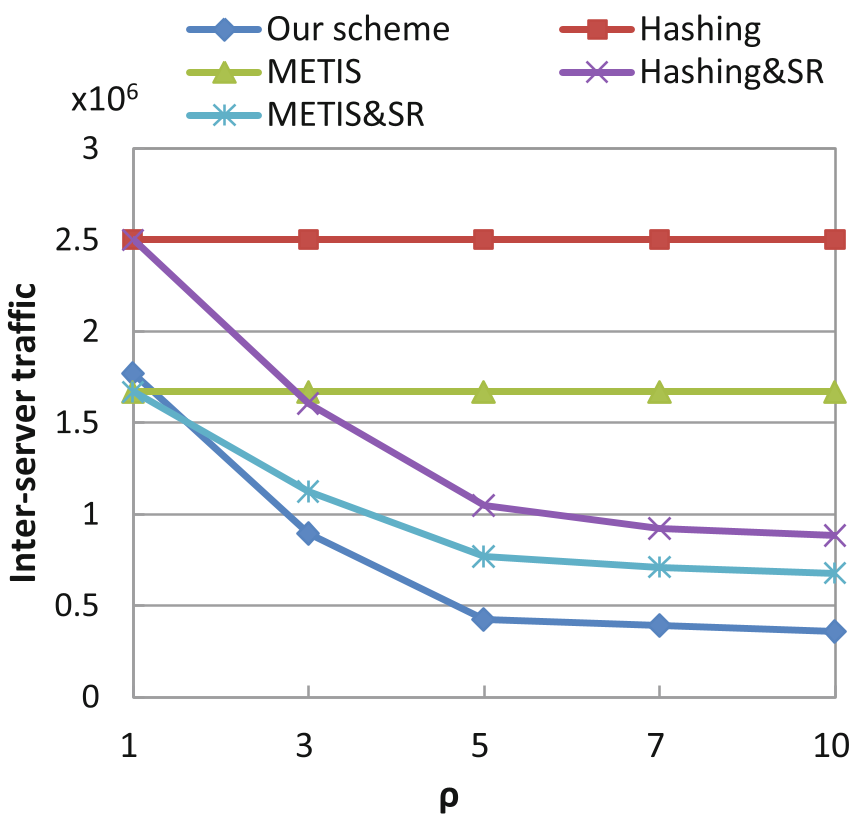
The paper reveals an interesting trend in replication degree (). While traditional replication (SPAR) becomes too expensive as you add more copies, the community-based approach finds a "plateau" where adding more replicas no longer helps, preventing the system from over-provisioning storage.
Critical Analysis & Takeaways
The brilliance of this work lies in its holistic view. By using the Gini coefficient to constrain the expansion, the authors ensure that one "popular" community doesn't grow so large that it crashes a single server.
Limitations: The current model assumes a static social graph. In reality, OSN links are dynamic. Future work would need to address how to "migrate" these communities in real-time as users change their interaction habits.
Final Thought: For engineers building large-scale distributed K-V stores, the message is clear: stop treating partitioning and replication as separate configuration flags. Integration is the key to breaking the scalability wall.