
SecRSC: Solving the Privacy-Reward Paradox in Spatial Crowdsourcing
Optimizing rewards allocation for privacy-preserving spatial crowdsourcing
This paper introduces SecRSC, an optimized reward allocation framework for spatial crowdsourcing that maximizes task acceptance rates (TAR) while ensuring absolute location privacy. By leveraging a novel combination of multiplicative homomorphic encryption and prime-number encoding, the system enables requesters to analyze worker distributions and adjust incentives without ever exposing individual worker movements.
TL;DR
Researchers have developed SecRSC, a framework that uses the mathematical elegance of prime numbers and Homomorphic Encryption to boost spatial crowdsourcing efficiency. It allows a platform to know which tasks need higher rewards to be "accepted" without ever knowing where the workers actually are. Experimental results show a significant jump in task completion rates with minimal computational cost.
Background: The Efficiency-Privacy Tug-of-War
In spatial crowdsourcing (e.g., platforms like Uber, Meituan, or Waze), there are two traditional modes:
- Worker-Selected Mode: Low efficiency. Workers pick what they like, usually ignoring distant or "hard" tasks.
- Server-Assigned Mode: High efficiency but high risk. The server knows everyone's location to optimize assignments, often leading to privacy leaks regarding home addresses or daily habits.
Past attempts to fix this using Differential Privacy (DP) often "blurred" the data so much that the assignments became useless. Cryptographic methods were safer but usually too slow for real-time mobile apps. SecRSC breaks this deadlock.
Methodology: Prime Numbers Meet ElGamal
The paper's core "aha!" moment is using Prime Number Factorization as a data aggregation tool.
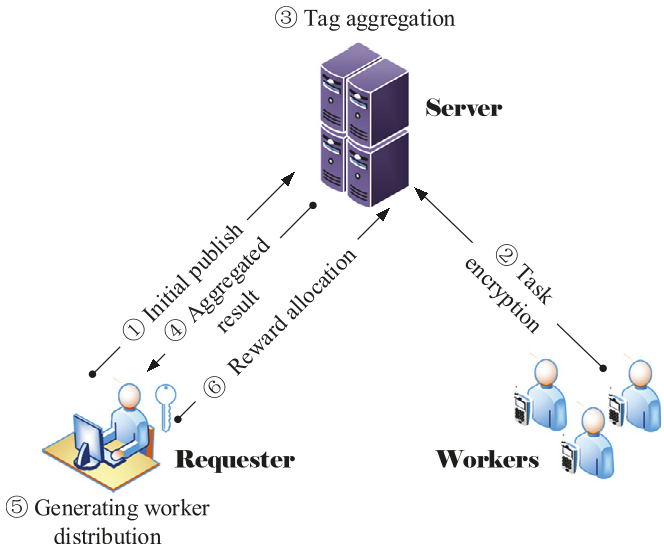
1. The Prime Tagging Mechanism
Every task is assigned a unique prime number (e.g., Task A = 2, Task B = 3, Task C = 5).
- If a worker likes Task A and B, they calculate .
- If another worker likes Task B and C, they calculate .
2. Homomorphic Aggregation
Instead of sending "6" or "15" in plain text (which would reveal their location), workers encrypt these numbers using the ElGamal cryptosystem. Because ElGamal is multiplicative homomorphic, the server can multiply these ciphertexts together:
The requester decrypts the result (90) and performs prime factorization: . Instantly, the requester knows:
- Task A (2) was selected by 1 person.
- Task B (3) was selected by 2 people.
- Task C (5) was selected by 1 person.
The requester knows the popularity but has no idea who chose what.
Optimized Incentive Allocation
Once the distribution is known, SecRSC applies two strategies to ensure the fixed budget is spent wisely:
- IRR (Identical Rate of Return): Ensures every task offers the same "value per mile" by subsidizing unpopular ones.
- OCF (Optimized Constraint Function): A more practical approach that keeps rewards within a specific range while still prioritizing the "lonely" tasks.
Experimental Validation
Using datasets from Gowalla and T-Drive, the authors compared SecRSC against the "Uniform" reward strategy (where all tasks pay the same).
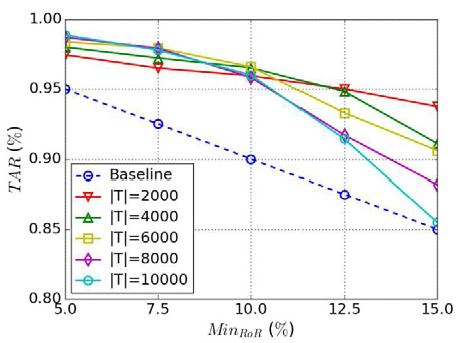
- Higher Acceptance: SecRSC consistently achieved higher Task Acceptance Rates (TAR), often exceeding the baseline by over 5%.
- Robustness: The system remained stable regardless of the number of workers or tasks, proving it can scale to city-wide applications.
In terms of performance, the decryption and factorization—traditionally the bottleneck—took only 20-75 seconds for massive datasets (10,000+ tasks). This makes it viable for daily crowdsourcing operations.
Critical Analysis & Conclusion
Takeaway
SecRSC proves that privacy doesn't have to come at the cost of utility. By moving the "intelligence" of the system to a secure aggregated distribution rather than raw individual data, platforms can remain efficient while respecting user boundaries.
Limitations
- Dynamic Tasks: The current model assumes tasks are static. In real-world scenarios, tasks might appear and disappear in seconds.
- Collusion Risk: The privacy holds as long as the Server and Requester do not collude to share keys and ciphertexts.
Future Outlook
The authors suggest extending this to private trajectories, allowing the same level of protection for moving workers. This prime-factorization-plus-encryption combo could also revolutionize private voting and secure surveys.