
SecRSC: Balancing Privacy and Incentives in Spatial Crowdsourcing
Optimizing rewards allocation for privacy-preserving spatial crowdsourcing
The paper introduces SecRSC, a secure framework for reward-based spatial crowdsourcing that optimizes task acceptance rates while guaranteeing worker location privacy. It utilizes a novel cryptographic protocol combining ElGamal homomorphic encryption and prime number product properties to aggregate worker preferences, achieving superior Task Acceptance Rates (TAR) compared to uniform allocation baselines.
TL;DR
In the world of spatial crowdsourcing (like Uber or TaskRabbit), location privacy is often sacrificed for operational efficiency. Researchers have developed SecRSC (Secure Reward-based Spatial Crowdsourcing), a framework that uses elegant number theory and homomorphic encryption to learn which tasks are "unpopular" and raise their rewards—all without ever knowing where the workers actually are.
The Conflict: Efficiency vs. Anonymity
Most crowdsourcing systems operate in one of two modes:
- Worker Selected: Workers pick what they like. Privacy is high, but "outlier" tasks in remote areas are ignored.
- Server Assigned: The server knows everyone's location and assigns tasks. Efficiency is high, but privacy is non-existent.
The authors of this paper argue that we don't need to know where a worker is; we only need to know the global distribution of task preferences to optimize rewards.
Methodology: The Elegance of Prime Numbers
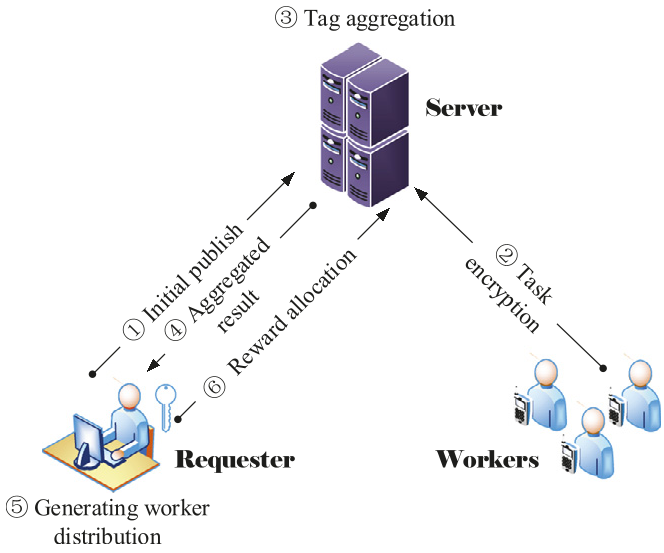
The core innovation lies in how worker preferences are collected. Every task is assigned a unique prime number as its tag.
1. The Cryptographic Hash
If a worker likes Task A (tag 2) and Task B (tag 3), they calculate the product (). Because of the Fundamental Theorem of Arithmetic, the number 6 can only be factored back into 2 and 3.
2. Homomorphic Multiplication
Workers encrypt their product () using the ElGamal cryptosystem. ElGamal is multiplicatively homomorphic, meaning: The crowdsourcing server multiplies all encrypted tags together. It sees only a giant, encrypted blob of data.
3. Decryption and Distribution
Only the requester (who has the private key) can decrypt the final product (). By factoring this massive number, they see exactly how many people were interested in Task 1, Task 2, etc.
Reward Allocation: Fixing the "Outlier" Problem
Once the requester knows the popularity () of each task, they use two mathematical strategies to redistribute a fixed budget:
- IRR (Identical Rate of Return): Ensures all tasks offer a similar "bang for your buck" relative to the estimated travel distance.
- OCF (Optimized Constraint Function): A more practical approach that keeps rewards within a strictly defined range using an exponential decay function.
Experiments & Results
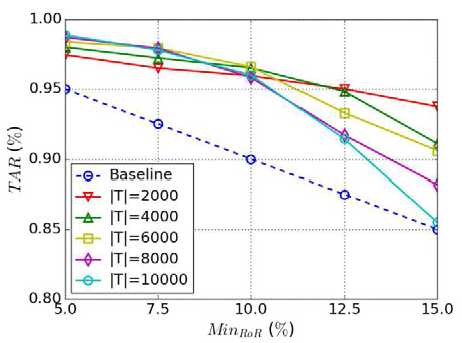
Using the Gowalla and T-Drive datasets, the authors compared SecRSC against the traditional "Uniform" reward strategy.
- Efficiency: SecRSC consistently achieved a higher Task Acceptance Rate (TAR). When only 90% of tasks were accepted under uniform pay, SecRSC pushed that number above 96%.
- Scalability: Even with 10,000 tasks, the factorization process (the most intensive part) took less than 20 seconds.
- Privacy: The paper proves that unless the server and requester collude, individual worker locations remain mathematically secure.
Critical Insight
The brilliance of this work is moving the "intelligence" from location tracking to incentive alignment. By treating worker preferences as a private aggregate, SecRSC achieves the efficiency of a centralized system with the privacy of a decentralized one.
However, the reliance on prime factorization means the system must carefully manage the size of the products to avoid exceeding the encryption modulus. Future iterations could explore lattice-based cryptography to handle even larger scales or spatiotemporal trajectories.
Conclusion
SecRSC proves that privacy doesn't have to cost efficiency. By using homomorphic encryption and optimized reward allocation, we can build crowdsourcing platforms that respect users while ensuring every task gets done.