
PSO-Driven Portfolio Optimization: Balancing Risk and Return in Friction-Heavy Markets
Research on Optimizing Security Investment Combination Based on PSO
This paper presents an optimized model for security portfolio selection by integrating Particle Swarm Optimization (PSO) with a multi-factor mean-variance framework. The core achievement is the successful adaptation of Markowitz's theory to the specific "friction factors" of the Chinese security market, utilizing swarm intelligence to find the efficient frontier.
TL;DR
Modern portfolio theory often ignores the "grit" of real-world trading—taxes and transaction costs. This paper bridges that gap by applying Particle Swarm Optimization (PSO) to a refined Markowitz model tailored for the Chinese security market. The result is a computationally efficient way to navigate the trade-offs between risk, return, and friction costs.
Background & Motivation: Beyond the Ideal Market
Since 1952, the Markowitz mean-variance model has been the bedrock of investment science. However, its "pure" form assumes a frictionless environment. In reality, investors face:
- Transaction Costs: Each trade eats into the principal.
- Taxation: Capital gains and dividends are taxed at different rates.
- Market Constraints: Short-selling and risk-asset loans are often restricted, particularly in the Chinese market context.
The authors argue that when these factors are added, the "Efficient Frontier" shifts. Traditional optimization struggles with these added complexities, necessitating a more flexible, heuristic approach.
Methodology: The Mechanics of the Swarm
The paper utilizes Swarm Intelligence, specifically PSO, to solve the multi-factor model.
1. The Refined Objective Function
The model transforms the standard return into a "Net Profit" () and adjusts the risk () for taxes:
- Net Profit (): Total gains minus capital gains tax, income tax, and transaction costs.
- Risk (): Adjusted variance taking tax rates into account.
The final objective is a weighted optimization using a risk aversion parameter :
2. The PSO Algorithm
Instead of relying on derivatives, PSO uses a population of "particles" that "fly" through the solution space. Each particle updates its velocity based on:
- Cognitive Component: Its own historical best position.
- Social Component: The best position found by any member of the swarm.

The authors use a dynamic inertia weight () that decreases over time, allowing the swarm to explore broadly at first and converge precisely on the optimal portfolio later.
Experimental Validation
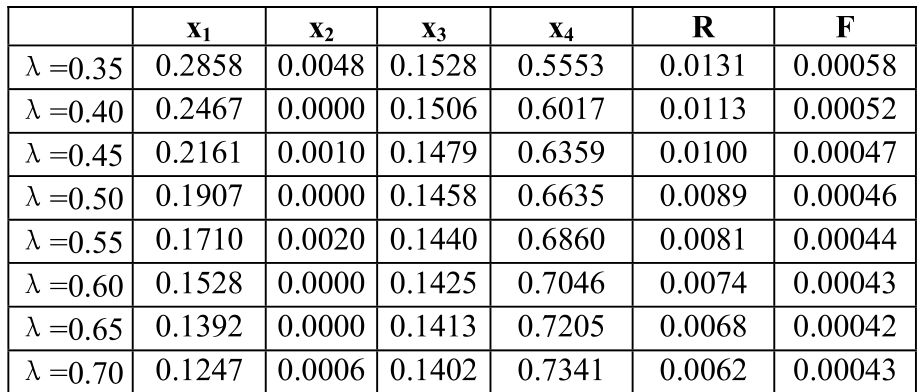
Using data from index 30 stocks (e.g., China Merchant Bank, Vanke A), the authors tested the model across different risk preferences.
Key Findings
- Efficient Adaptation: As the risk aversion () increases, the PSO correctly shifts the portfolio from high-growth/high-risk assets to more stable, lower-variance choices.
- Practical Feasibility: The algorithm reached optimal or near-optimal solutions within 1000 iterations, proving it suitable for real-time or frequent rebalancing.
Critical Insight & Conclusion
The significance of this work lies in its pragmatism. While many papers focus on pure mathematical elegance, this study acknowledges that "slippage" (taxes and costs) is often the difference between a profitable strategy and a failing one.
Takeaway for Practitioners: While PSO is powerful, its performance is highly sensitive to parameter tuning (like the scaling factors). Future iterations of this research could benefit from Hybrid Meta-heuristics (e.g., combining PSO with Genetic Algorithms) to prevent premature convergence in even larger, thousand-asset universes.
For investors in the Chinese market, this model provides a "scientific foundation" that respects the specific tax and cost structures of their environment.