
ORACE-Net: Engineering Reliable Communications for the Heart of Disaster Zones
ORACE-Net: A novel multi-hop body-to-body routing protocol for public safety networks
The paper introduces ORACE-Net, a beacon-less multi-hop routing protocol designed for Public Safety Networks (PSNs). It optimizes communication between wearable Body-to-Body (B2B) networks by replacing periodic beacons with a dual-phase route discovery mechanism, achieving superior Packet Reception Rate (PRR) and energy efficiency compared to AODVv2 and OLSRv2.
TL;DR
Public Safety Networks (PSNs) demand extreme reliability under chaos. ORACE-Net (Optimized Routing Approach for Critical and Emergency Networks) is a novel protocol that ditches traditional, energy-hungry "Hello" beacons. By using Command Center-led advertisements and data-driven reverse pathing, it maximizes battery life and ensures live video/audio streams reach rescue teams even when infrastructure is obliterated.
The "Infrastructureless" Dilemma
In the wake of an earthquake or flood, cellular towers are often the first to fail. Emergency responders must rely on Body-to-Body (B2B) networks—ad-hoc connections between wearable devices. However, standard protocols like AODVv2 or OLSRv2 were built for general-purpose mobile networks. In a disaster:
- Energy is Finite: Constant "Hello" packets for neighbor discovery drain radio batteries.
- Topology is Violent: Rapid movement (panic behavior) breaks links faster than protocols can repair them.
- Hierarchy Matters: Data must flow to and from a Command Center (CC), yet most MANET protocols treat all nodes as equal.
Methodology: The Beacon-less Revolution
The core "Aha!" moment of ORACE-Net is the elimination of the neighbor discovery overhead. Instead of every node shouting its presence every few seconds, the protocol uses a three-phase "Wave" approach:
- Advertisement (ADV) Broadcasts: The CC-node initiates a wave. Only when a node receives an ADV does it learn about its neighbors and its path to the CC.
- Direct Route Establishment: Nodes calculate the best path back to the CC using a metric called E2ESSL (End-to-End Signal Strength Level), prioritizing signal stability over just a simple hop count.
- Reverse Route Establishment: Instead of sending more control packets, ORACE-Net "piggybacks" on actual data packets. As data flows to the CC, intermediate nodes learn the reverse path.
 Figure 1: Conceptual overview of B2B and Off-Body communication in PSN.
The E2ESSL Metric
Unlike protocols that only look at the shortest path (hop count), ORACE-Net sums the signal strength across the entire chain: This ensures that a 3-hop path with strong signals is preferred over a 2-hop path that is on the verge of dropping out.
Experimental Results: Performance Under Pressure
The researchers tested ORACE-Net against AODVv2, OLSRv2, and GPSR using Bonnmotion to simulate "Disaster Area Mobility"—a model that mimics rescue groups and casualty clearing zones.
- Packet Reception Rate (PRR): In the highly challenging disaster model, ORACE-Net maintained nearly 70% PRR, while AODVv2 struggled below 40% due to its reactive delays.
- Energy Distribution: For ORACE-Net, 86% of energy is used for data. In contrast, AODVv2 wastes 93% of its energy just on Route Establishment.
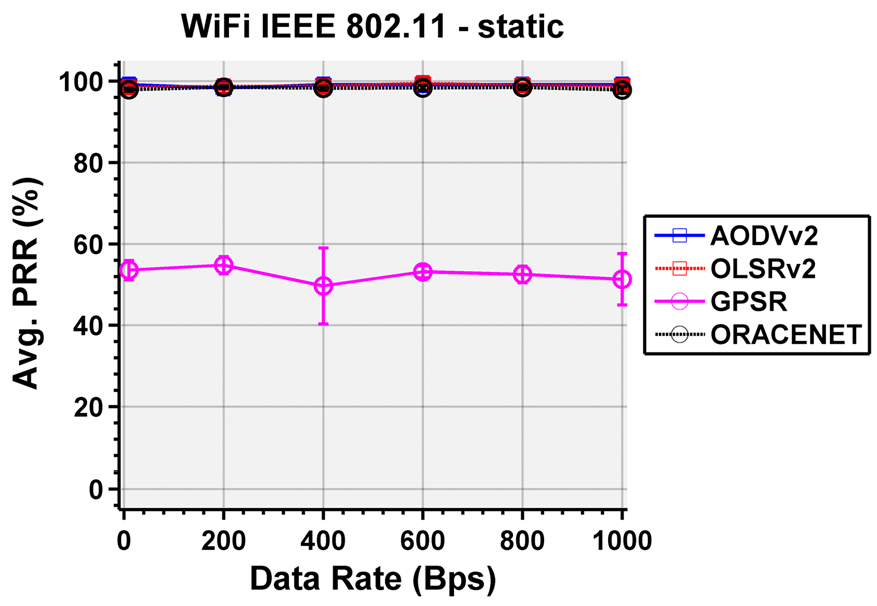 Figure 2: Packet Reception Rate and Energy Consumption comparison across Static, Random, and Disaster models.
Critical Insight & Future Outlook
The primary value of ORACE-Net lies in its operational awareness. It recognizes that in a PSN, the Command Center is the "Sun" around which the network revolves. By centering route discovery on the CC and using a beacon-less approach, it solves the "Scaling Wall" where control traffic usually chokes the bandwidth needed for actual rescue data.
Limitations: Currently, the protocol assumes a single CC-node. Future iterations must address the "Multi-Command" scenario where data needs to be synchronized between multiple medical and fire-fighting headquarters.
Final Takeaway
ORACE-Net transitions B2B networks from academic curiosity to tactical reality, offering a robust, energy-aware backbone for the next generation of "Smart Rescuers."