
Orca: Simulating the World within a Unified Latent Space
Orca: The World is in Your Mind
Orca is a general world foundation model developed by the Beijing Academy of Artificial Intelligence that learns a unified world latent space for "Next-State-Prediction." It utilizes a dual-learning paradigm—unconscious and conscious learning—to enable multimodal downstream readouts including text generation, image prediction, and embodied action.
TL;DR
The Orca Team from the Beijing Academy of Artificial Intelligence (BAAI) has unveiled Orca, a general world foundation model that shifts the AI paradigm from predicting "what comes next in a sequence" (tokens or frames) to modeling "what is the next state of the world." By learning a unified world latent space from 125K hours of video and 160M event annotations, Orca achieves superior performance in text reasoning, image prediction, and real-world robot control—all using a frozen backbone.
Problem & Motivation: Beyond Passive Prediction
Most current AI models are "passive predictors." LLMs predict the next token, and Sora-like models predict the next pixel frame. However, these models often lack a fundamental grasp of physical laws and causal relationships—the "why" behind the "what."
The authors argue that true general intelligence requires a model that internalizes the world's dynamics. The core challenge is: How can a model learn a unified representation of the world that supports diverse tasks without being purpose-built for each? Orca addresses this by treating language, vision, and action as different "readouts" of a single underlying world state.
Methodology: The Dual Learning Paradigm
Orca's architecture is built on the philosophy that human intelligence is divided into unconscious perception and conscious reasoning.
1. Unconscious Learning (Dense Dynamics)
This paradigm focuses on learning from raw observation. By predicting the latents of future frames in continuous video without labels, the model internalizes atemporal and physical regularities like motion, occlusion, and gravity.
2. Conscious Learning (Meaningful Transitions)
This introduces language as a constraint. Using VQA and event-level annotations, the model learns "sparse" transitions—those that matter for human intentions or causal outcomes.

The model employs a query-based implementation where Query 1 handles implicit dynamics and Query 2 handles explicit (language) conditions to map the current state to the next.
Experiments & Results: Proving the Latent Power
The researchers froze the Orca backbone after pre-training and only trained lightweight "readout" decoders. This was a critical test: Is the world representation itself powerful?
Scalability
As model size increased from 0.8B to 4B and data scaled up, the loss continued to decrease. More importantly, downstream performance in text, image, and action generation improved in tandem with lower pre-training loss, proving that "a stronger world latent leads to stronger capabilities."
Real-World Robotics
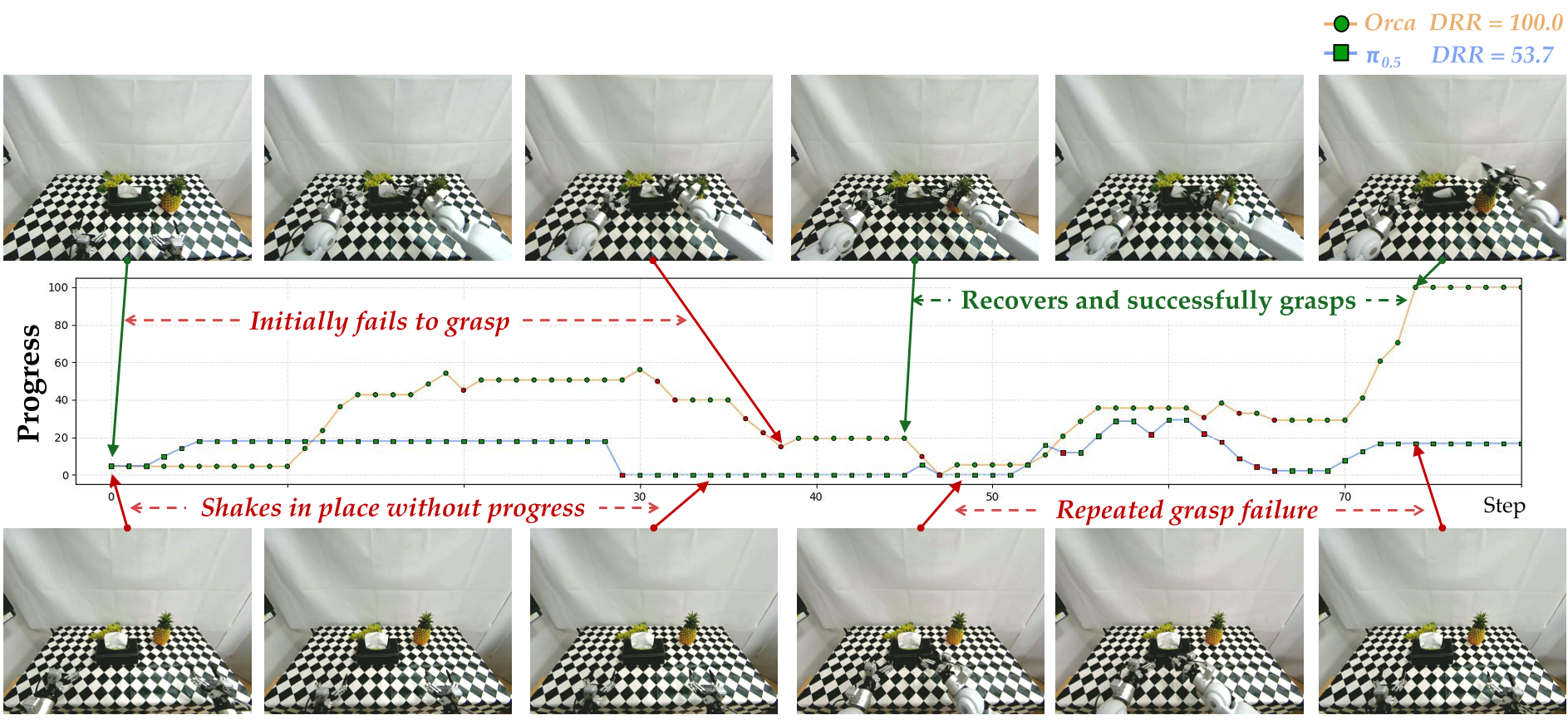
In real-robot tasks (like "Scooping Sugar" or "Taking a Book"), Orca demonstrated a remarkable ability to recover from failures—such as missing a grasp—by re-planning based on its understanding of the state.
Visual Prediction (PRICE-V0.1 Benchmark)
To test "imagination," the team built the PRICE benchmark. Orca outperformed specialized image editing models (like FLUX.1-Kontext) by maintaining better physical consistency and adhering more strictly to instructions during state transitions.
Critical Analysis & Conclusion
Takeaways
Orca proves that Next-State-Prediction is a viable and potentially superior path toward general intelligence compared to pure token-based modeling. Its ability to provide "world-aware" features to a robot or an image generator without changing its core weights is a testament to the robustness of its latent space.
Limitations & Future Work
Despite its success, Orca currently relies heavily on vision and language. The BAAI team notes that the next step is incorporating "force," "tactile," and "audio" signals. Furthermore, the model is currently supervised in the space of a frozen ViT encoder; a "native" world model would learn its own alignment directly from raw multi-source signals.
In conclusion, Orca represents a milestone in moving from AI that mimics data to AI that understands the environment it inhabits.