
Ravel: Decoding the Logical Pulse of Massively Parallel Programs
Ordering Traces Logically to Identify Lateness in Message Passing Programs
This paper introduces a method to extract the "Logical Communication Structure" from parallel event traces and implement it in a tool called Ravel. By utilizing happened-before relationships and developer intent to align concurrent events, it identifies performance bottlenecks like "Lateness" and "Differential Lateness" across thousands of processes.
TL;DR
Parallel performance analysis is often a "hairball" of overlapping events. This paper introduces a technique to extract the Logical Communication Structure of MPI programs—aligning events based on meaning rather than just time. By introducing metrics like Differential Lateness, it allows developers to stop looking at symptoms (waiting) and start finding the cure (the specific process injecting delay).
The Problem: The High-Scale Obfuscation
When running simulations on thousands of cores, traditional "Gantt-chart" style visualizations (like Vampir) break down. Network noise, tiny imbalances, and complex collective operations create a "jagged" timeline where it's impossible to see if Process A is late because of its own work or because it's waiting for a message from Process B that was delayed by Process C.
The core issue? Physical time is a poor coordinate system for logical intent.
Methodology: Mining the Logical Structure
The authors argue that to understand a trace, we must first reconstruct what the developer intended to happen simultaneously. They achieve this through three key innovations:
1. Phase Partitioning & Leap Merging
Instead of a single massive graph, the trace is broken into "Phases" (e.g., a halo exchange or a global reduction). They use a "Leap Merge" algorithm to ensure that if a code is bulk-synchronous, the logic captures every process participating in a phase before moving to the next.
2. Logical Alignment (The Lamport Shift)
Based on Lamport’s "happened-before" relation, the algorithm assigns events to discrete Steps.
- Collective Sync: All operations in a collective (like
MPI_Bcast) are forced into the same logical step. - Send-Driven Logic: Since send operations are the "producers" of dependence, they are used as the primary anchors for the structural grid.
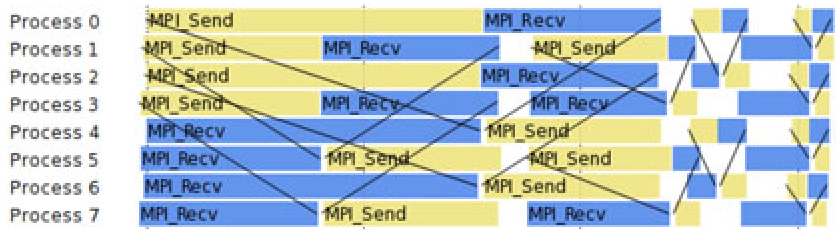 Figure: The process of moving from a complex message graph (b) to aligned logical steps (e, f).
3. Metric: Lateness vs. Differential Lateness
This is the "killer feature."
- Lateness (): How much later did this operation finish compared to the fastest peer in the same logical step?
- Differential Lateness (): How much new delay did this specific operation add, subtracted from the lateness it inherited from its predecessors?
Experimental Results: Finding the "Ghost" in the Machine
In a case study using the AMG2013 benchmark (a sparse linear solver), the authors used Ravel to spot a periodic lateness pattern.
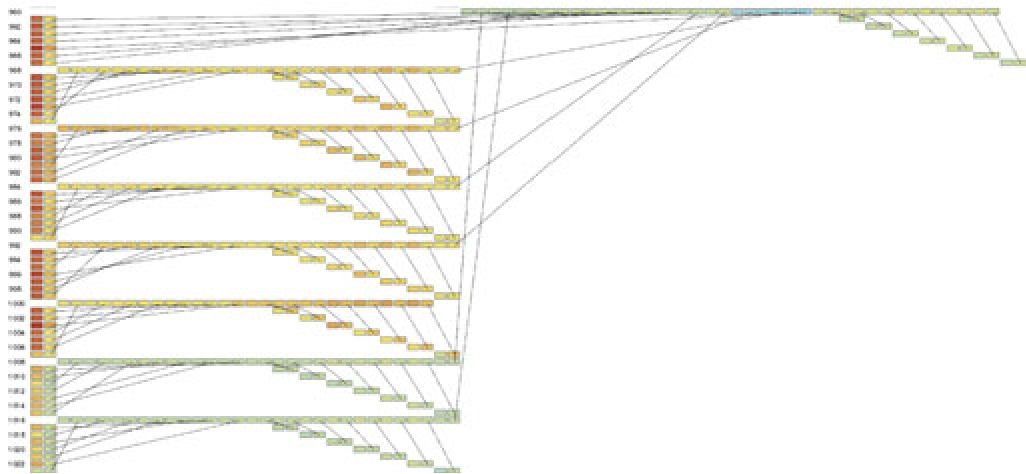 Figure: Visualizing AMG2013. The high differential lateness (darker colors) points directly to the bottlenecks.
By isolating an "aberrant" 12ms MPI_Waitall, they discovered it wasn't a network issue—it was an asynchronous progress bug in the MPI implementation. By simply toggling an environment variable (PAMID_ASYNC_PROGRESS), they eliminated the bottleneck entirely. This type of insight is nearly impossible to derive from standard wall-clock traces where the 12ms delay would be drowned out by the overall execution time.
Critical Analysis & Conclusion
Takeaway: The "Logical Structure" approach acts as a denoising filter for HPC performance engineering. It separates the "what happened" (physical time) from the "how it was supposed to happen" (logical structure).
Limitations:
- Asynchronous Complexity: The "happened-before" ordering struggles with highly non-deterministic asynchronous code where the logical order truly is chaotic.
- Memory Overhead: Matching millions of messages for the trace-to-graph conversion is still a significant memory bottleneck for the analysis tool itself.
Future Outlook: As we move toward Exascale computing, where jitters and OS noise become constant, tools that understand "Logical Intent" will no longer be a luxury—they will be the only way to keep parallel software sane.