
Cultural Failure: Why Engineering Alone Cannot Save Critical Infrastructure
The role of organizational culture and values in the performance of critical infrastructure systems
This paper investigates the critical role of organizational culture and values in the reliability of socio-technological infrastructure systems. Through a multidisciplinary lens, it posits that institutional resilience is as vital as physical robustness for preventing catastrophic cascading failures in critical services.
TL;DR
Infrastructure is more than pipes and wires; it is a socio-technological system where human organizations are the ultimate fail-safe or the primary point of failure. This paper argues that when organizational culture shifts its values from safety and reliability toward "efficiency" and "profit," it inadvertently recalibrates the system's tolerance for catastrophe. By using the Taylor-Russell diagram, the author demonstrates how management decisions shift threshold lines until "Normal Accidents" become inevitable.
The Blind Spot of Modern Engineering
We often discuss critical infrastructure—power grids, bridges, space shuttles—in terms of hardware. However, the real value lies in the services they provide. The author argues that our current models are dangerously incomplete because they ignore the "Institutional Resilience" of the organizations managing these assets.
The core irony of modern infrastructure management is the drive for "lean and mean" operations. While efficiency is a virtue in manufacturing, in critical systems, it often means capacity shedding: removing the "redundancy" that serves as the essential shock absorber for the society.
Methodology: The Geometry of a Disaster
The paper introduces the Taylor-Russell diagram to explain the invisible trade-off's managers make every day.
- Type I Error: Launching when you should have aborted (leads to catastrophe, e.g., Challenger explosion).
- Type II Error: Aborting when it was actually safe to launch (leads to lost time/money).
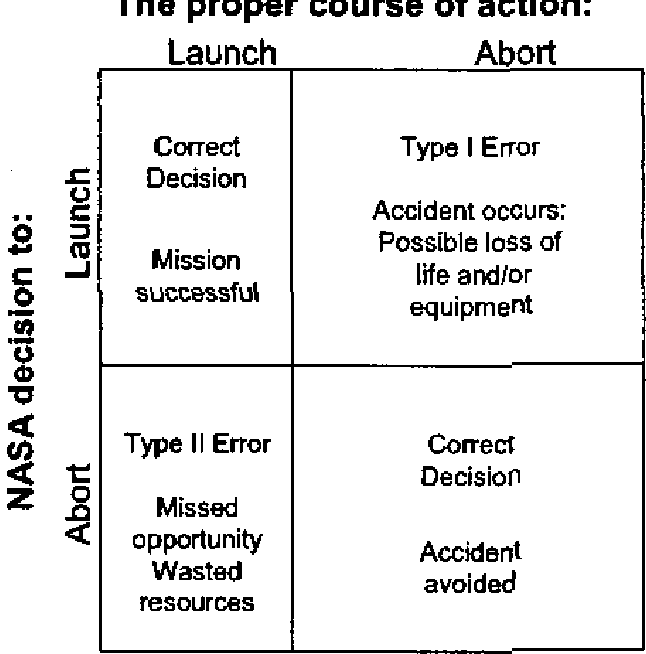
When an organization like NASA or a utility company faces pressure to reduce costs or "streamline," they move the decision threshold (the vertical line in the diagram) to the left to minimize Type II errors (wasted resources). The mathematical consequence is an automatic, often unseen, increase in the likelihood of a Type I error. The paper argues that both the Challenger and Columbia disasters resulted from this specific organizational shift, where known technical risks were "accepted" to maintain mission schedules.
Case Studies in Institutional Decay
The paper contrasts various disasters to highlight a recurring theme:
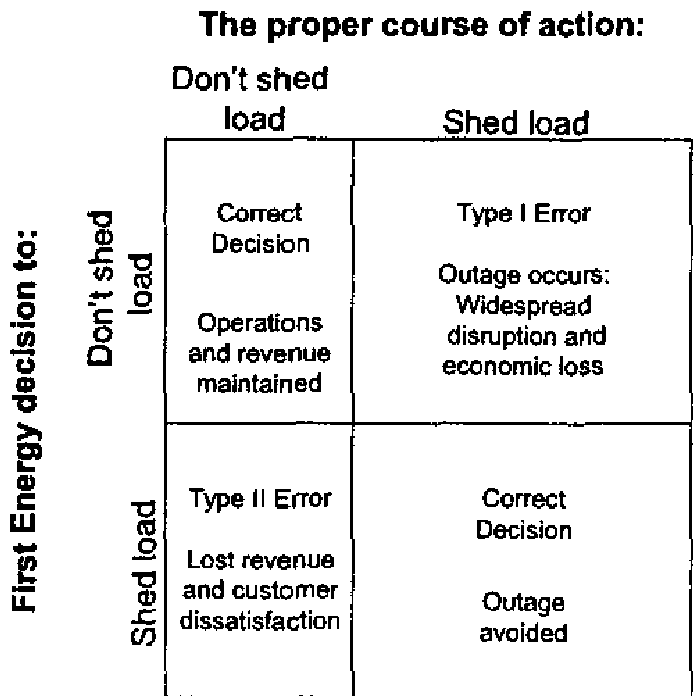
- The 2003 Northeast Blackout: Not a failure of power supply, but a failure of corporate policy. First Energy prioritized business concerns over national grid security, refusing to shed local load to save the larger system.
- Infrastructure "Lapses": Bridges like Mianus River and Schoharie Creek collapsed not because of "unknowable" physics, but because maintenance contracts were deleted due to budgetary concerns or poor inspection culture.
- The 9/11 Recovery: A rare positive example. New York City recovered quickly because its institutions—rich in "redundant" human experts and state-of-the-art equipment—possessed the institutional resilience to improvise and adapt.
Deep Insight: Normal Accidents vs. High Reliability
The author bridges two competing academic theories:
- Normal Accident Theory (NAT): Claims that in complex, tightly-coupled systems, accidents are "normal" and inevitable because we cannot predict every interaction.
- High Reliability Theory (HRT): Points to organizations (like aircraft carriers) that operate in high-risk environments with near-zero errors because their culture nurtures safety above all else.
The takeaway is clear: Resilience is a choice. An organization that views redundancy as "waste" is preparing for a "Normal Accident." An organization that views redundancy as "insurance" is building a High Reliability Organization (HRO).
Critical Analysis & Future Outlook
The paper concludes that we are currently in a dangerous trend of "decoupling" and "deregulation," which encourages infrastructure providers to discard the very buffers that prevent cascading failures.
Limitations: While the Taylor-Russell diagram is a powerful visualization tool, the paper acknowledges that it doesn't solve the political problem of how to fund redundancy in a profit-driven market.
Future Work: The author suggests the use of Agent-Based Modeling (ABM) to simulate how organizational culture affects the total socio-technological system. By modeling humans not just as "operators" but as "value-driven agents," we can better predict which organizations are brittle and which are resilient.
Conclusion: If efficiency becomes the sole motivating value of a safety-critical organization, devastating failures are no longer a matter of "if," but "when." We must design the organization as carefully as we design the bridge.