
Organizational Intrusion: Mapping the Shadows with Socialbots
Organizational Intrusion: Organization Mining Using Socialbots
The paper introduces a novel organizational mining method that combines social network crawling with stealthy socialbots to infiltrate and map the internal structures of target companies. By deploying "socialbot" accounts on Facebook, the researchers successfully bypassed privacy barriers, discovering up to 13.55% more employees and 18.29% more informal organizational links than public crawling alone.
TL;DR
In the era of digital transparency, your "Private" profile isn't as secure as you think. This paper demonstrates how socialbots—automated fake profiles—can systematically infiltrate organizations by exploiting social trust. By befriending employees on Facebook, the researchers successfully reconstructed informal corporate hierarchies, discovering nearly 20% more internal connections than traditional public data mining could ever reveal.
Context: The Vulnerability of Informal Links
Standard organizational charts tell you who reports to whom. However, the informal network—who grabs coffee with whom, or who shares mutual friends—often dictates the actual flow of power and information. While platforms like Facebook have improved privacy settings, they remain vulnerable to "Infiltration Attacks" where an adversary gains access to the "Friends only" data of an entire organization.
The "Trojan Horse" Strategy: Methodology
The researchers didn't just send random requests. They used a sophisticated multi-stage algorithm to bypass the Facebook Immune System (FIS) and maximize acceptance rates:
- Credibility Building: The socialbots initially targeted "random" users with over 1,000 friends to establish a high friend count, making the profile look popular and legitimate.
- Strategic Target Selection: They identified "Alpha" employees (those with the highest centrality) and sent the first wave of corporate requests to them.
- Mutual Friend Exploitation: Once a few employees accepted, the bot targeted their colleagues. The psychological hook of "Mutual Friends" drastically increased the success rate.
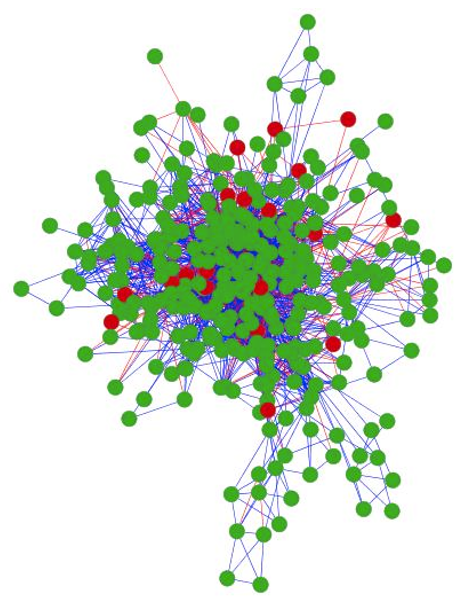 Figure 5: The progression of successful friend acquisitions over time, showing the bot's ability to accumulate organizational insiders effectively.
Results: Breaking the Privacy Barrier
The results were stark. By moving from a "Public" view to an "Infiltrated" view, the researchers gained a much higher resolution of the target companies.
- Node Discovery: They found up to 13.55% more employees who had hidden their workplace from the public but revealed it to "Friends."
- Link Mapping: They uncovered 18.29% more informal links.
- Cluster Analysis: Using the Markov Clustering Algorithm (MCL), they identified 25 distinct sub-groups (departments/social circles) in Organization O2, whereas public data only suggested 12.
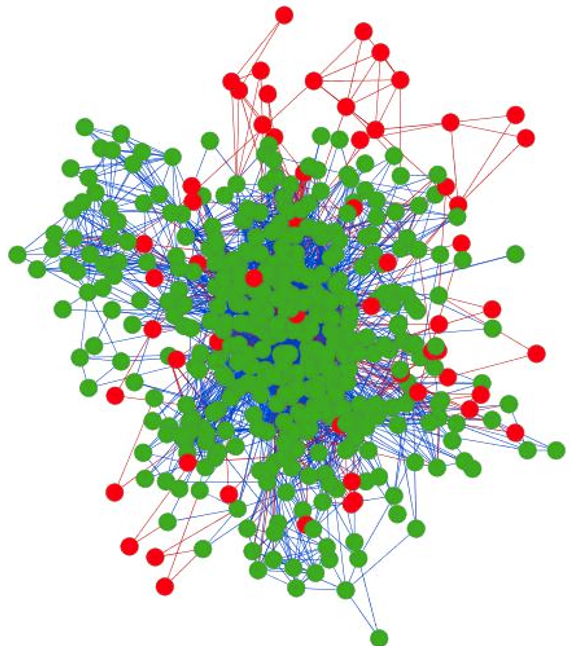 Fig. 4: Visualization of Organization O2 after infiltration. Red nodes and links represent data that was completely invisible to public crawlers.
Deep Insight: Is the Facebook Immune System Enough?
The paper highlights a critical cat-and-mouse game. While Facebook uses FIS (an adversarial learning system) to block accounts with low acceptance rates or suspicious IP patterns, the researchers bypassed this by:
- Limiting requests to 20 per day.
- Using static, dedicated IPs.
- Using "Non-threatening" profile pictures (puppies for male personas, obscured views for female personas) to avoid immediate facial recognition/rejection.
Conclusion & Critical Analysis
The study proves that the bottleneck for organizational security isn't just software—it's human psychology. Even with advanced AI defenses, the "Mutual Friend" heuristic remains a powerful bypass for social engineering.
Takeaway for Organizations: Standard cybersecurity (firewalls, VPNs) does nothing against socialbots. Companies must implement Social Media Hygiene training, as a single employee's "Accept" click can effectively leak the social graph of an entire department.
Limitations: The study was conducted in a specific era of Facebook's API and defense mechanisms. Today's challenges include more aggressive bot detection and multi-factor authentication, though the rise of Generative AI allows bots to hold complex conversations, potentially making them even more dangerous than the ones in this 2012-era study.