
Decoding Corporate Facebook Usage: From Strategic Tool to Malleable Playground
Providing Contextual Insights on the Organizational Usage of Public Social Network Sites -- The Case of Facebook
This paper performs a genre analysis of the organizational usage of Facebook by seven major German DAX corporations. It identifies 33 individual sub-genres clustered into seven top-level categories, revealing that while usage is increasing, it remains highly erratic and lacks a standardized strategic approach.
TL;DR
Is corporate social media usage a calculated strategy or an experimental shot in the dark? By analyzing seven German DAX giants, this study reveals that even the world’s largest organizations struggle with the "malleability" of Facebook. While they post frequently, their approach is often erratic, shifting between promotion and community-building without a clear, consistent roadmap.
The "Malleability" Trap: Why Corporations Struggle with SNS
In the world of Information Systems (IS), we usually deal with tools that have a dedicated purpose: ERP systems manage resources, and CRM systems manage customers. However, Social Network Sites (SNS) are what the authors call malleable technologies. They are open, flexible, and their "true nature" only manifests through user sense-making.
The pain point for organizations is that SNS lack an "instruction manual." Because the technology doesn't prescribe how it should be used, companies fall into a trial-and-error loop. This paper explores this tension: how do structured organizations handle unstructured, user-centric platforms?
Methodology: The Anatomy of a Post
The researchers utilized Genre Analysis, a framework that looks at two pillars of communication:
- Purpose: Why is this being posted? (e.g., to recruit, to sell, to build community).
- Form: How is it being posted? (e.g., video, link, status update).
They analyzed seven diverse industry leaders (BMW, BASF, MunichRe, etc.) and categorized thousands of posts into seven top-level "genres."
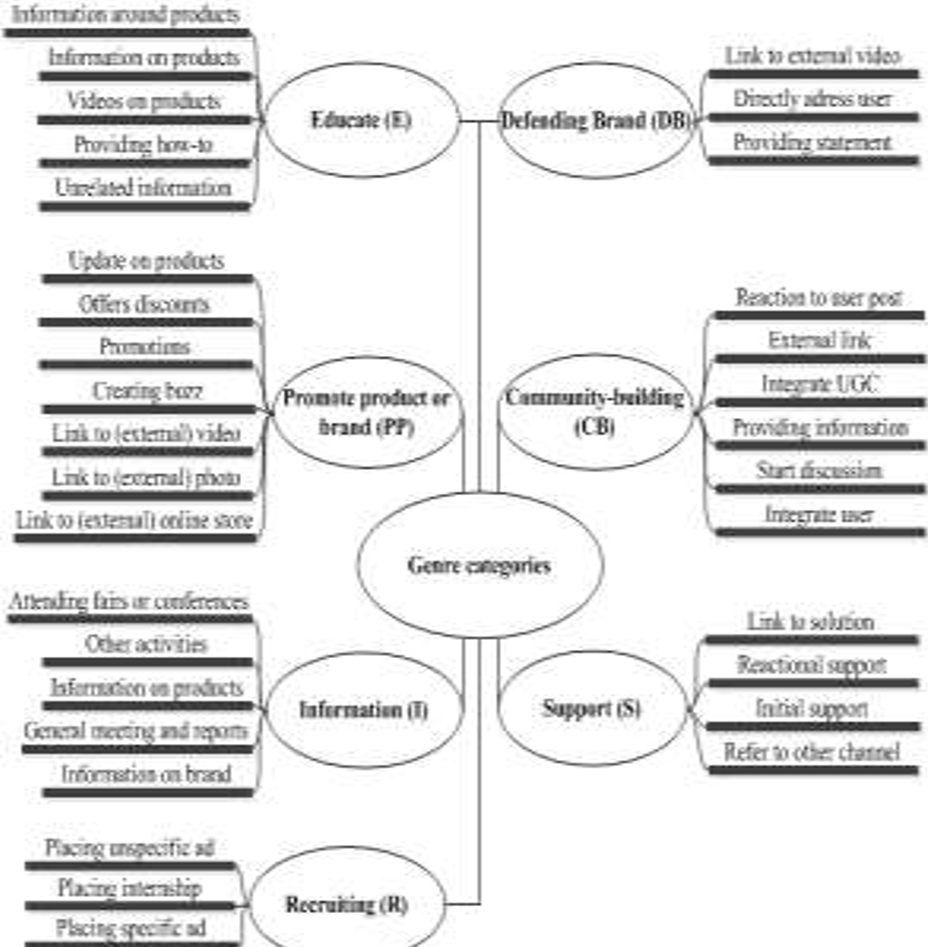
Key Findings: The Great Disconnect
The study discovered a massive gap between the "social" potential of Facebook and its "corporate" reality.
1. The Tripartite Distribution
Nearly 85% of all corporate activity is limited to three buckets:
- Community Building (29.5%): Keeping the lights on with general interest content.
- Information (28.8%): Passive updates on fairs, reports, and product specs.
- Promoting Products (25.8%): Traditional marketing masked as social content.
2. The Myth of the "Social" Organization
Despite Facebook being a two-way street, corporations are largely driving one-way buses. The data shows companies reacted to user comments in only 1% of posts. They are using a Web 2.0 tool with a Web 1.0 mindset—broadcasting rather than conversing.
3. Erratic Evolution
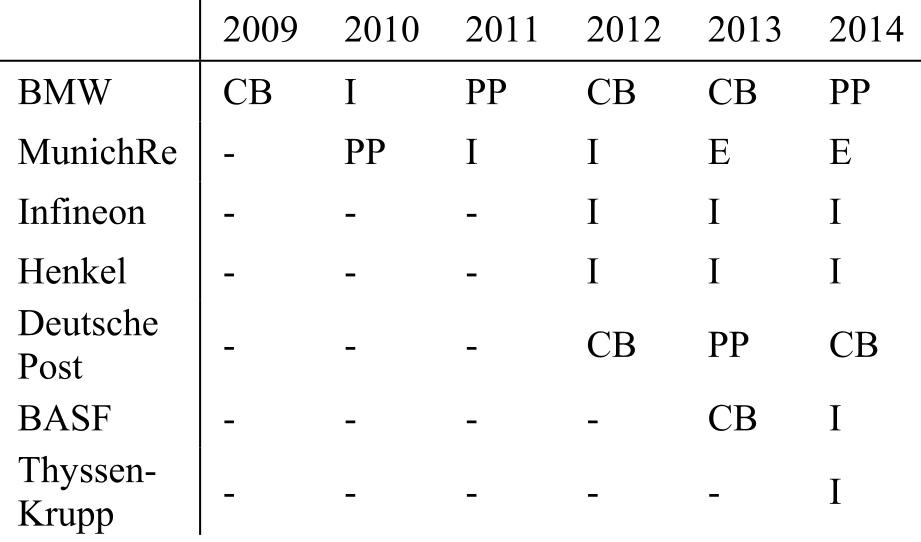
The most striking finding was the lack of consistency over time. As shown in the table below, companies like BMW and MunichRe frequently flipped their primary communication focus every year.
Deep Insight: Organizations as "New Players"
The paper argues that when organizations enter the SM ecosystem, they change the "socio" part of the sociotechnical system. They aren't just users; they are entities trying to impose a corporate context onto a personal space. This mismatch is why we see "erratic" behavior—organizations are constantly trying to find a "socially acceptable" way to be profitable in a space designed for friendship.
Critical Analysis & Future Outlook
While the study provides a robust snapshot of DAX companies, its focus is limited to Facebook. In today’s multi-platform world (Instagram, TikTok, LinkedIn), the "malleability" of technology is even higher.
The Takeaway? Social media success in a professional setting isn't about mastering the features; it's about mastering the context. Companies that treat SNS as a rigid marketing channel fail to capture the network effects and "bottom-up" energy that make social media powerful.
Future Research: We need to look inside the "black box" of the organization. How do internal hierarchies and approval processes dictate these "erratic" external posts? Only by understanding the internal social construction of the technology can we predict its external impact.