
Organizational Uses of the Crowd: Decoding the Framework of Modern Crowdsourcing
Organizational uses of the crowd: developing a framework for the study of crowdsourcing
This paper presents a grounded theory study that develops a multi-dimensional framework for understanding how established organizations leverage crowdsourcing. It categorizes the phenomenon into four primary organizational uses—Productivity, Innovation, Knowledge Capture, and Marketing/Branding—mapping them against specific crowd characteristics and organizational risks.
TL;DR
Crowdsourcing is no longer just a buzzword for outsourcing cheap labor; it is a sophisticated strategic tool for established enterprises. This paper provides a grounded theory framework that classifies crowdsourcing into four functional pillars: Productivity, Innovation, Knowledge Capture, and Marketing. By aligning these pillars with specific "crowd types" and "knowledge requirements," the research helps organizations navigate the trade-offs between speed, cost, and intellectual property.
Context: Beyond the Hype
In the early 2010s, companies like P&G and Netflix demonstrated that "the crowd" could solve problems that stumped internal experts. However, for most organizations, the "how" and "why" remained a black box. This study moves away from anecdotal success stories to build a formal theory, positioning itself as a foundational taxonomy for Information Systems (IS) research.
The Problem: The Mismatch Gap
The core challenge identified by Erickson et al. is the lack of alignment. Organizations often fail because they:
- Use the wrong crowd for specialized domain tasks (e.g., asking the general public for deep chemistry solutions).
- Underestimate organizational "buy-in" and the "Not Invented Here" syndrome.
- Struggle with the tension between transparency (necessary for external crowds) and secrecy (necessary for competitive advantage).
Methodology: The Emergent Framework
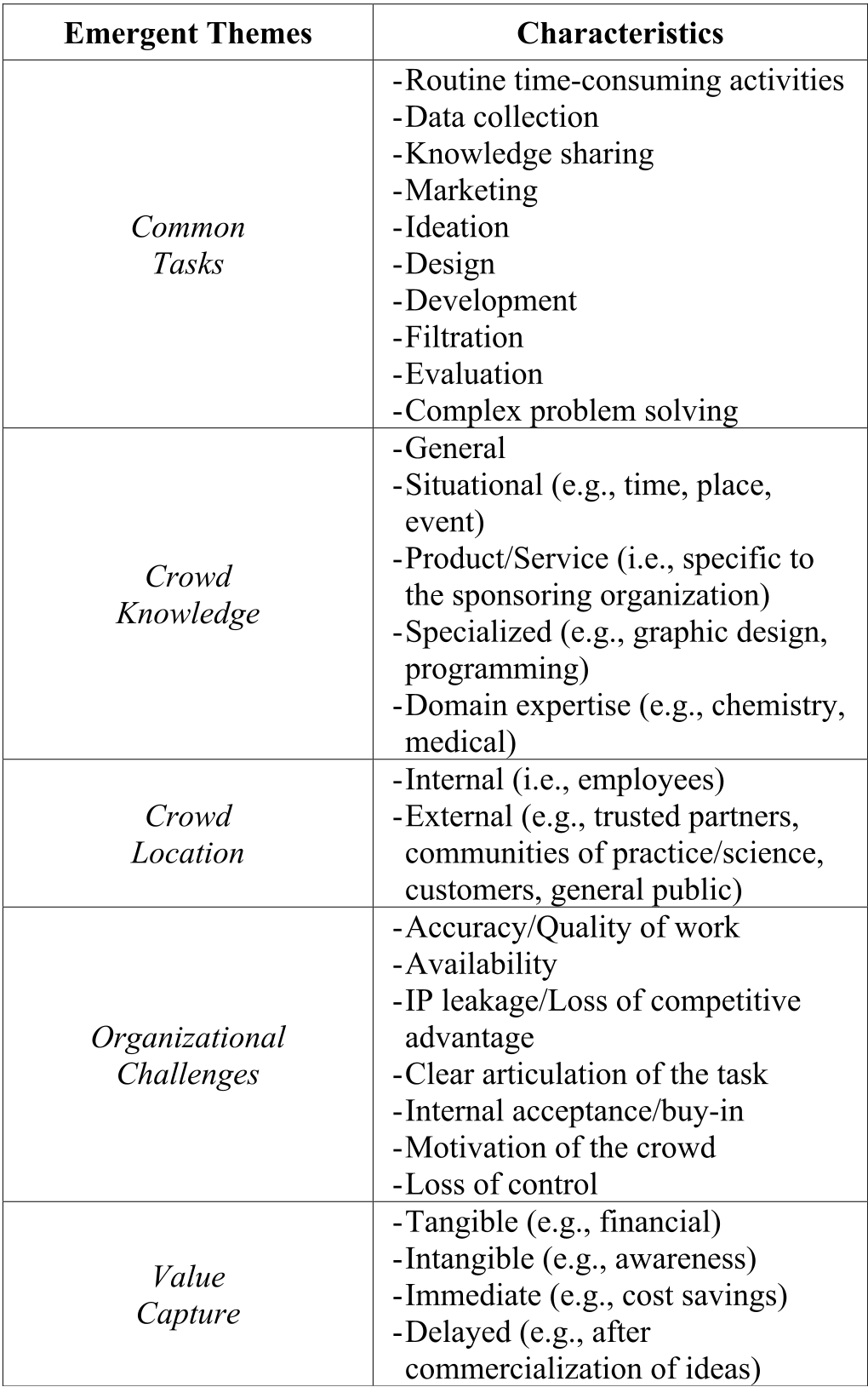
The researchers used Grounded Theory to extract patterns from both literature and 29 deep-dive interviews. The result is a dual-table framework that connects organizational motivations to operational realities.
1. The Five Recurring Themes
The authors identify five dimensions that define any crowdsourcing initiative:
- Tasks: From routine data tagging to complex R&D.
- Knowledge: Ranging from General (basic literacy) to Domain Expertise (PhD-level science).
- Location: Internal (employees) vs. External (customers, general public).
- Challenges: IP leakage, quality control, and motivation.
- Value: Tangible (money saved) vs. Intangible (brand loyalty).
Deep Dive: The Four Strategic Uses
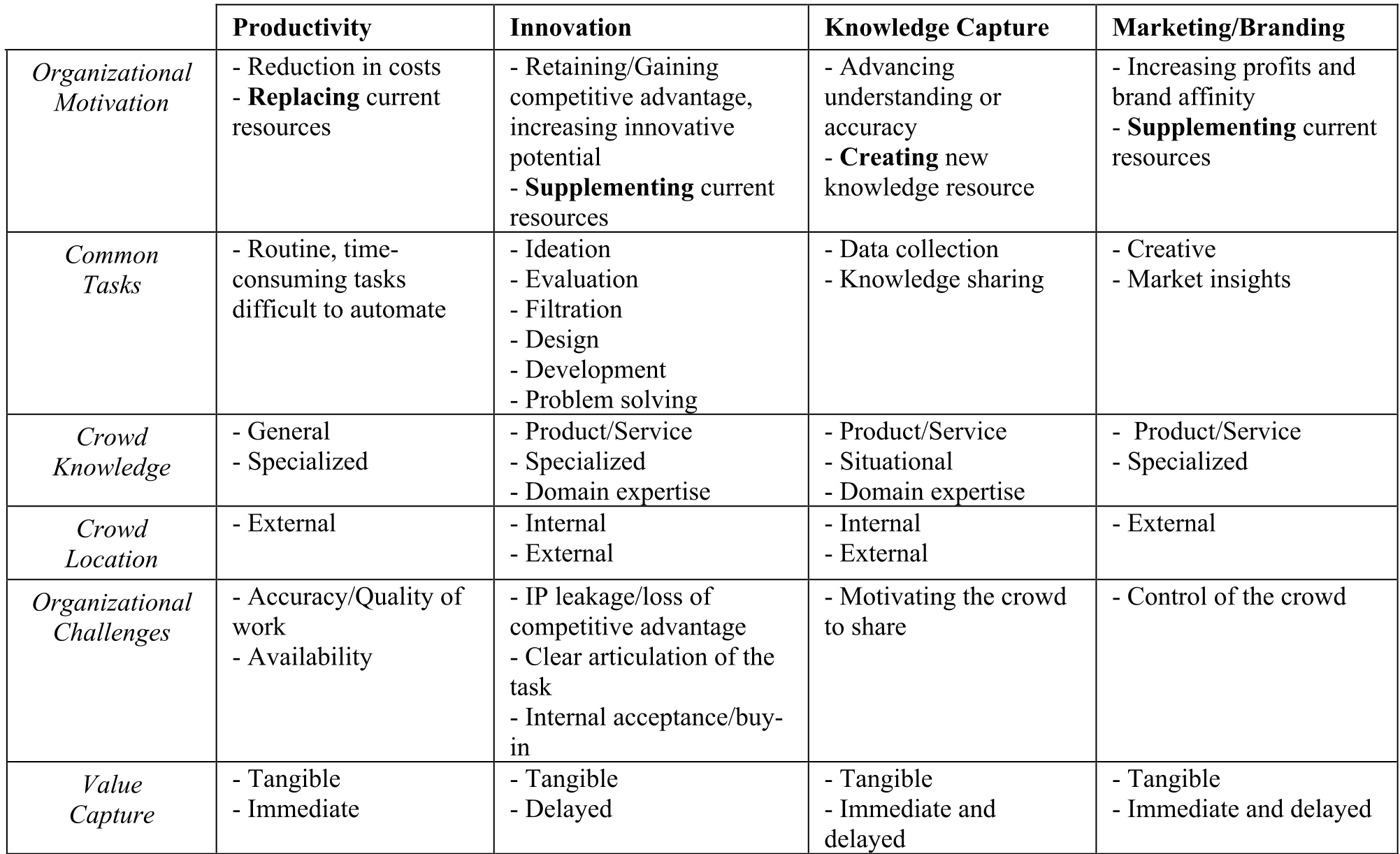
The brilliance of this paper lies in Table 2, which maps the four "Uses" to specific behaviors.
Productivity vs. Innovation
- Productivity is about efficiency. Organizations use external crowds for routine tasks. The goal is cost reduction, and the value is immediate.
- Innovation is about a competitive edge. Here, organizations often pivot to internal crowds or trusted partners to prevent IP leakage. The value here is delayed but potentially transformative.
Knowledge Capture vs. Marketing
- Knowledge Capture focuses on building a resource (like customer service wikis).
- Marketing uses the crowd for creative engagement, shifting control from the brand to the consumer to build "brand affinity."
Critical Insight: The Internal Crowd
One of the most valuable insights of this study is the emphasis on the Internal Crowd. While we often think of crowdsourcing as "the internet," many large firms leverage their own employees from disparate departments to solve problems. This mitigates the risk of losing control while still injecting "diverse perspectives" into silos like R&D.
Conclusion & Future Outlook
The framework presented by Erickson, Petrick, and Trauth provides a vital sanity check for any manager looking to "leverage the crowd."
Key Takeaways:
- Match the Knowledge to the Task: Don't use general crowds for domain-specific problems.
- Plan for Value Capture: Decide if you need immediate cost savings (Productivity) or long-term growth (Innovation).
- Acknowledge the Friction: Crowdsourcing requires internal cultural shifts and clear task articulation to succeed.
Note: As a "research in progress" at the time of publication, the authors suggest further testing is needed to move from a substantive theory to a formal theory of crowdsourcing.