
Scaling Social Influence: Efficient Event Organization Under Budget Constraints
Organizing an Influential Social Event Under a Budget Constraint
This paper addresses the Budget-Constrained Influential Social Event Organization (IEO) problem, which aims to select a group of influential users with specific features to maximize influence spread under a budget B. The authors propose IEO1 and IEO2, polynomial-time algorithms that achieve bi-criteria approximation ratios, significantly outperforming existing exponential-time methods.
TL;DR
Organizing influential social events requires balancing user features, influence reach, and strict budgets—a problem known as IEO. This paper moves beyond the limitations of uniform costs and exponential complexity by introducing surrogate optimization and lazy RR-set sampling. The result? Algorithms that scale to millions of nodes (like Orkut) in minutes while providing provable bi-criteria approximation guarantees.
Background: Beyond Simple Influence Maximization
Standard Influence Maximization (IM) asks: "Who are the most influential people?" The Influential Social Event Organization (IEO) problem is far more nuanced. It asks: "Who are the most influential people who also possess the specific skills/features needed for my event, all without exceeding a fixed monetary budget ?"
This adds "packing" (budget) and "covering" (features) constraints to an already #P-hard influence calculation. Previous SOTA methods (like PICS+) suffered from two fatal flaws:
- They assumed every user costs exactly "1", ignoring real-world heterogeneity.
- They used partition-based enumeration, leading to exponential time complexity that chokes on even medium-sized datasets.
Methodology: The Power of Surrogate Functions
The authors' core "aha!" moment is the construction of a surrogate optimization problem. Instead of juggling three separate constraints, they define a function that rewards both feature coverage and influence spread: where is the influence and is the number of target features covered.
1. The Binary Search Strategy (BiSearch)
By proving that is monotone and submodular, the authors transform IEO into a Submodular Set Cover (SSC) problem. They use a binary search over the possible influence values, solving an SSC problem at each step to find the minimum cost set that satisfies the surrogate threshold.
2. Lazy RR-Set Sampling
To avoid the #P-hard trap of calculating , they employ Reverse-Reachable (RR) sets. While IEO1 generates a massive batch of samples upfront, IEO2 (Lazy Sampling) generates samples only as needed, checking its progress via a "trial-and-error" mechanism.
(Note: Refer to Algorithm 2 and 6 in the paper for the specific BiSearch and RR-Set logic.)
Experimental Results: Scaling to the Millions
The performance gap between the proposed IEO2 and previous baselines is staggering. On the FX and Facebook datasets, IEO2 is orders of magnitude faster than PICS+.
On massive datasets like Orkut (3.1M nodes, 117M edges):
- PICS+: Time limit exceeded (12h+).
- IEO2: Terminates in minutes.
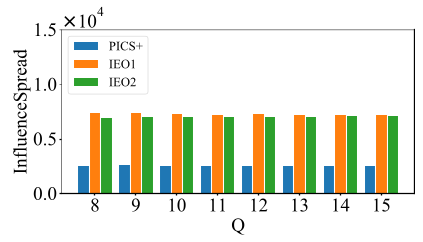 Fig 2: IEO1 and IEO2 maintain superior influence spread across Random, Feature, and PageRank cost models compared to baselines.
Robustness to Uncertainty
The paper also introduces Robust IEO, where the influence model is unknown or adversarial. By using a different surrogate function——they provide the first bi-criteria approximation for robust social event organization, achieving up to a 90% performance improvement over non-robust adaptations.
Critical Insight: Why Does This Work?
The success of this work lies in the bi-criteria approximation. The authors acknowledge that sticking strictly to budget while maximizing influence is impossible in polynomial time. By allowing a slight "stretch" in the budget (logarithmic in ), they unlock the ability to use greedy submodular optimization, which is the "gold standard" for scalability in graph algorithms.
Conclusion
This paper is a significant leap forward for Event-Based Social Networks (EBSNs). It bridges the gap between theoretical influence maximization and the practical, heterogeneous, and budget-constrained reality of marketing and political campaigns. For practitioners, the IEO2 algorithm represents a production-ready approach to navigating the complex social landscape.
Author Note: While the paper focuses on the Independent Cascade (IC) model, the methodology is largely model-agnostic and could potentially be applied to Linear Threshold models with minor adjustments to the RR-set generation.