
OrgBR-M: Navigating the Bibliographic Maze via Formal Concept Analysis
OrgBR-M: a method to assist in organizing bibliographic material based on formal concept analysis—a case study in educational data mining
This paper introduces OrgBR-M, a semi-automatic method utilizing Formal Concept Analysis (FCA) to systematically organize bibliographic material for literature reviews. By mapping domain concepts to scientific articles, the method generates conceptual lattices that reveal hierarchical relationships and research subdomains, specifically demonstrated through a case study in Educational Data Mining (EDM).
TL;DR
The explosion of scientific literature makes manual organization a bottleneck for researchers. OrgBR-M (Organization of Bibliographic References Method) addresses this by applying Formal Concept Analysis (FCA). It transforms a collection of papers and expert-defined domain concepts into a hierarchical "lattice," allowing researchers to visualize how different topics intersect and where new research trends are emerging.
The Problem: Information Overload vs. Human Insight
Conducting a literature review is often an exercise in frustration. Researchers typically face two extremes:
- Manual Tagging: High accuracy but low scalability and prone to inconsistency.
- Black-box Algorithms: Latent Semantic Analysis (LSA) or clustering that finds "similarity" but lacks the structured logic an expert requires.
The authors argue that existing methods miss the "Human-in-the-loop" necessity. We don't just need to find similar papers; we need to understand how Domain Abstractions (like "Pedagogical Strategy" vs. "Student Behavior") relate to one another in a formal hierarchy.
Methodology: The Power of the Lattice
The heart of OrgBR-M lies in the transition from a Formal Context to a Conceptual Lattice.
1. Conceptual Modeling (Sphere-M)
Before a single paper is processed, the expert identifies the "Ceiling" (general concepts) and "Floor" (specific entities) of the field. This prevents the "noisy term" problem common in standard text mining.
2. The FCA Engine
By treating papers as Objects and domain concepts as Attributes, the method uses the mathematical derivation of FCA.
- Extent: The set of objects sharing properties.
- Intent: The set of properties shared by objects.
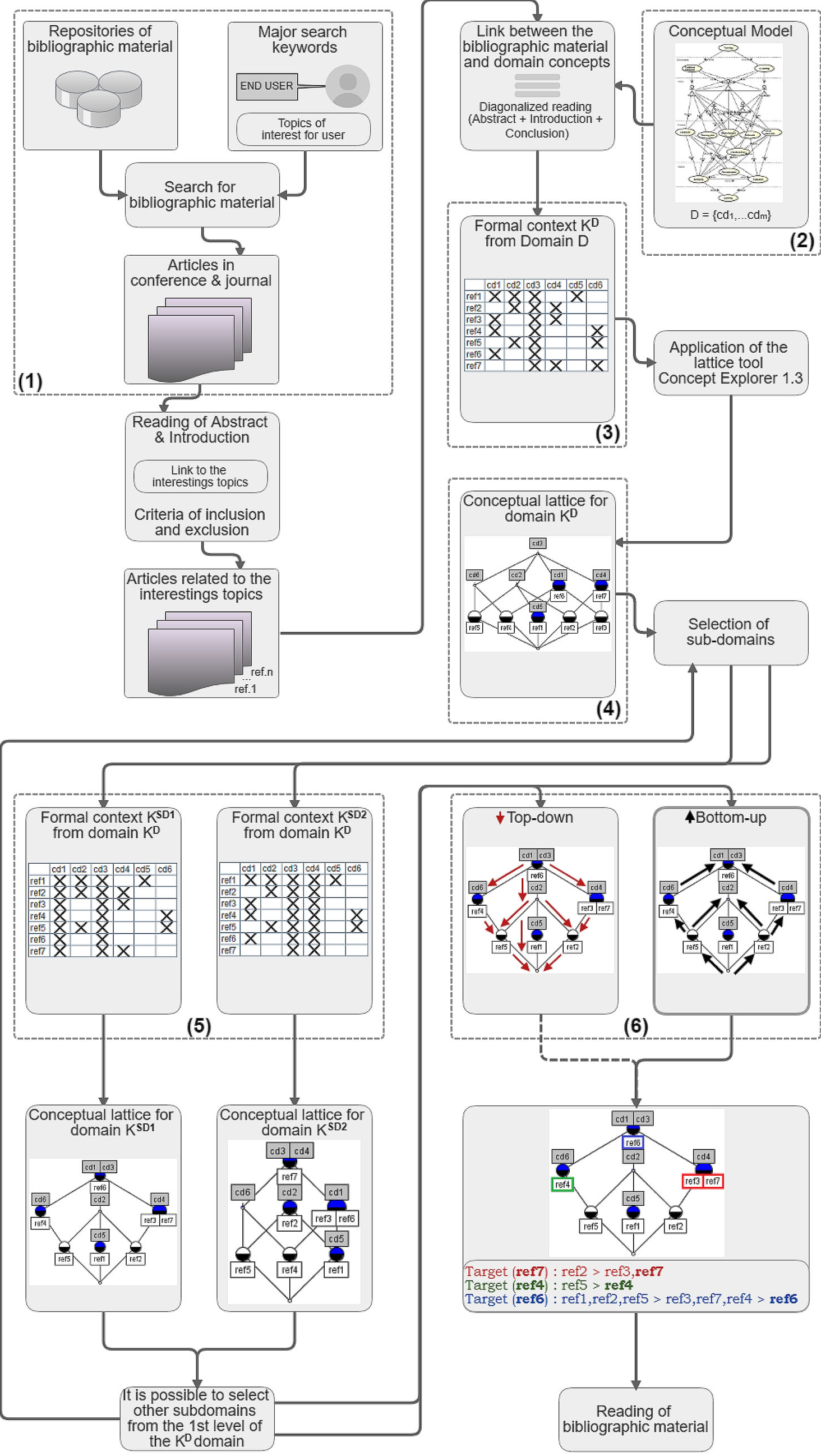
The resulting lattice (a directed acyclic graph) allows for a Top-Down Analysis, ensuring a fluid movement from general overview to specific sub-niches without redundant reading.
Case Study: Educational Data Mining (EDM)
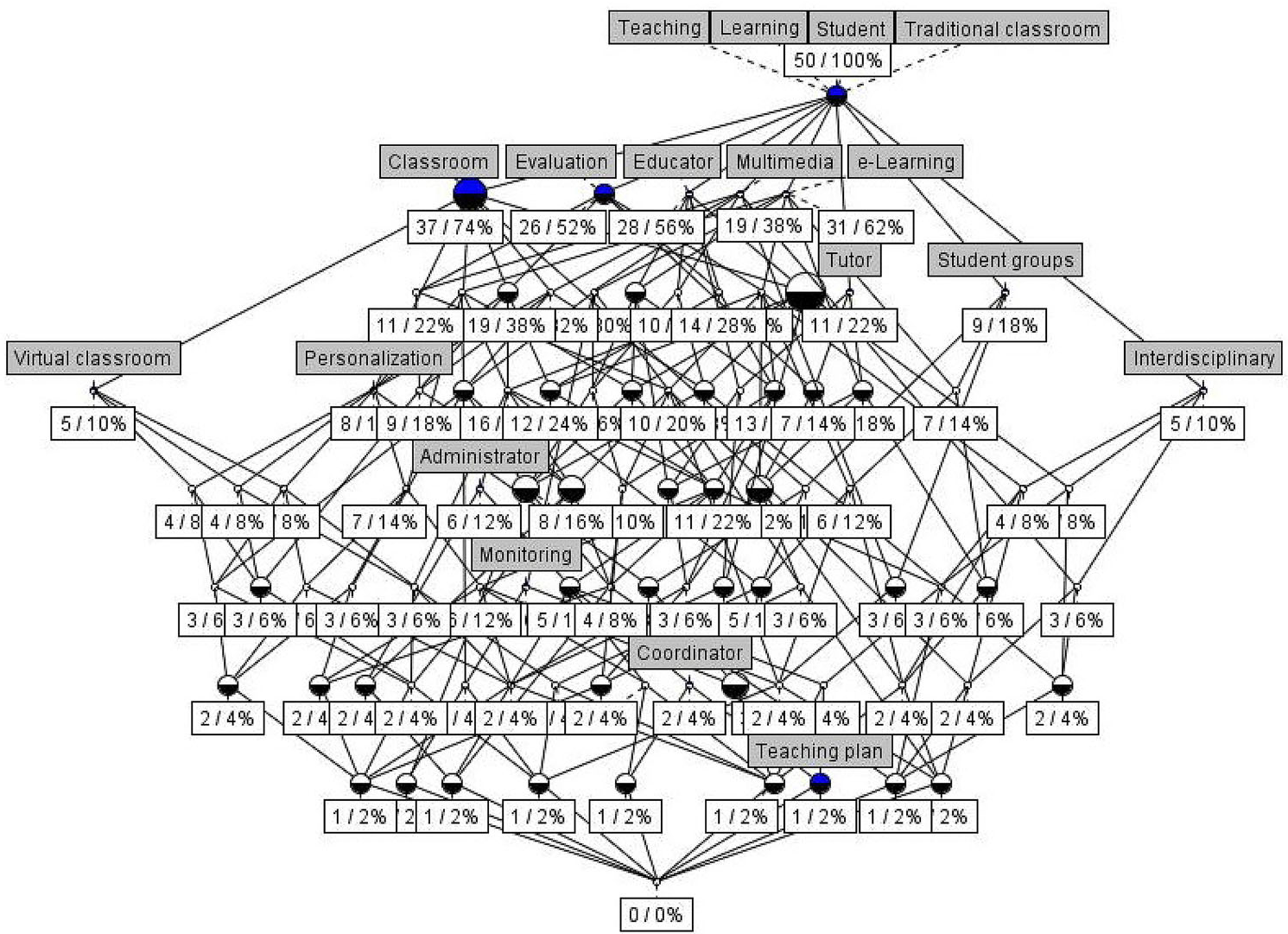
The authors applied OrgBR-M to 50 key papers in EDM. The lattice revealed five major subdomains. By analyzing the "Labeled Formal Concepts," the researchers could identify specific research directions, such as:
- Smart Classrooms: Using facial recognition and IoT.
- Hybrid Models: Merging conventional and virtual environments.
Evaluation Metrics: Measuring Knowledge Density
The paper introduces several formal metrics to evaluate the state of a research field:
- Generality vs. Specificity: Does the collection cover a broad range of topics or a specific niche?
- Completeness: Are there domain concepts that have no papers attached? (This identifies research gaps).
- Density: How interconnected are the topics?
Critical Insight & Performance
While FCA is powerful, it faces "combinatorial explosion" in high-dimensional spaces. The authors' benchmarks show that for specialized contexts (e.g., 50 papers with 20 concepts), performance is instantaneous. However, as the number of objects grows to 400+, the complexity spikes, requiring offline processing.
| Metric | Traditional Classroom | e-Learning Subdomain |
|---|---|---|
| Generality | 0.78 | 0.72 |
| Density | 0.43 | 0.34 |
| Dispersion | 0.80 | 0.43 |
Conclusion: A Roadmap for Future Reviews
OrgBR-M effectively bridges the gap between expert intuition and mathematical rigor. By visualizing the "landscape" of a field, it doesn't just categorize papers—it reveals the structure of knowledge itself. For PhD students and tech leads, this offers a structured way to justify "why" a certain research gap exists and "how" different sub-fields are pivoting.
Future Outlook: Integrating LLMs (Large Language Models) to perform the initial "Binding" of documents to concepts could make OrgBR-M a fully automated, yet expert-steerable, research assistant.