
Orientation in Social Networks: Decoding the Intimacy Mechanism of the Small-World Phenomenon
Orientation in social networks
This paper introduces an "Intimacy Degree" based approach for navigation in complex social networks, addressing the "six degrees of separation" phenomenon. By reconstructing nodes' intimacy attributes through local interactions, the authors enable efficient search without requiring global network structures.
Executive Summary
TL;DR: This paper tackles the classic "six degrees of separation" problem by proposing an intimacy-based orientation algorithm. Instead of relying on global coordinates, nodes learn their "intimacy" with the rest of the network through local message passing, allowing for efficient decentralized search that effectively bypasses the need for high-degree hubs.
Positioning: This work moves beyond purely structural small-world models (like Watts-Strogatz) by focusing on the navigability of these networks. It acts as a bridge between abstract graph theory and the empirical observations that individuals can find short paths using only local, social information.
Problem & Motivation: The Puzzling Efficacy of Human Search
Stanley Milgram’s 1960s experiments proved that the world is small, but the real mystery remains: How do individuals find these short paths without a map?
Existing models, such as Kleinberg’s, require specific lattice structures or geographic knowledge. However, in real social networks, information like "profession" or "interests" acts as a proxy for closeness. The authors argue that these attributes are not just "extra" data—they are fundamentally encoded in the network topology itself. The challenge is to recover this latent "intimacy" using only local interactions to guide navigation.
Methodology: Reconstructing Intimacy Vectors
The core innovation is the Intimacy Degree. Each node is assigned an -dimensional vector , where represents how "intimate" node is with node .
1. The Local Interaction Algorithm
The vectors evolve through a three-step iteration:
- Aggregation: A node sums the intimacy vectors of all its immediate neighbors.
- Normalization: All elements (except the self-intimacy) are rescaled so their sum equals 1.
- Self-Reinforcement: The node’s intimacy with itself is reset to a constant .
As the vectors converge, the researchers discovered a critical mathematical property: Intimacy degree decays exponentially relative to the shortest path length. This provides the "gradient" necessary for greedy routing to succeed.
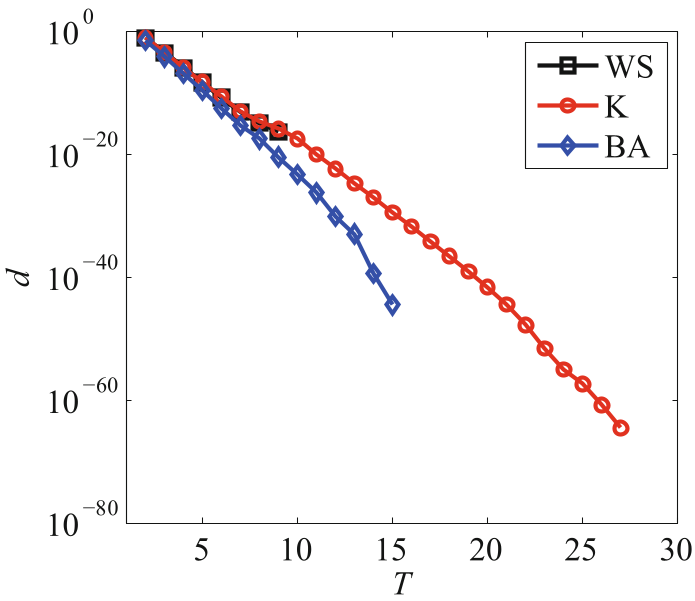 Figure 1: Illustration of how intimacy information propagates across the network over time.
2. The Orientation Process
When a node holds a message for target , it looks at the intimacy vectors of all its neighbors and forwards the message to the one with the highest .
Experiments & Results: Efficiency and Hub Limitations
The authors tested the algorithm on three classic artificial network types: Watts-Strogatz (WS), Kleinberg (K), and Barabási-Albert (BA).
Key Findings
- Search Performance: The algorithm successfully finds paths very close to the theoretical shortest path (high accuracy) across different topologies.
- The Hub Paradox: Real-world experiments suggest that "hubs" (nodes with massive degrees) aren't as important as one might think for social search. The authors prove that intimacy decays inversely to the degree of the intermediate node, explaining why "weak ties" or intermediate connections are often more effective than simply finding a "local celebrity."
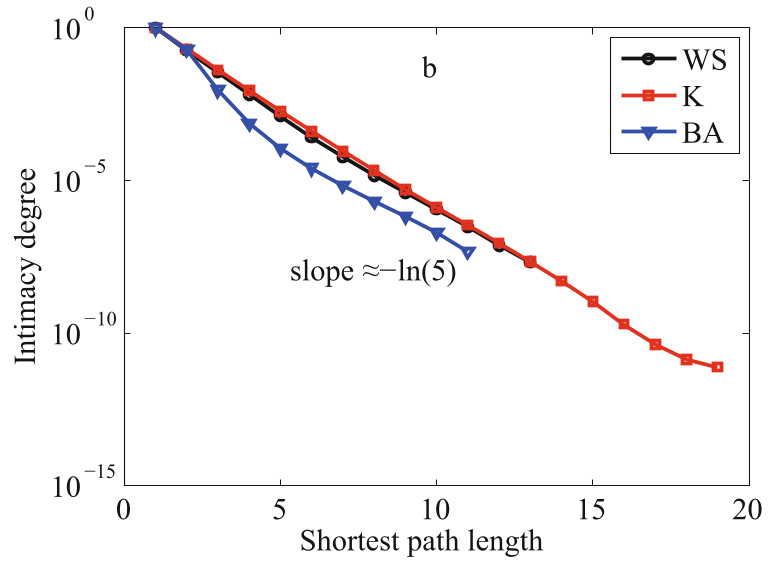 Figure 3: Numerical results showing search success and accuracy in various network models.
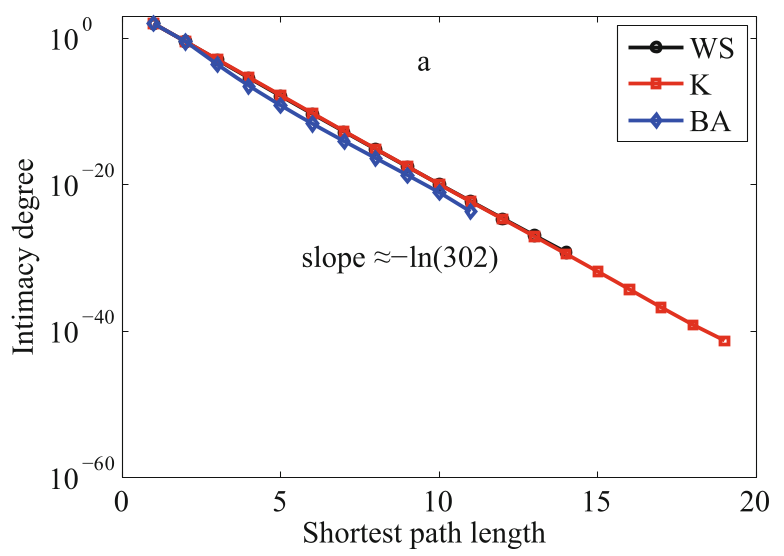 Figure 2: Statistical evidence showing that intimacy degree declines exponentially as the shortest path length increases.
Critical Analysis & Conclusion
Takeaway: The study proves that network topology implicitly contains enough information to guide efficient search, provided nodes can "learn" their proximity to others through their neighbors. This decentralized orientation removes the need for global knowledge.
Limitations:
- Space Complexity: Requiring every node to store an -dimensional vector is costly ( total for the system).
- Dynamic Networks: The current model assumes a static topology during the vector evolution phase.
Future Outlook: By integrating community detection, the vector size could be compressed, making this a viable candidate for large-scale peer-to-peer (P2P) routing and autonomous traffic navigation systems where global maps are unavailable or too dynamic to maintain.