
Turning Social Streams into Data Stories: Evolution of the University Fabric
Orienting Social Event Streams as Data Stories
The paper presents a comprehensive data pipeline and dashboard system designed to transform social media event streams into "data stories." By analyzing Twitter data from a university community, the authors implement a social-affiliation network model to monitor community evolution and micro-community dynamics over time.
TL;DR
This paper introduces an intelligent system designed to monitor and visualize the social development of a university community. By crawling Twitter traces and applying social-affiliation network analysis, the authors track how relationships form around institutional "foci" (clubs, departments) and use data storytelling to render these complex interactions as intuitive, evolving narratives.
Background: The Social-Affiliation Perspective
In the age of digital transformation, an institution's heartbeat is often found in its online interactions. While most prior work treats social networks as simple user-to-user graphs, this research adopts a Social-Affiliation Network model. In this paradigm, nodes represent both individuals and their affiliations (Social Clubs, Academic Departments). This dual-nature graph allows for a deeper understanding of Homophily—the tendency of individuals to associate with similar others—and the mechanics of community growth.
Methodology: The Three-Stage Pipeline
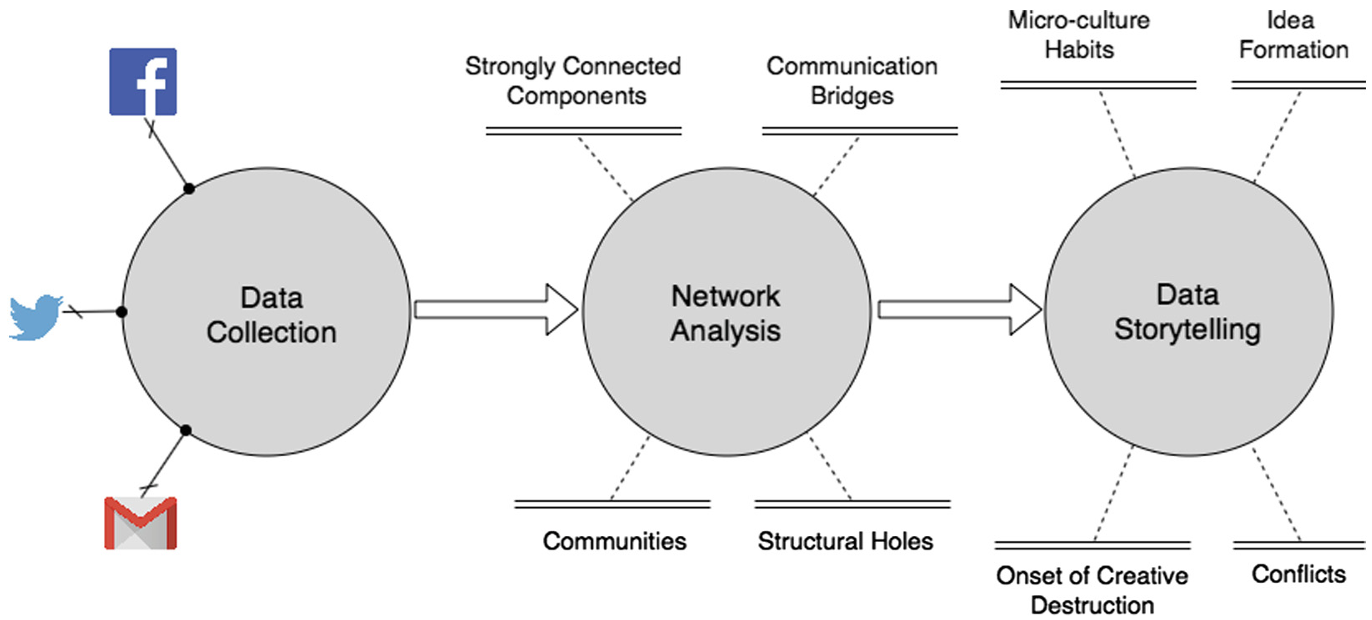
The authors propose a robust architecture consisting of three layers: Data Collection, Network Analysis, and Data Storytelling.
1. Validated Crawling
To ensure data integrity, the system doesn't just crawl randomly. It uses a set of "ego nodes" (official university accounts) and a text-based membership score based on Levenshtein distance to validate that users actually belong to the community.
2. The Dynamics of Closure
How do links form? The study explores three specific closure processes:
- Triadic Closure: Two people becoming friends through a mutual friend.
- Focal Closure: Two people becoming friends because they share a common affiliation (e.g., both are in the same student club).
- Membership Closure: An individual joining an affiliation because their friends are already part of it.
Experiments & Results: Debunking Language Barriers
One of the most compelling findings of this study is the analysis of Homophily by Language. The authors compared the "observed" heterogeneity (links between people using different primary languages) against a "theoretical limit" ().
| Network Type | Observed Heterogeneity | Theoretical Limit () |
|---|---|---|
| Social-Affiliation Network | 0.48 | 0.38 |
| Social Network | 0.52 | 0.39 |
Since the observed values were higher than the theoretical limit, the study proves that the university community is effectively multi-cultural, with users actively forming links across language barriers rather than clustering only with those who speak the same language.
Deep Insights & Future Work
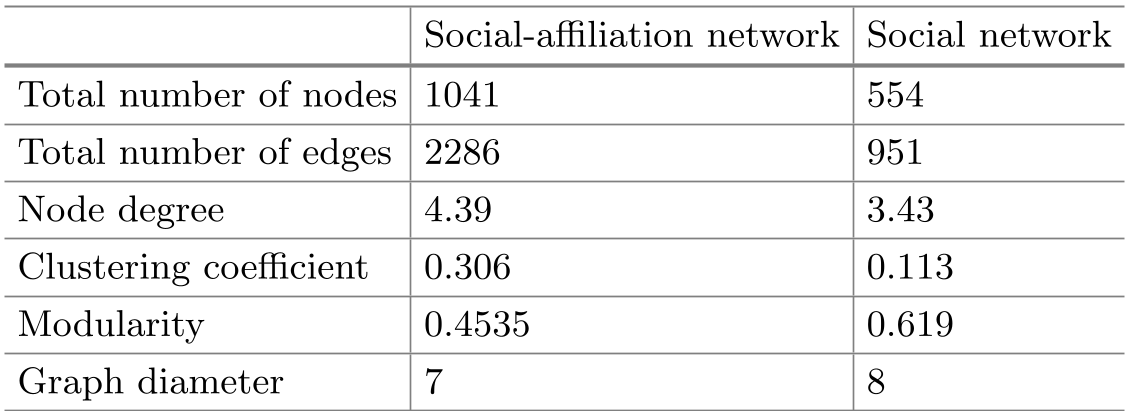
The research highlights that the Social-Affiliation Network has a smaller diameter (7) compared to a pure Social Network (8). This implies that institutional "foci" act as bridges, making the community "smaller" and more connected.
However, the authors acknowledge that their current storytelling capability is "primitive," focusing largely on static visualization. Future iterations aim to include Smart Overlays to detect "calls for change" and visualize the flow of influence through local bridges—the individuals who connect separate micro-communities.
Conclusion
This work serves as a blueprint for universities and large organizations to move beyond simple "social listening" toward "social understanding," turning volatile event streams into structured, actionable data stories.