
Out of Control: Why Permaculture is the Future of Sustainable HCI
Out of control: reframing sustainable HCI using permaculture
This paper introduces "Permaculture" as a theoretical alternative to the dominant "Control and Correction" paradigm in Sustainable Human-Computer Interaction (SHCI). By analyzing ethnographic fieldwork of contemporary agricultural practices in Taiwan, the authors propose a shift from persuasive technology toward a model of human-nature collaboration and care.
TL;DR
Sustainable HCI is currently obsessed with control—tracking your steps, monitoring your thermostat, and "correcting" your bad habits. This paper argues we need to let go. By looking at radical farmers in Taiwan who embrace "pests" and "waste," the authors show that true sustainability comes from working with nature, not trying to outsmart it.
The Problem: The "Correction and Control" Trap
For years, the SHCI community has viewed sustainability as an awareness and persuasion problem. The logic goes like this: if we sense enough data and provide enough "eco-feedback," we can persuade users to optimize their lives.
The authors argue this creates a narrow version of sustainability that:
- Over-emphasizes individual choice while ignoring macro societal structures.
- Treats nature as an object to be managed rather than a partner to collaborate with.
- Ignores the messy reality of everyday life in favor of sterile metrics.
Methodology: Permaculture as a New Framework
To break this cycle, Liu et al. turn to Permaculture (Permanent Agriculture). Unlike industrial farming which uses "warfare" tactics (pesticides, heavy machinery), permaculture emphasizes:
- Collaboration: Humans as one actor among many.
- Care: Maintaining, repairing, and returning surplus to the environment.
The authors conducted ethnographic fieldwork in two Taiwanese townships, Pinglin and Yuanshan, to see how these theories look in practice.
Case Study 1: The Beauty of "Infection"
In Pinglin, tea farmers produce "Oriental Beauty" tea. Remarkably, the honey-like aroma of this expensive tea is triggered by the Jacobiasca Formosana—a tiny leafhopper insect that bites the leaves.
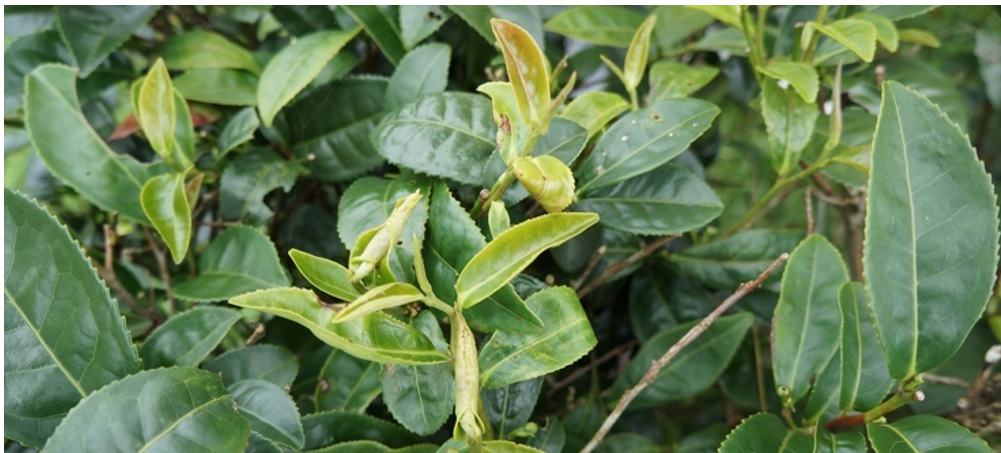 Figure 1: Leaves damaged by insects (yellow and stunted) are actually the source of the tea’s unique value.
The Insight: Instead of using pesticides to "control" the pests, farmers relinquish control. They allow the bugs to bite the crops, which triggers a chemical defense in the tea plant that creates the flavor. This is a Natureculture—a successful collaboration where the human, the bug, and the plant all play vital roles.
Case Study 2: The Logic of "Waste"
In Yuanshan, rice farmers Jeff and Sophia use unique bamboo racks for threshing grain. They deliberately leave some grain on the stalks instead of harvesting every last bit.
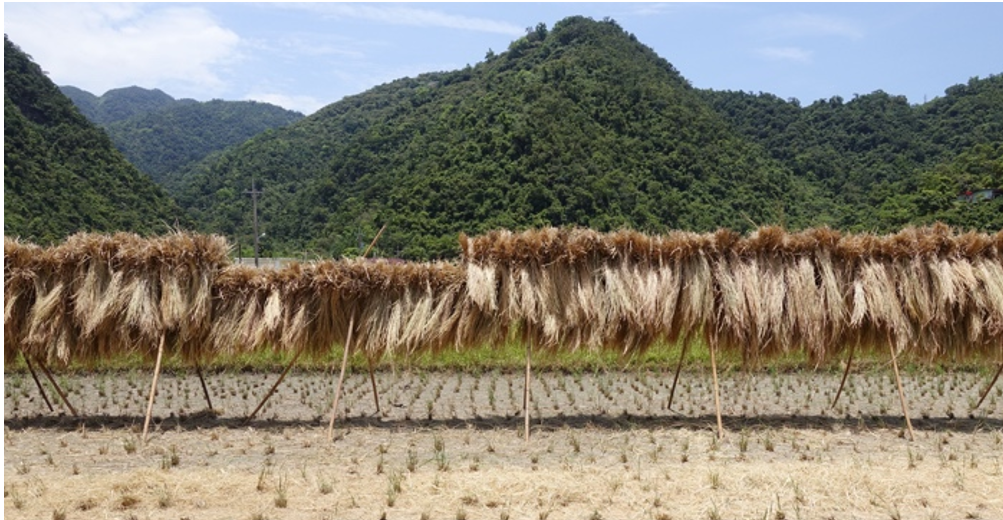 Figure 2: Custom bamboo racks designed to hold straw so birds can feed on leftover grains.
The Insight: What looks like "inefficiency" is actually a Return of Surplus. By feeding the birds, the farmers maintain the local ecosystem. They act as "gardeners" rather than "industrialists," shifting the focus from labor efficiency to the ethics of care.
Critical Insight: Beyond Aesthetic Order
One of the most profound points in the paper is about Aesthetics. Industrial agriculture looks "clean" and "ordered"—neat rows, no weeds. Permaculture looks "messy," "dirty," and "out of control."
The authors challenge HCI designers to rethink their own "aesthetic of order." Does a sustainable system have to look like a clean dashboard of graphs? Or can it be something more organic, complex, and human?
Conclusion and Future Outlook
This paper isn't just about farming; it's a manifesto for a new kind of HCI.
- Takeaway: We must stop designing systems that treat users like problems to be fixed.
- The Shift: Move from persuasion (you should do this) to cultivation (how can we grow this together?).
Limitations: The authors admit that permaculture-based farming is currently "risky" and often requires the farmer to have a safety net (like a prior career in tech). The challenge for the future is how to scale these "messy" collaborations into mainstream technology and policy.
By reframing our role from "masters of the machine" to "gardeners of the ecosystem," we might finally find a version of sustainability that actually lasts.