
Towards an Overarching Classification Model of CSCW: Bridging the Social and the Technical
Towards an overarching classification model of CSCW and groupware: a socio-technical perspective
The paper presents an overarching socio-technical classification model for Computer-Supported Cooperative Work (CSCW) and groupware. It synthesizes decades of taxonomic research into a unified framework that interrelates the "3C model" (Communication, Coordination, Cooperation) with technological requirements, group dynamics, and awareness mechanisms.
TL;DR
This paper addresses the long-standing fragmentation in how we classify collaboration technologies. By performing a meta-review of literature spanning 25 years, the authors propose a unified socio-technical model. This model moves beyond simple "when and where" (Time/Space) and dives into the "how and why" of human interaction, providing a rigorous framework for designing the next generation of socially-aware groupware.
Problem & Motivation: The Gap Between Code and Context
In the world of Computer-Supported Cooperative Work (CSCW), there has always been a "Great Divide." On one side, we have Social Scientists focused on the nuances of group dynamics and human behavior. On the other, we have Software Engineers building tools based on technical specifications.
Existing taxonomies—like the famous Time/Space matrix—were revolutionary in their day but are now too simplistic for modern, polymorphic work environments. The authors argue that current models lack standardization, leading to "vagueness" in requirements that often results in the failure of collaboration projects.
Methodology: Digging Through the Taxonomic Anthology
The researchers conducted a systematic meta-analysis of key taxonomies from 1984 (a landmark year for CSCW) to 2009. They didn't just look at what the systems do, but how they are classified across several dimensions:
- The 3C Model: Communication, Coordination, and Cooperation.
- Group Issues: Size, composition, and task types.
- Technical Criteria: Scalability, hardware, and software architectures.
Historical Context of CSCW Taxonomies
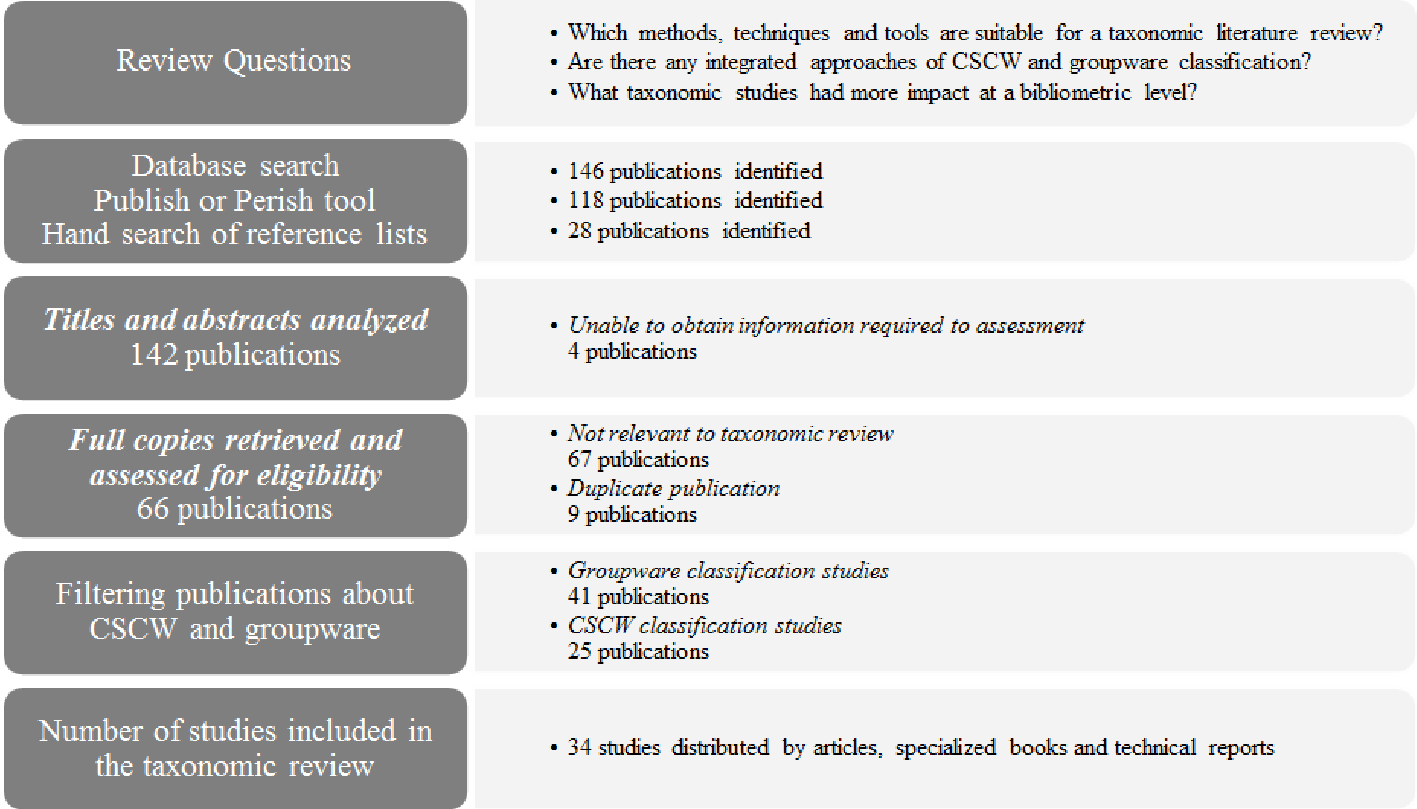 The image above illustrates the evolution of taxonomic focus, showing a growing interest in CSCW characteristics over time.
The Core: The Socio-technical Classification Model
The authors propose a new hierarchical model that integrates these disparate views. At its heart is the realization that Collaboration is a cycle bounded by Awareness.
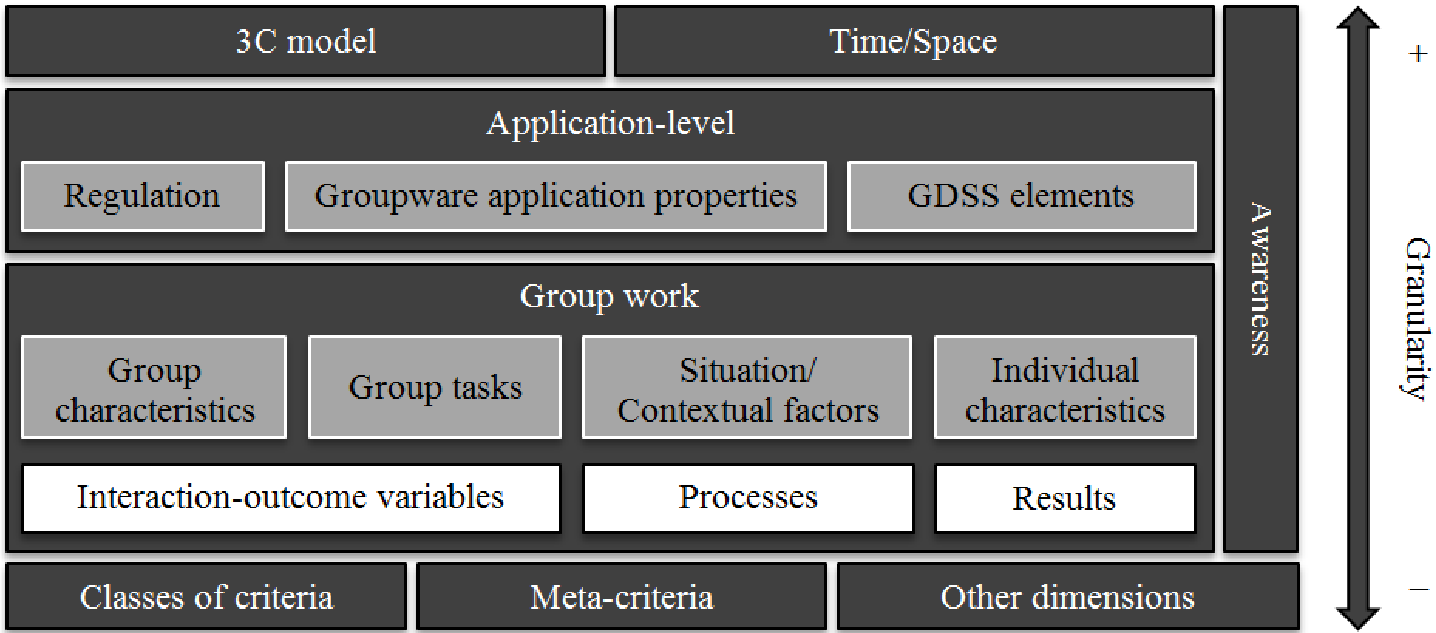
Key Components of the Model:
- The 3C Cycle: Communication (the exchange of information), Coordination (managing interdependencies), and Cooperation (working toward a shared goal).
- Awareness Pillars: Perception of what others are doing is crucial for reducing "work losses."
- Regulation Mechanisms: Rules and roles that ensure group activities align with ultimate goals.
- Granular Context: Distilling technical requirements down to "session persistence," "audio/video delay," and "floor control."
Critical Insight: Why This Matters
The most striking takeaway from the authors' meta-analysis is the "Bibliometric Evidence." High-impact papers like Ellis et al. (1991) and Grudin (1994) succeeded because they captured the social phenomenon of work, not just the technical stack.
The authors point out that while interest in "HCI" and "3C characteristics" is rising, "Group Issues" (like leadership and hierarchy) are being neglected in recent literature. This is a blind spot: you cannot build effective tools if you ignore the power structures and personal backgrounds of the people using them.
Conclusion & Future Outlook
The proposed model isn't just a theoretical exercise; it’s a blueprint for Collaboration Engineering. It allows organizations to evaluate existing tools and identify what’s missing—be it better "Awareness Indicators" or more "Flexible Regulation."
Limitations: The model is primarily based on a review of existing literature. The authors suggest that the next step is to break the "tunnel effect" of theoretical terminology by using ethnography and interviews to observe how these requirements play out in real-world virtualized work practices.
As we move toward a future of nomadic work and AI-driven assistance, this overarching model serves as a necessary anchor, reminding us that "Computer-Supported" must always be preceded by "Cooperative Work."