
MFC & MFC+: Leveraging Overlapping Communities to Solve the Social Cold-Start Problem
Overlapping Community Regularization for Rating Prediction in Social Recommender Systems
This paper introduces MFC and MFC+, two social recommendation models that integrate overlapping community regularization into the Matrix Factorization framework. By leveraging social group structures rather than just direct friendships, the methods achieve significant SOTA improvements across four real-world datasets, particularly for cold-start users.
TL;DR
While social recommender systems have long used "friendship" to predict user tastes, they often hit a wall when users have few direct connections. This paper proposes a transition from Individual Social Ties to Community-Level Influence. By introducing Overlapping Community Regularization into Matrix Factorization, the authors reduced prediction error (RMSE) by up to 16% on major datasets and provided an effective lifeline for "Cold-Start" users.
The Problem: The "Lonely" User in Social Recommendation
Most SOTA social recommenders rely on a simple intuition: I like what my friends like. Technically, this is implemented as a regularization term that minimizes the distance between the latent vectors of two friends ( and ).
However, this logic breaks in two common scenarios:
- Rating-Cold-Start: The user has rated almost nothing.
- Social-Cold-Start: The user has almost no friends.
If you have no friends and no ratings, individual-based social recommendation (like SR or SocialMF) has zero signal to work with. The authors argue that even if you don't have a direct "friend," you belong to communities (e.g., "Mystery Novel Fans" or "Local Foodies") that can define your latent preferences.
Methodology: From Direct Ties to Global Communities
The authors propose two distinct flavors of community regularization:
1. MFC (Mutual Friend-Community Regularization)
In MFC, the model assumes that if you are in the same community as someone else, your tastes should be similar. However, it adds a weight () based on how much you "interest" that community. This prevents a user from being overly influenced by a community they are only peripherally part of.
2. MFC+ (Community Center Regularization)
Instead of comparing a user to every other member (which is computationally expensive and potentially noisy), MFC+ creates a Latent Community Vector (). Every user in that community is pulled toward this "center of mass."
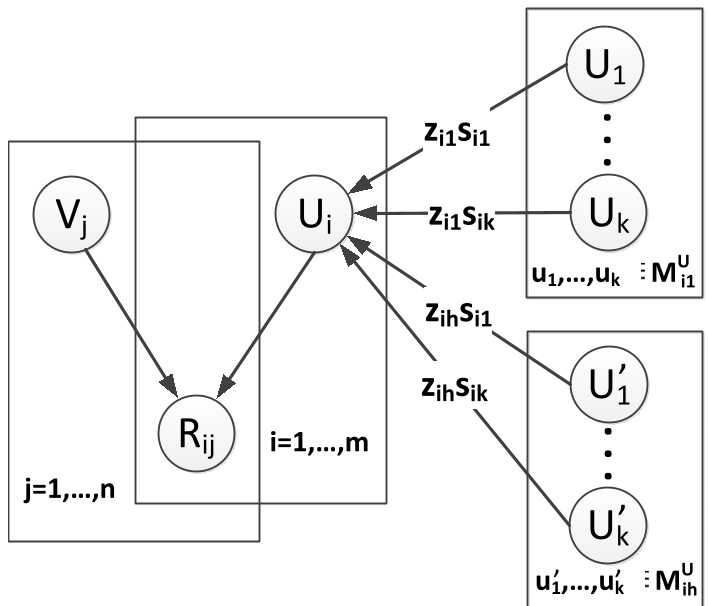 Figure: The MFC Model structure illustrating the interaction between User (U), Item (V), and Community (Z).
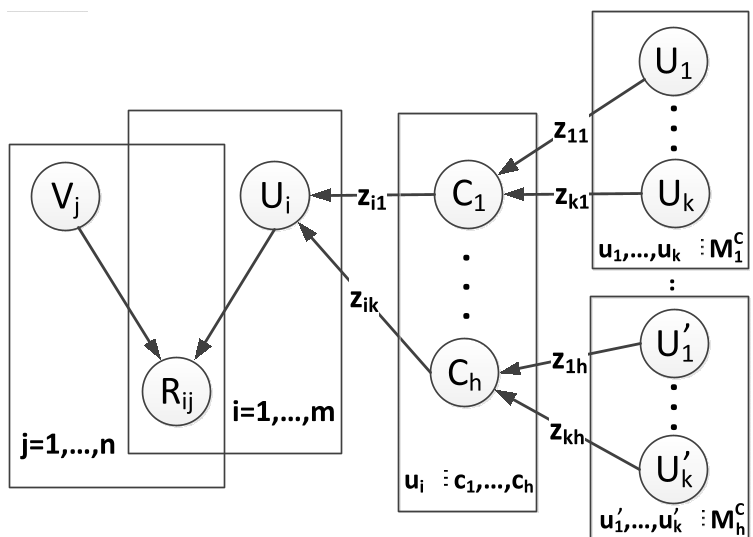 Figure: The MFC+ Model introducing the Community Latent Factor (C).
Experimental Battleground
The authors tested their models against heavyweights like SR, SR+, and CircleCon using four massive datasets: Yelp, Flixster, Douban, and Dianping.
Key Breakthroughs:
- Universal Improvement: The models consistently beat all competitors across all datasets.
- The 10% Barrier: In the world of Recommender Systems, a 10% improvement in RMSE is considered a "Netflix Prize" level achievement. MFC/MFC+ achieved improvements in this range (7%-16%) over SR.
- Solving Social Sparsity: For users with <5 friends, the models still outperformed others by 4%-10%.
(Refer to Table 2 in original paper for detailed RMSE comparisons)
Deep Insight: Why does it work better?
The genius of this approach lies in its Inductive Bias. Direct social links are "noisy"—some friends are close, some are acquaintances. Communities, especially overlapping ones, capture the multi-faceted nature of a user. A user might belong to a "Jazz" community and a "Coding" community. By weighting user interests against these specific community centers, the model performs a "denoising" of the social graph.
MFC vs. MFC+ Comparison: The authors noted that MFC+ (Center-based) performs better when community members have highly consistent tastes (low RMSD), while MFC (Member-based) is more robust when the community is diverse and lacks a strong central preference.
Conclusion & Future Outlook
This paper shifts the paradigm of social recommendation from "who you know" to "where you belong." By using community detection algorithms (like BigClam or CESNA) as a pre-processing step, the authors transformed a sparse social graph into a dense feature set.
Limitations: The current model relies on community detection as a separate step. A truly end-to-end model that learns community structures and item ratings simultaneously (perhaps using contemporary Graph Neural Networks) would be the logical next step for this lineage of research.
Final Takeaway: If your recommendation engine is struggling with sparse data, look past individual edges—find the communities hidden in the noise.