
Selective Awareness: Harmonizing Overlay Networks for MANET Social Applications
An Overlay-Based Resource Monitoring Scheme for Social Applications in MANET
This paper introduces an overlay-based resource monitoring scheme specifically designed for group-based social applications in Mobile Ad Hoc Networks (MANETs). By constructing an on-demand cluster-head overlay that aligns with application group semantics, it achieves SOTA-level efficiency, reducing response time by up to 90% and traffic overhead by up to 75% compared to generic hybrid monitoring approaches.
TL;DR
In the volatile landscape of Mobile Ad Hoc Networks (MANETs), traditional resource monitoring often collapses under the weight of excessive traffic or high latency. This paper presents a specialized monitoring scheme that builds a logical overlay on top of physical clusters, specifically tailored to the membership of social applications. By pruning irrelevant network branches, it achieves a staggering 90% reduction in response time and 75% less traffic than previous hybrid models.
The Gap: Why Generic Monitoring Fails in Social Contexts
MANETs are characterized by high mobility and strict resource constraints. Previous state-of-the-art (SOTA) solutions, such as the hybrid approach by Tuduce and Gross, attempted to balance "Push" and "Pull" strategies using proximity-based clustering.
However, these systems suffer from a "Group Blindness" problem. When a social application (like photo sharing among a specific set of users) needs to check the battery or CPU status of its members, the monitoring layer treats all nodes as equal targets. This leads to two critical inefficiencies:
- Flooding: Queries are sent to clusters that contain zero group members.
- Timeout Latency: Cluster heads wait for responses from non-existent members in irrelevant branches, delaying the final result for the end-user.
Methodology: Building an Application-Aware Overlay
The proposed scheme introduces a hierarchical approach where the monitoring layer understands the Group ID and Coordinator ID.
1. Two-Tiered Architecture
The system first organizes nodes into proximity clusters (Physical Layer). Then, it constructs a Source-Rooted Tree consisting only of Cluster Heads (CHs) that house at least one group member (Logical Layer).
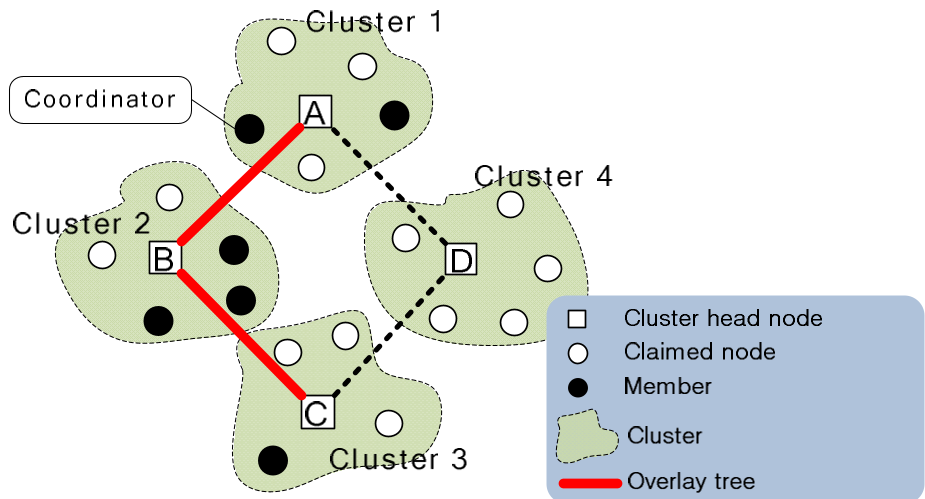 Figure 1: Comparison of the physical cluster distribution vs. the selective logical overlay.
2. Intelligent Maintenance
To handle mobility without the overhead of constant beaconing, the authors implemented:
- Receiver-Initiated Join: Uses expanded ring search to re-attach disconnected branches locally.
- Accuracy-Driven Recreation: Unlike ODOMP which recreates periodically (wasting bandwidth), this system only triggers a full overlay refresh when the reply accuracy drops below a threshold (e.g., 50%).
- Cross-Group Aggregation: If a node belongs to multiple social circles (e.g., Music Sharing and Photo Sharing), control messages are bundled into a single packet to minimize MAC-layer contention.
Experimental Validation: Efficiency Reimagined
The researchers compared their scheme against the Tuduce and Gross model using NS2 simulations.
Performance in Single-Group Scenarios
As member separation (hop count) increases, the "Group Blindness" of previous models causes an exponential spike in traffic. The overlay-based approach remains relatively flat because it only communicates with relevant nodes.
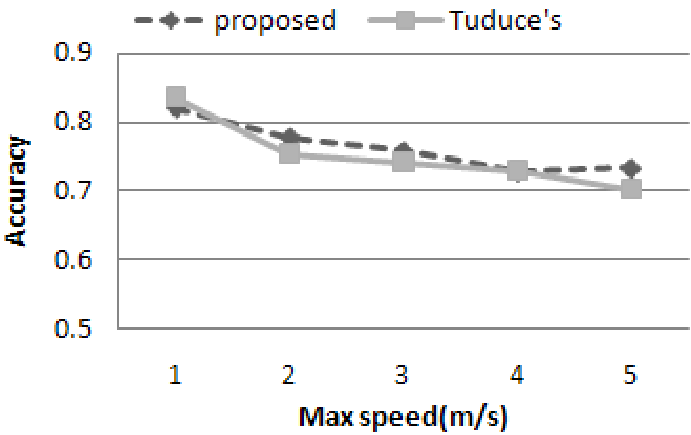 Figure 2: Performance metrics showing marked improvement in traffic overhead as group dispersion increases.
The "Overlapping" Stress Test
In a realistic MoSoSo environment, users often participate in multiple groups. The study demonstrated that Message Aggregation is the "secret sauce" for scalability. Without it, traffic doubles with overlapping groups; with it, the overhead increase is restricted to a negligible 9%.
Critical Analysis & Conclusion
The brilliance of this work lies in its Semantic Pruning. By acknowledging that "not every node matters to every application," the authors transformed resource monitoring from a network-wide burden into a surgical operation.
Takeaway for Future Research: While the results are impressive, the reliance on a central "Coordinator" within the group remains a potential single point of failure. Future iterations could benefit from a more distributed gossip-based protocol integrated into the overlay to enhance resilience against coordinator disconnection.
This paper serves as a vital blueprint for anyone building decentralized social software, proving that the key to MANET scalability isn't just better hardware—it's smarter, context-aware routing.