
OverSoc: Reclaiming Social Sovereignty via Individualized P2P Overlays
OverSoc: Social Profile Based Overlays
OverSoc is a decentralized social networking architecture that utilizes structured Peer-to-Peer (P2P) overlays to replace centralized providers. It employs a two-tier system: a public directory overlay for discovery and individualized private profile overlays for data sharing, achieving secure, friend-only access via Public Key Infrastructure (PKI).
TL;DR
OverSoc is a research framework designed to decouple social networking from centralized giants like Facebook. It organizes social connections into structured P2P overlays, where every user's profile is its own mini-network. By combining a public directory for discovery with private, PKI-secured "profile overlays," it ensures that only verified friends can access metadata and personal content, even when the owner is offline.
Problem & Motivation: The Prison of Centralization
In the current social media landscape, users are at the mercy of platform policies. Whether it's data mining, lack of transparency in "opt-out" programs, or unilateral terms-of-service changes, the root cause is centralization.
The technical challenge in moving to a Peer-to-Peer (P2P) model lies in:
- Connectivity: Most users are behind NATs and firewalls.
- Availability: If your friend is offline, how do you see their profile?
- Privacy: How do you enforce "friends-only" access without a central server checking permissions?
OverSoc's research intuition is that a social link is inherently a P2P relationship. By mapping these links directly to network topology, we can eliminate the middleman.
Methodology: The Two-Tier Overlay Architecture
The core innovation of OverSoc is its dual-layered approach to network organization.
1. The Public Directory Overlay
This acts as the "Yellow Pages." It is a structured overlay (likely based on DHTs like Chord or Kademlia) where users store public, searchable fragments of their identity (e.g., name or email hashes). It serves two purposes:
- Friend Discovery: Finding candidates to "befriend."
- Bootstrapping: Helping a user find the entry points (active IP addresses) for a friend's private overlay.
2. Individual Profile Overlays
This is where the actual social interaction happens. Instead of one giant network, OverSoc creates millions of tiny, interconnected overlays.
- User as CA: Every user acts as their own Certificate Authority. When you "accept" a friend, you sign their PGP certificate.
- Access Control: Only peers with a valid signature from the owner can join the profile overlay.
- Data Persistence: Profile updates and messages are stored in the DHT within the profile overlay. This means your friends' computers collectively host your profile data for you.
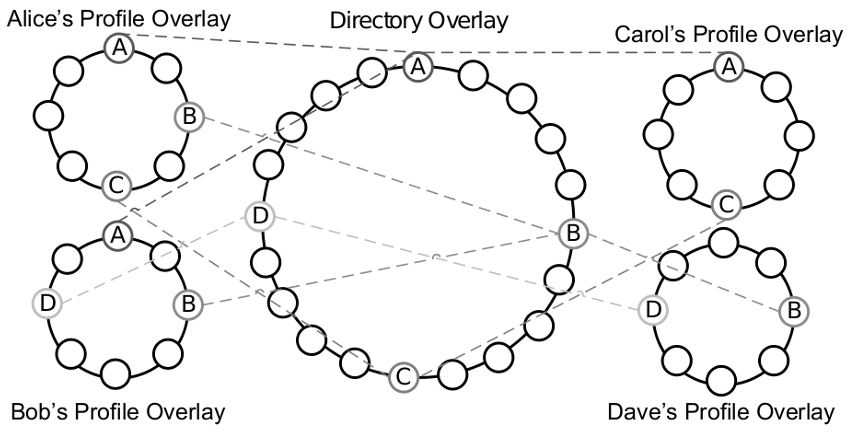 Figure 1: Alice's overlay includes Bob and Carol, while Bob's includes Alice and Dave. These overlapping memberships form the global social fabric.
Clinical Interaction: How it Works
When Alice wants to befriend Bob:
- She finds his entry in the Public Overlay.
- She sends an encrypted Friendship Request to a "mailbox" key in the DHT.
- Bob accepts, signs Alice's certificate, and they exchange Signature Packets.
- Alice can now join Bob's Private Overlay to see his status updates or send private messages.
Experiments & Challenges
The authors identify several critical hurdles for P2P social networks:
- Small Overlay Reliability: Standard P2P research focuses on millions of nodes. A person with 50 friends has a very fragile overlay. If all 50 go offline, the profile vanishes.
- Mobile Constraints: Smartphones cannot stay constantly connected to a P2P mesh without draining the battery.
- Management of State: Handling "defriending" and certificate revocation in a decentralized way requires immediate broadcast and DHT-based blacklists.
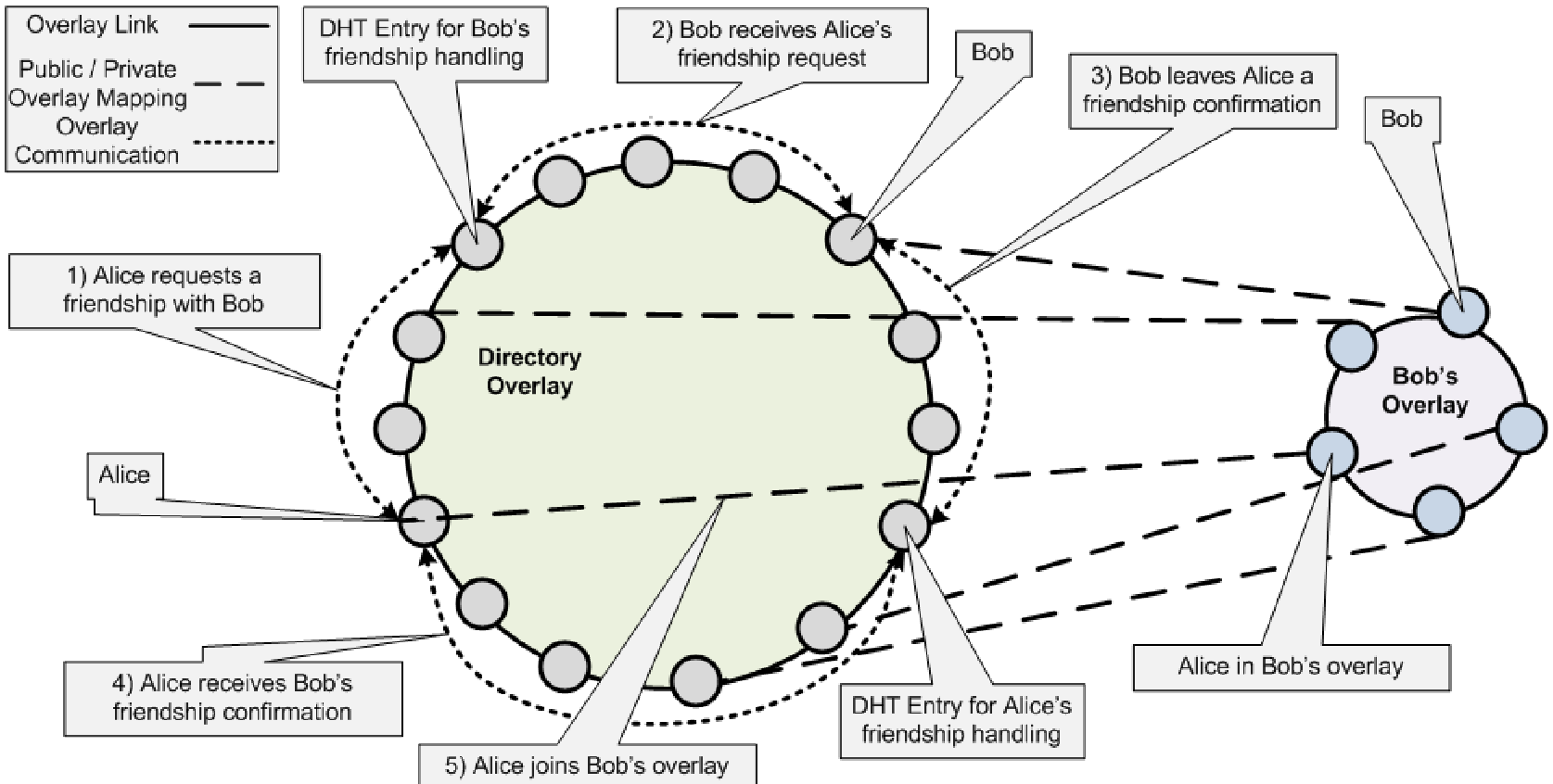 Figure 2: The handshake process leveraging public-key cryptography to establish trust without a central authority.
Critical Insight & Conclusion
OverSoc is more than just a P2P app; it’s a blueprint for Social Sovereignty. By treating the "Profile" as a network topology rather than a database entry, it solves the privacy-performance trade-off.
Takeaway: The "Individualized Overlay" approach is a powerful abstraction. While challenges in mobile power consumption and small-network churn remain, OverSoc proves that we don't need a billion-dollar data center to stay connected—we just need the collective resources of our friends.