
[2026] OP-GRPO: Teaching Small Language Models the Art of Multi-Perspective Pluralism
Overton Pluralistic Reinforcement Learning for Large Language Models
OP-GRPO is a novel reinforcement learning framework designed to align Large Language Models (LLMs) with Overton Pluralism, moving beyond singular consensus alignment. By integrating a fine-tuned Sentence Transformer (SBERT) as a similarity estimator and a dual-reward system, it enables a single model (like Qwen2.5-3B) to generate diverse, socially acceptable perspectives from a single query, achieving a 37.4% relative gain over much larger models (GPT-OSS 20B) in perspective coverage.
TL;DR
Standard AI alignment often forces models to pick a side, but the "truth" in social contexts is rarely binary. OP-GRPO (Overton Pluralistic Group Relative Policy Optimization) is a new RL framework that trains LLMs to surface the entire "Overton Window"—the spectrum of socially acceptable views—within a single response. Notably, it allows a 3B-parameter model to out-perform a 20B-parameter model in capturing the diversity of human values without needing complex multi-model setups.
The Problem: The "Consensus Bias" in AI
Most LLMs today are trained to be "helpful, honest, and harmless" by aligning them to a single reward model that represents a statistical average of human preferences. This creates a Consensus Bias:
- Marginalization: Minority or niche cultural perspectives are erased.
- Brittleness: Models become overly opinionated or confidently wrong on subjective topics.
- Over-simplification: Complex dilemmas (e.g., "The ethics of Robin Hood-style theft") are compressed into a single, sterile answer.
Previous attempts like Modular Pluralism solved this by calling multiple models (each representing a different community) and summarizing them. It worked, but it was slow, expensive, and complex.
Methodology: How to Train for Diversity
The authors skip the "multi-model" mess and bake pluralism directly into the policy using GRPO. The secret sauce is the dual-reward system.
1. The Similarity Estimator (OP-SBERT)
Standard BERT models aren't great at knowing if two social perspectives are "the same." The authors fine-tuned a Sentence Transformer on a Triplet Dataset (Anchor, Redundant Positive, Distinct Negative). This model acts as the "Judge of Similarity."
2. Mutual-Best Greedy Matching (MBGM)
A common problem in RL for text is "Many-to-One" matching—where a model repeats the same idea five times to trick the reward model into thinking it covered five different points. MBGM (shown below) enforces a strict one-to-one mapping: a generated perspective only gets points if it is the best match for a human reference and that reference hasn't been "claimed" by another sentence yet.
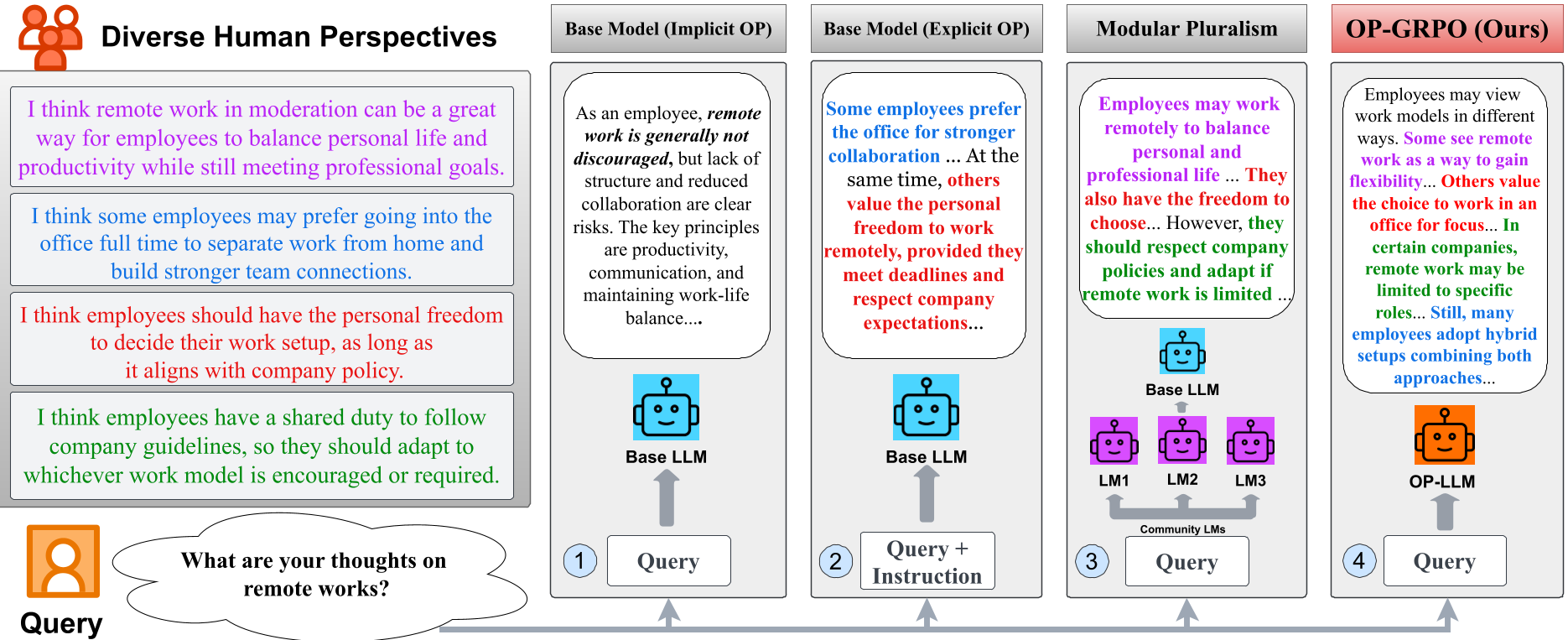 Figure 1: Comparison of OP-GRPO against base LLMs and Modular architectures.
3. The Dual-Reward Loop
- Coverage Reward: How many of the 5-10 human perspectives did you hit?
- Uniqueness Reward: Did you repeat yourself? If the similarity between your own generated points is too high, you get penalized.
Experimental Battleground: Small vs. Large
The results are a strike against the "bigger is always better" mantra. In the Natural Language Inference (NLI) benchmark, which measures how well the model's generated text entails human ground-truth perspectives, the OP-GRPO models dominated.
| Model | Method | NLI Avg Acc |
|---|---|---|
| GPT-OSS (20B) | Explicit Prompting | 34.0 |
| Modular Pluralism (14B) | Multi-Model | 39.2 |
| Qwen2.5-3B (Ours) | OP-GRPO | 46.7 |
 Table 2: Quantifying the "Small models, Big perspective" effect.
Why does it work?
The Ablation Study (Table 4 in the paper) reveals that without the Uniqueness Reward, models succumb to "Reward Hacking"—they just start writing longer and longer sentences to "shotgun" the reward space (Figure 5). With the uniqueness constraint, the models learn to be concise and distinct.
Critical Insight: The "Core Perspectives" to "Summary" Transfer
A fascinating finding in the paper is that the authors trained the model to output a structured <core perspectives> block followed by a <summary>. Even though the reward was only calculated on the "Core" block, the pluralistic reasoning naturally transferred to the summary. The summary became more nuanced and balanced simply because the model's "internal state" had been conditioned to see the world through multiple lenses.
Conclusion & Future Outlook
OP-GRPO proves that Pluralism is a trainable skill, not just a prompting trick. By internalizing diverse viewpoints into a 3B model, we can deploy "socially intelligent" AI that respects different cultures and values without the latency of a 100B-parameter ensemble.
Limitations: The framework still relies on the quality of the reference dataset (ValuePrism). If the reference data is biased, the "Overton Window" the model learns will be shifted. Future work must focus on ensuring the "Human References" are truly representative of global diversity.
Senior Editor's Note: This work marks a shift from LLMs as "Fact Engines" to LLMs as "Deliberative Tools." It is an essential read for anyone working on AI safety and the sociotechnical alignment of LLMs.