
Who Really Owns Your Timeline? Navigating the Social Norms of Digital Property
Exploring the Ownership and Persistent Value of Facebook Content
This study investigates user attitudes toward the ownership, control, and persistent value of social network data using Facebook-based scenarios. Through a controlled survey of 244 participants, it establishes that social norms regarding data reuse and saving are heavily mediated by social distance and identity curation rather than legal terms of service.
TL;DR
In the digital age, your Facebook profile is more than just data—it's a "documentary record" of your life. This paper by Marshall and Shipman explores the friction between what users feel they own and what legal terms of service dictate. Through a series of clever hypotheticals, the study reveals that our sense of ownership on social media is driven by social distance and identity curation, not institutional rules.
The "Archival" Crisis of Social Media
Most users view Facebook as a communication tool, yet it serves as a massive, unintended personal archive. The problem? Social media content is highly volatile. Users curate, delete, and untag content to manage their "current" reputation, often destroying historical records in the process. When a service founders or a user wants to move, who holds the keys to the data?
The authors argue that unlike the "open web," social networks operate under strict social strictures. Simply because you can see a post doesn't mean you feel you have the right to keep it.
Methodology: Testing the "Edges" of Social Norms
The researchers used a technique borrowed from legal education: Hypotheticals. By presenting subjects with a base scenario (e.g., "Susie wants to delete her Facebook account") and then varying one specific detail at a time (e.g., "Susie saves her own photos" vs. "Susie saves a stranger's photos"), they mapped the exact point where a behavior shifts from "acceptable" to "creepy."
 Figure 1: The impact of social distance on the perceived right to save content.
Key Insights: Social Distance & The Curated Self
1. The Proximity Rule
The study found a sharp decline in the perceived right to save content as social distance increases. Participants were comfortable with saving their own and their friends' data but found it highly inappropriate to save content from a "friend-of-a-friend" or a stranger, even if that content was public. This proves that ownership in social media is relational.
2. The Power of "Un-tagging" and Removal
Removal isn't just about deleting mistakes; it's a vital part of identity curation.
- 78% of users reported removing content to keep accounts "tidy" or protect their reputation.
- Participants felt they should have the right to remove photos of themselves, even if someone else took the picture (H7 vs H8).
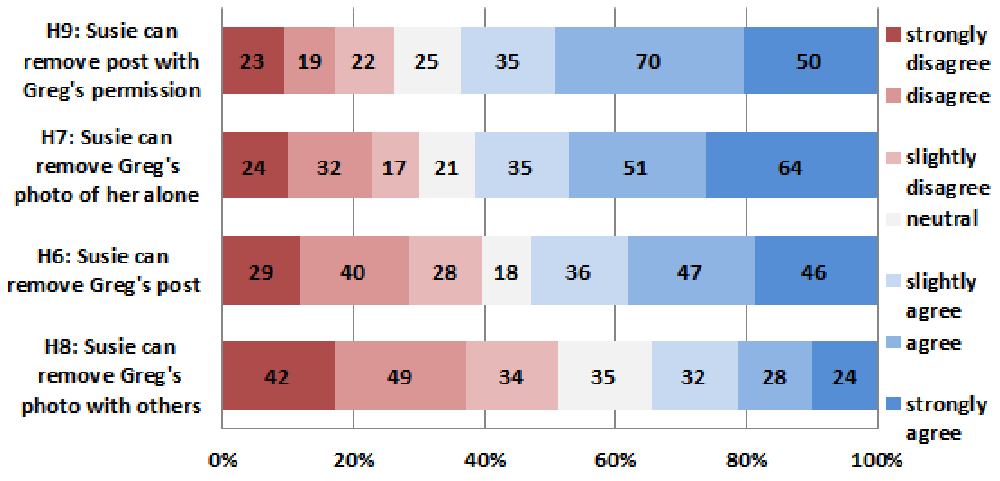 Figure 2: User attitudes toward content removal and the role of permission.
3. The Hypocrisy of Monetization
One of the most striking findings was the double standard regarding "Big Data":
- The Individual Right: Nearly 60% of participants felt they should be able to sell their own data to a company like Amazon.
- The Corporate Prohibition: Over 80% felt it was "very negative" for Facebook to sell that same data to survive a financial crisis. Users view their data as a personal asset, not a corporate one, regardless of the license agreements they signed.
Experimental Findings: What Do We Take With Us?
When asked what they would take if they moved to a new service (like moving from Facebook to Google+), the hierarchy of value became clear:
- Photos (53.7%): The primary "valued" asset.
- Contacts (34.8%): Vital for the social graph.
- Messages & Statuses (<10%): Seen as transient and low-value.
Interestingly, many users (20%) preferred a "fresh start," suggesting that for some, the value of a social network is in the present, not the past.
Critical Analysis: Perceived Rights vs. Reality
The "Senior Academic" take on this work is that it highlights a massive literacy gap. Users treat Facebook like a private diary or a shared family photo album, while corporations treat it as a searchable, monetizable database.
The paper concludes that Social Norms, not just Terms of Service, should inform the design of future social archives. If we don't account for how users "curate" their identities through deletion and selective sharing, we risk building digital archives that users find invasive rather than valuable.
Final Takeaway: Ownership on social media is a negotiation between the individual's desire for a "clean slate" and the network's desire for a "persistent record." Any future technology in this space must respect the fixity and fluidity of the human identity.