
PRemiSE: Bridging the "Word of Mouth" and Matrix Factorization for News Recommendation
PRemiSE: personalized news recommendation via implicit social experts
This paper introduces PRemiSE, a novel news recommendation framework that integrates content-based filtering, collaborative filtering, and implicit social expert influence into a unified Probabilistic Matrix Factorization (PMF) model. It specifically targets the news domain to provide personalized suggestions by leveraging virtual social networks.
TL;DR
The news cycle moves at a breakneck pace, rendering traditional collaborative filtering (CF) nearly useless for brand-new stories or anonymous readers. PRemiSE (Personalized news Recommendation via implicit Social Experts) solves this by identifying "virtual experts" within a reading community. By blending content analysis with the "word of mouth" effect into a Probabilistic Matrix Factorization (PMF) framework, it achieves superior accuracy and solves the notorious cold-start problem.
The Core Challenge: The Ephemeral Nature of News
Most recommendation systems rely on long-term user-item interactions. In news, however:
- Data Sparsity: Users read only a tiny fraction of daily news.
- Double Cold-Start: New articles arrive every hour (item cold-start), and many readers are unregistered or first-time visitors (user cold-start).
- Lack of Explicit Social Data: Unlike Twitter or Facebook, news portals don't usually have "friend" or "follow" graphs to rely on.
The authors' insight is simple: even without an explicit social network, a virtual social network exists. If a small group of "experts" reads a niche technical story and it eventually spreads, their early adoption serves as a signal for others.
Methodology: The PRemiSE Framework
PRemiSE doesn't just look at what you liked; it balances your personal profile with the influence of community experts.
1. Hybrid Factorization
In standard PMF, a rating is the product of user factor and item factor . PRemiSE modifies this by defining the user's preference as a weighted combination:
- : Personal preference (dominant for experienced users).
- : "Word of mouth" from experts (dominant for new users).
2. Semantic Integration
To handle new items, the model maps news content (TF-IDF vectors) directly into the latent factor space. This allows the system to estimate an item's factor based on its words before anyone has even clicked on it.
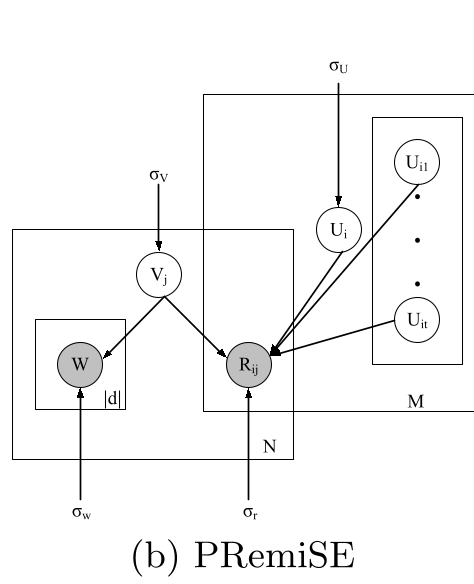 Figure 1: Comparison between basic PMF (a) and the PRemiSE framework (b) which includes social expert influence and content semantics.
Experiments and Cold-Start Mastery
The authors tested the model against standard CF, basic Matrix Factorization, and LDA-based filtering.
Key Performance Indicators:
- Accuracy: PRemiSE consistently yielded lower RMSE (Root Mean Square Error) across multiple datasets (Stories and Entities).
- Cold-Start Resilience: While baselines like CF and MF struggle to make meaningful predictions for new users, PRemiSE uses the "Global Expert" opinion as a fallback, maintaining high recommendation quality.
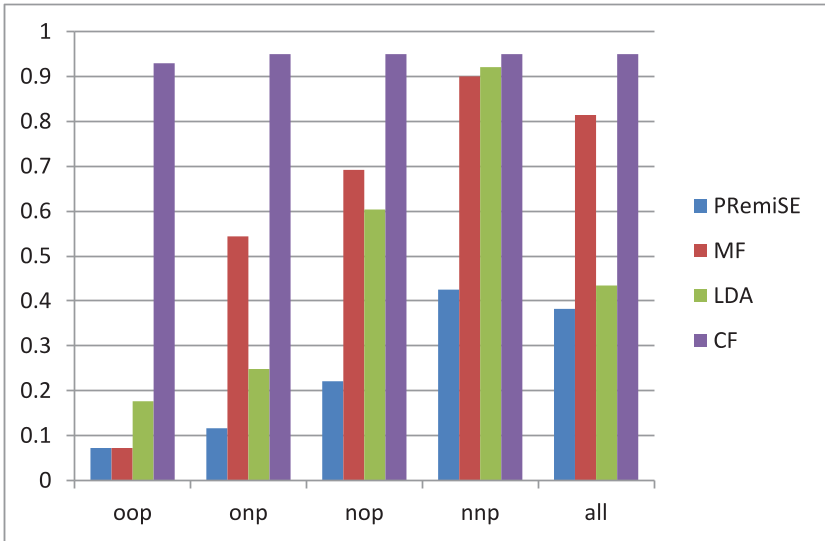 Figure 3: Breakdown of results for Existing-User/Existing-Item (oop) vs. Cold-Start scenarios (onp, nop, nnp). PRemiSE shows a clear advantage in new item/user prediction.
Critical Insight: Why Experts?
The "Wisdom of the Few" is often more effective than the "Wisdom of the Crowd" in specialized domains. By automatically detecting experts—those who have a high influence on the information diffusion within the community—PRemiSE creates a robust "anchor" for recommendations when individual user data is missing.
Conclusion
PRemiSE demonstrates that social influence is a powerful latent feature even when no explicit "Follow" button exists. By integrating content, collaboration, and implicit social structures, the framework provides a blueprint for building resilient recommenders in high-churn environments like digital journalism.
Future Outlook: Integrating these "implicit experts" with modern transformer-based embeddings could potentially push the boundaries of zero-shot personalization even further.