
P2PSTORY: Decoding the Secret Language of Peer-to-Peer Storytelling
P2PSTORY: Dataset of Children as Storytellers and Listeners in Peer-to-Peer Interactions
The paper introduces P2PSTORY, a first-of-its-kind dataset capturing natural peer-to-peer storytelling interactions among 5-6-year-old children. It provides time-synchronized audio-video data, behavioral annotations, and developmental profiles to support the design of companion-like educational technologies (social robots/virtual agents) that can emulate authentic child-peer behaviors.
TL;DR
Researchers from the MIT Media Lab have released P2PSTORY, a unique multi-modal dataset documenting how 5-6-year-old children tell stories to one another. Unlike previous datasets that rely on adult-child interactions, this study reveals that children have their own distinct "social code." The most striking finding? What an adult thinks "listening" looks like is not what a child thinks.
The "Peer" Gap in Educational Tech
We are entering an era of social robots and virtual tutors. However, most of these systems are designed to act like teachers or follow adult communication patterns. The problem is that peer-to-peer learning—where a child interacts with someone of their own level—is often more effective for building confidence and language skills.
Until now, we lacked the data to know how children actually behave when no adults are in the room. P2PSTORY fills this gap by capturing uninhibited peer dynamics.
Methodology: Capturing the Narrative Flow
The researchers observed 18 kindergarteners over five weeks, resulting in 58 storytelling episodes. The setup used three synchronized cameras and high-quality audio to capture every nuance.
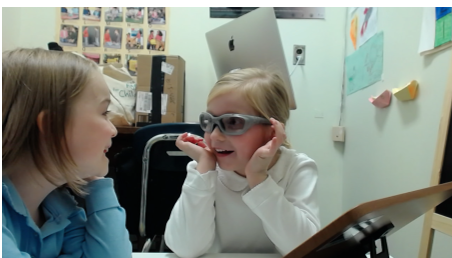
The dataset is uniquely rich because it includes:
- Multi-modal raw data: Audio and 720p video.
- Behavioral Coding: Gaze, posture, nods, and eyebrow movements.
- Prosodic Features: Pitch and energy changes used by the storyteller.
- Developmental Context: ASQ (Ages and Stages Questionnaire) scores for each child.
Key Insight: The Perception Rift
The core of the paper lies in its comparison of how adults and children perceive "attentiveness."
Adult Perception
When adult coders watched the videos, they identified nods and eyebrow raises as the primary indicators that a child was listening. If the child didn't nod, the adult assumed they were tuned out.
Child Perception
However, the child storytellers had a different view. Their ratings of their partners were driven by gaze (eye contact), leaning forward (proximity), and smiling. Interestingly, children at this age rarely used verbal cues like "uh-huh" or "wow," which are staples of adult conversation.
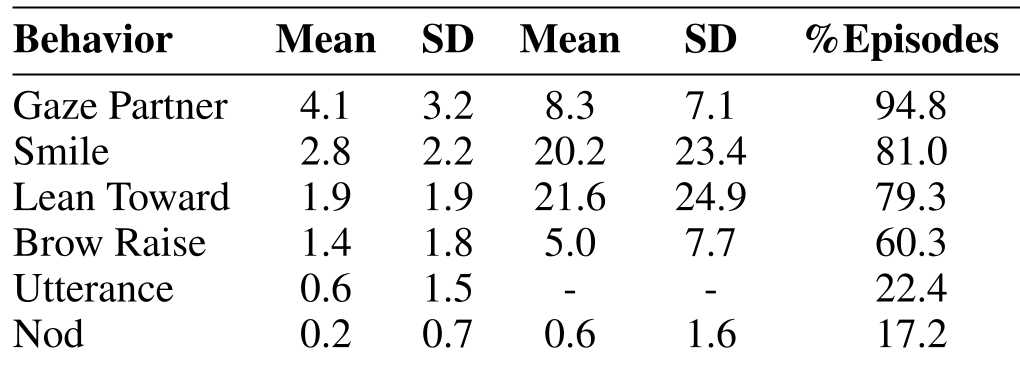 Table: Statistical frequency of nonverbal behaviors in child listeners.
Why This Matters for AI and Robotics
If we want a social robot to be a "friend" to a child, it shouldn't just nod like a miniature adult. According to the P2PSTORY data:
- Prioritize the Eyes: Sustained gaze is the strongest signal of peer attention for a 5-year-old.
- Smile and Lean: These are the "social currency" of early childhood interaction.
- Tone over Content: Storytellers used pitch variation and pauses (prosody) more than complex sentence structures to engage their listeners.
Critical Analysis & Future Work
While the dataset is relatively small (18 participants), its depth is impressive. It provides a rare look into the Inductive Bias we often bring to HCI (Human-Computer Interaction)—assuming that adult social norms are universal.
The next step for the industry is to use this data to train Recognition Models that can detect if a child is losing interest during a digital learning session and Generation Models that allow robots to "backchannel" in a way that feels natural to a child.
Conclusion
P2PSTORY reminds us that to design technology for children, we must first learn to see the world through their eyes. By aligning robot behaviors with child-specific social cues, we can create more engaging, effective, and empathetic educational partners.