
P3D: Reclaiming Relationship Privacy in Decentralized Social Networks
P3D - Privacy-Preserving Path Discovery in Decentralized Online Social Networks
This paper introduces P3D, a Privacy-Preserving Path Discovery protocol designed for decentralized social networks. It enables resource owners to verify if a requestor satisfies access constraints (depth, trust, and relationship type) via an indirect path without revealing specific relationship details to any node, achieving state-of-the-art efficiency through hash-based trust aggregation.
TL;DR
The P3D protocol (Privacy-Preserving Path Discovery) allows decentralized social network users to discover paths to others without revealing who their friends are. By combining hash chains and homomorphic encryption, it manages relationship type, depth, and trust level verification while remaining resilient to offline nodes—a common Achilles' heel in peer-to-peer systems.
Background: The Price of Connection
In modern social networks, access to resources is often governed by the "friend of a friend" logic. If you are within 3 hops of me and I trust you at a level of at least 0.6, you get access. However, in centralized systems, the provider knows everything. In existing decentralized systems, the path discovery process often leaks the identity of intermediate nodes or the specific nature of their links. P3D steps in to solve the paradox: How can I prove a path exists without showing you the path?
Methodology: The Cryptographic Toolkit
P3D breaks down path properties into three distinct "tokens" that circulate through the network.
1. Depth and Trust (The Hash Chain Insight)
For depth, P3D uses a simple recursive hash: . The number of hashes equals the number of hops. For trust, the authors propose a non-increasing multiplication strategy. Unlike prior work where a malicious node could boost trust values, P3D uses hash-based mapping of logarithms. Since adding logarithms is equivalent to multiplying the original values, and hashing is one-way, nodes can only "add" to the hash count (effectively decreasing the total trust product, since trust ), preventing malicious inflation.
2. Relationship Type (Homomorphic Stealth)
To verify if every step of a path is a "Colleague" or "Friend," P3D uses ElGamal homomorphic encryption. The owner provides an encrypted requirement; intermediate nodes can update the token such that it only decrypts to a valid "success" signal if all edges match the required type. If even one edge differs, the result is a useless random number.

3. Handling Volatility: Virtual Edges
Decentralized networks are plagued by offline nodes. P3D introduces Virtual Edges. When a path is successfully discovered, the owner issues a "certificate" to the requestor. If a node goes offline in a future search, other nodes can use these certificates as "shortcuts" to jump over the gap, utilizing the aggregate data of the previous successful discovery.
Experiments and Performance
The authors tested P3D against real-world datasets like Epinions and Wiki-vote.
- Efficiency: The hash-based trust aggregation is significantly faster than standard public-key encryption approaches (ElGamal).
- Resilience: Without virtual edges, the "grant ratio" (successful path finds) drops significantly as nodes go offline. With 25,000 virtual edges, the network performance recovers to the level of a 100% online network.
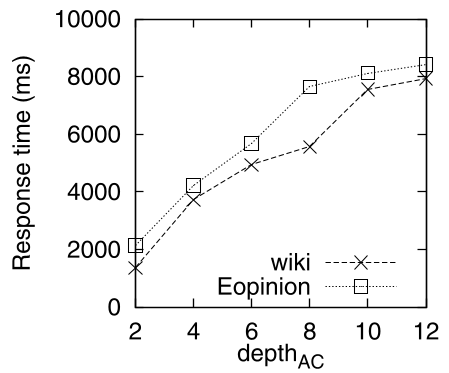 Figure (a): Response time remains under 10s even as the depth constraint increases to 12 hops.
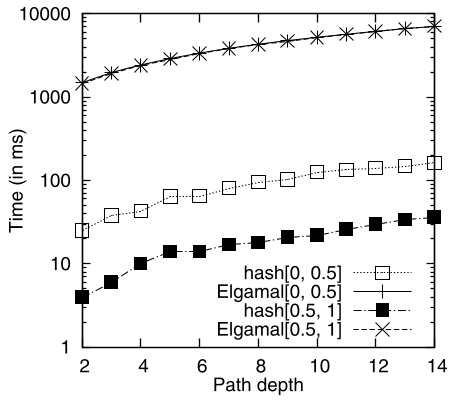 Figure (b): Comparison shows the Hash-based approach is orders of magnitude more efficient than ElGamal for aggregating trust values.
Critical Analysis & Conclusion
P3D succeeds in balancing high security (protecting requestor anonymity and relationship privacy) with high utility (robustness against churn).
Key Takeaways:
- Trust Integrity: The non-increasing multiplication via hash chains is a clever "physical" constraint that prevents nodes from lying about trust levels.
- Scalability: By moving away from purely encryption-heavy protocols, P3D achieves sub-10-second response times on networks with over 75k nodes.
- Limitation: The current protocol assumes a semi-honest model for protocol adherence; while it prevents trust inflation, it may still be susceptible to sophisticated timing attacks or collusion in very sparse graphs.
In conclusion, P3D provides a robust blueprint for the next generation of enterprise-oriented or private social networks where confidentiality is as important as connectivity.