
PACE: Marrying Generalization and Consistency in Parameter-Efficient Fine-Tuning
PACE: Marrying generalization in PArameter-efficient fine-tuning with Consistency rEgularization
PACE is a novel Parameter-Efficient Fine-Tuning (PEFT) framework that enhances model generalization by integrating consistency regularization. It utilizes multiplicative noise perturbation on adapter features to achieve state-of-the-art performance across visual adaptation (VTAB-1k, FGVC), text classification (GLUE), and mathematical reasoning (GSM-8K) tasks.
TL;DR
Adapting massive foundation models to downstream tasks usually involves a trade-off: gain task-specific accuracy, but lose the broad generalization inherent in the pre-trained weights. PACE (PArameter-efficient fine-tuning with Consistency rEgularization) breaks this trade-off. By perturbing adapter features with multiplicative noise and enforcing output consistency, PACE implicitly smooths the loss landscape and keeps the model "in pace" with its pre-trained ancestor.
Problem & Motivation: The "Alignment" Trap
In the world of PEFT (e.g., LoRA, Adapter), we want to tune as few parameters as possible. However, even small updates to these parameters can cause the model's output to diverge wildly from the pre-trained distribution.
Common wisdom suggests "aligning" the fine-tuned model with the pre-trained one (e.g., minimizing the distance in output space). However, the authors of PACE discovered a critical flaw: Naive alignment does not guarantee stable gradients. In fact, direct alignment can lead to gradient explosion or unpredictable optimization paths, complicating the training of stable, generalizable models.
Methodology: The Physics of "Flat Minima"
PACE is built on a rigorous theoretical foundation connecting gradient norms to generalization. The intuition is simple: a model that resides in a "flat" region of the loss landscape (where small weight changes don't spike the loss) generalizes better than one in a "sharp" pit.
1. Multiplicative Perturbation
Instead of standard Ganz-style noise, PACE applies multiplicative noise () to the features learned by the adapter branch ().
2. Consistency Loss
The core objective is to minimize the difference between two different "noisy" views of the same data point:
3. Why It Works (The "Aha!" Moment)
The paper proves that this consistency loss is equivalent to penalizing the first- and second-order gradients. By making the model robust to noise in its adapters, PACE forces the optimization toward flatter minima, which naturally aligns the fine-tuned model's behavior with the robust pre-trained foundation.
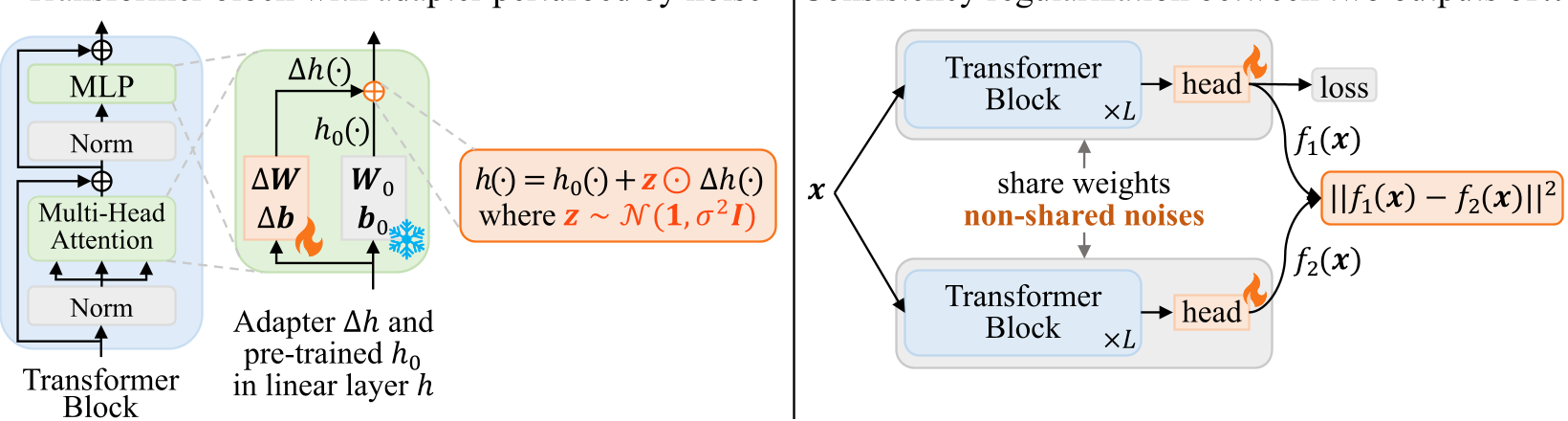 Figure 1: The PACE pipeline showing how adapter outputs are perturbed and regularized for consistency.
Experiments: Superior Adaptation
PACE was tested across a massive battery of benchmarks:
- Vision (VTAB-1k): Surpassed previous SOTA (GLoRA) by 1%, despite GLoRA using expensive parameter searches.
- Reasoning (GSM-8K): Improved LoRA performance on Phi-3-mini by 3.11%.
- Generalization: Under domain shift (ImageNet-A/R/Sketch), PACE provided a persistent +1.5% boost, proving it retains "knowledge" better than standard LoRA.
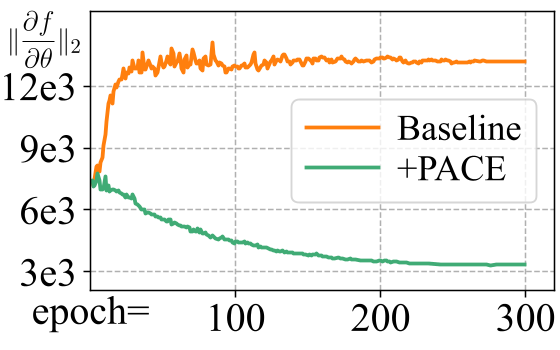 Figure 2: Analysis showing PACE (blue) maintains lower gradient norms and FP-Distance (alignment with pre-trained model) compared to the baseline.
Efficiency Variants: PACEfast
One common criticism of consistency regularization is the "double forward pass" cost. The authors address this with PACEfast, which compares current outputs with stored outputs from the previous epoch.
The results are staggering: PACEfast can achieve better-than-baseline accuracy even when the batch size and total epochs are cut to 1/8th, making it a prime candidate for edge-device fine-tuning where compute is the primary bottleneck.
Critical Analysis & Conclusion
Takeaway
The success of PACE suggests that for PEFT, how you regularize is just as important as what you tune. By focusing on the smoothness of the adaptation (via consistency) rather than just the magnitude of the change (via weight decay or sparsity), we can maintain the rich priors of foundation models.
Limitations
- Hyperparameter Sensitivity: PACE introduces (regularization strength) and (noise level). The authors note that smaller datasets require higher values for both, providing a heuristic, but manual tuning is still required.
- Memory: While PACEfast is efficient, it does require storing the previous epoch's outputs, which scales with the number of training samples.
PACE proves that consistency is the key to longevity in model knowledge. It is a robust, theoretically-backed upgrade to standard LoRA that should likely become a default part of the fine-tuning toolkit.