PACELA: Fusing Neural Embeddings with Spatial Latent Attributes for Smarter LBSN Predictions
PACELA: A Neural Framework for User Visitation in Location-based Social Networks
PACELA is a novel neural framework designed for check-in prediction in Location-Based Social Networks (LBSNs). It integrates network embeddings (DeepWalk) with a probabilistic matrix factorization-based latent attribute model to capture area attraction, neighborhood competition, and social homophily, outperforming state-of-the-art models like PACE.
TL;DR
Predicting where a user will check-in next is a daunting task due to massive data sparsity. PACELA (Preference and Context Embeddings with Latent Attributes) solves this by combining the representational power of Deep Learning with the physical intuition of Geographical Latent Attributes. It explicitly models why we visit certain areas—attraction, competition, and social ties—and feeds these into a neural engine to beat existing SOTA models like PACE by up to 4% in F1-score.
The "Why": Why standard Neural Networks aren't enough
While Deep Learning is excellent at capturing non-linear relationships, it often struggles with the "physics" of geography when data is sparse. In a typical LBSN like Foursquare, the density is a mere 0.1%. Standard Graph Embeddings or MLPs struggle to "see" that a venue isn't just a point in a latent space, but a competitor in a physical neighborhood. Prior works either focused on pure spatial modeling or pure neural collaborative filtering; PACELA bridges this gap.
Methodology: The Best of Both Worlds
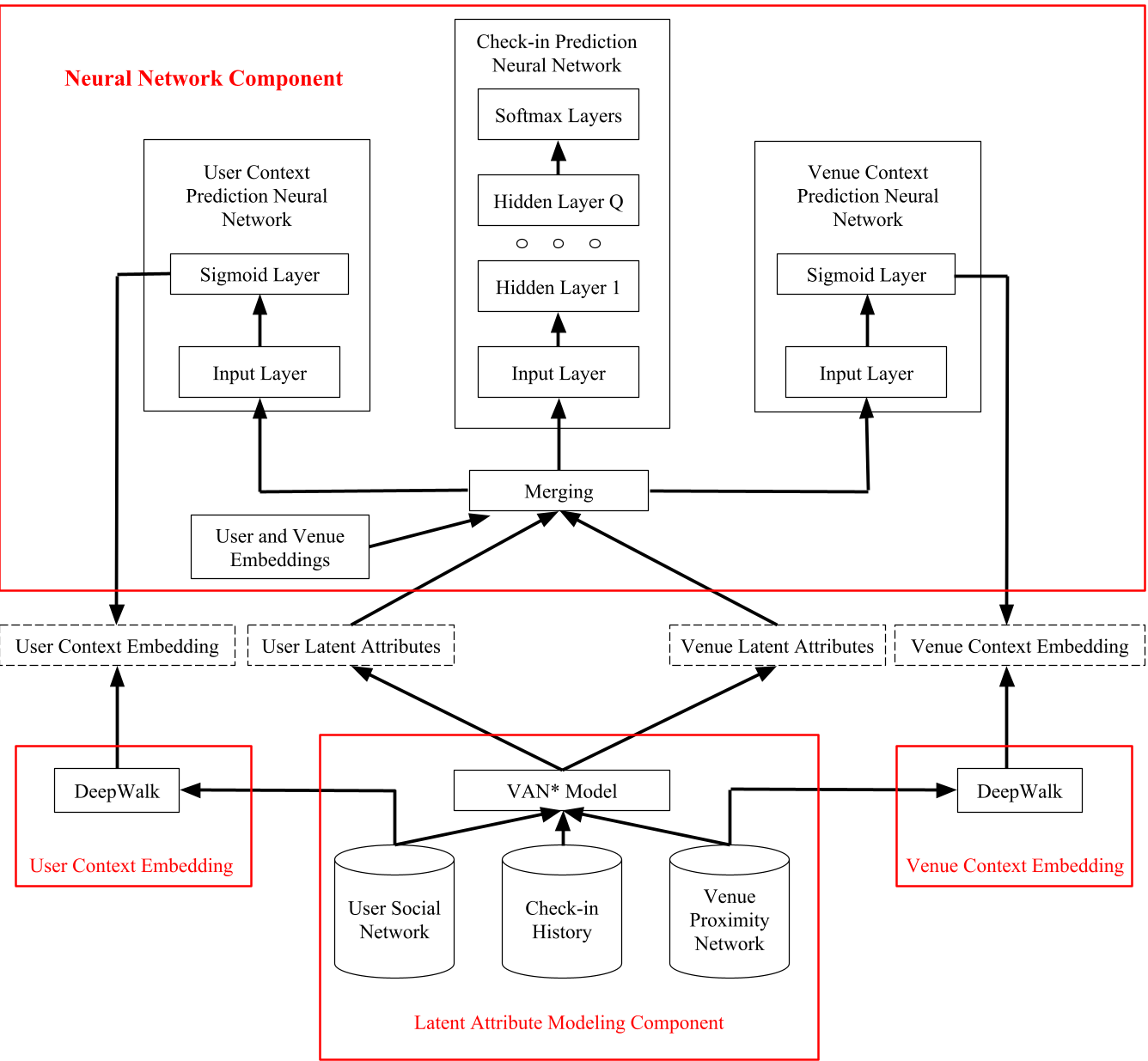
The PACELA framework (shown below) operates on a modular architecture:
- Network Embeddings: Using DeepWalk to capture social and proximity contexts.
- *Latent Attribute Modeling (The VAN Model)**: This is the secret sauce. Instead of just learning ID embeddings, PACELA uses a probabilistic model to calculate:
- Area Attraction: Why users flock to specific clusters (e.g., Downtown).
- Neighborhood Competition: How a venue must "win" against its immediate neighbors to get a check-in.
- Social Homophily: The tendency of friends to visit similar spots.
The Formal Intuition
The model defines the probability of a check-in as a two-step process: Essentially: First, the user chooses a Region (), then the Venue () must defeat all its neighbors () in a latent "tug-of-war" for the user's preference.
Experiments and Results
The authors tested PACELA across three massive datasets: Singapore (SG), Jakarta (JK), and NYC.
SOTA Comparison
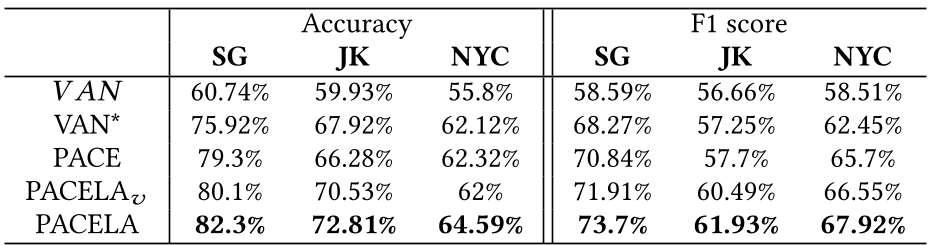
As seen in the table below, PACELA consistently outperformed standard matrix factorization (VAN*) and the primary neural competitor (PACE).
Key Insights from the Results:
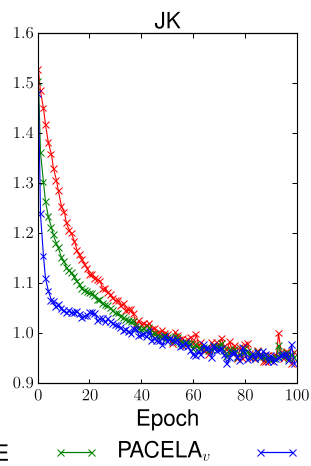
- Convergence: PACELA reaches significantly lower loss levels much faster than PACE. By feeding the model "pre-digested" latent attributes, the neural network doesn't have to waste epochs learning spatial constraints.
- Venue vs. User Context: The study found that venue context (spatial neighbors) provides a more significant accuracy boost than user context (social friends). This suggests that in LBSNs, current location and local competition are stronger predictors than social influence.
Critical Analysis & Conclusion
Why it works
PACELA succeeds because it uses Inductive Bias correctly. It doesn't expect the neural network to "discover" that distance and competition matter; it calculates those as features and uses the MLP to learn the interaction between those features and user preferences.
Limitations
- Temporal Dynamics: The model currently treats check-ins as static events. It doesn't account for the fact that a user's preference changes between 2:00 PM (Coffee) and 10:00 PM (Bar).
- Computational Overhead: Calculating neighborhood competition for every venue in a dense city can be expensive.
Final Takeaway
For researchers and engineers building recommendation systems, PACELA serves as a blueprint for Hybrid Architectures: use probabilistic models to handle the domain-specific constraints (geography) and neural networks to handle the high-dimensional mapping.