
Padoc: Breaking the Cloud Dependency for Hyper-Local Social Networking
Padoc: Enabling social networking in proximity
The paper introduces Padoc, an open-source middleware designed for off-the-shelf iOS devices to facilitate multi-hop social networking in proximity (MNP) without Internet access. It implements a Location-based Multicast Addressing (LMA) service and introduces Heya, a classroom interaction app, achieving reliable peer-to-peer communication in infrastructure-scarce environments.
TL;DR
Padoc is a novel middleware that enables multi-hop social networking on standard iOS devices without an Internet connection. By bridging the gap between theoretical ad hoc networking and practical mobile application development, Padoc supports resilient, peer-to-peer communication through its "Heya" classroom interaction app, proving that decentralized social spaces can thrive even in connectivity-scarce environments like rural Mozambique.
Problem & Motivation: The "Connected" Illusion
We live in an era of ubiquitous social media, yet our digital lives are surprisingly fragile. Current platforms (Twitter, Facebook, StackOverflow) are "cloud-tethered." In scenarios involving government censorship (e.g., the 2014 Iraq or Hong Kong protests) or infrastructure collapse (e.g., Nepal earthquake), these tools become useless precisely when they are needed most.
The authors identify a critical implementation gap: decades of research exist on Mobile Ad Hoc Networks (MANETs), but developers still lack off-the-shelf tools to build multi-hop apps for standard commercial smartphones. Padoc seeks to solve this by providing a developer-friendly library that hides the complexity of multi-hop routing behind simple multicast primitives.
Methodology: The Core of Padoc
Padoc's architecture is built on top of Apple’s MultipeerConnectivity Framework, but it bypasses the framework's one-hop limitation.
1. Location-based Multicast Addressing (LMA)
The middleware uses LMA to define groups geographically. Instead of IP-based routing, messages are addressed to everyone within a certain hop-count or physical radius, perfectly suiting the "social networking in proximity" use case.
2. Message Diffusion Strategies
The authors implemented and compared three core strategies to handle the "Broadcast Storm Problem" (where too many devices rebroadcasting leads to packet collisions):
- Scoped Flooding: A simple hop-limited broadcast.
- Scoped Counter-Based Scheme (CBS): Nodes listen before they talk. If they hear a neighbor rebroadcast the same message, they cancel their own transmission to save bandwidth.
- Scoped Gradient Routing (GR/Pull): A more sophisticated approach where a "warm-up" phase creates a virtual directional graph, allowing messages to flow efficiently toward specific interested parties.
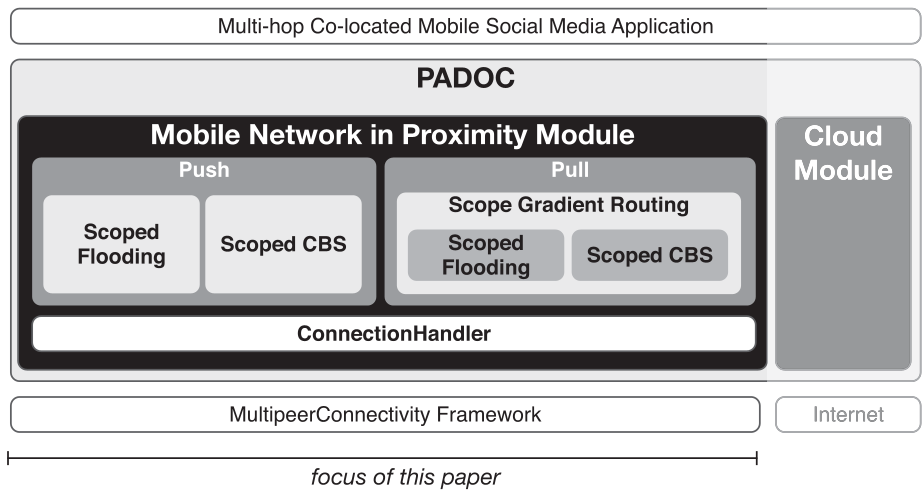 Figure: The Padoc middleware stack, extending the standard iOS connectivity layers with multi-hop logic.
Experiments & Results: Performance in the Field
The team evaluated Padoc using 10 physical iPod Touch devices across three topologies: Cluster (dense), Line (sparse/distributed), and Small Field Class (mobile/dynamic).
Key Findings:
- Efficiency: In the Cluster topology, the PushCBS strategy was significantly more efficient than standard flooding, reducing the retransmission ratio from 1.0 (everyone sends) to ~0.2 (only 20% send).
- Reliability vs. Overhead: While the Pull strategy offered the best efficiency for specific recipients, it recorded a slightly lower delivery rate (~90%) compared to the more aggressive Push strategies (~98-100%).
- Real-World Usability: When deployed with Médecins Sans Frontières (MSF) staff in Mozambique, the system achieved a System Usability Scale (SUS) score of 80.5. Users highlighted the potential to "play the system" (bypass government monitoring) and the massive cost savings on cellular data.
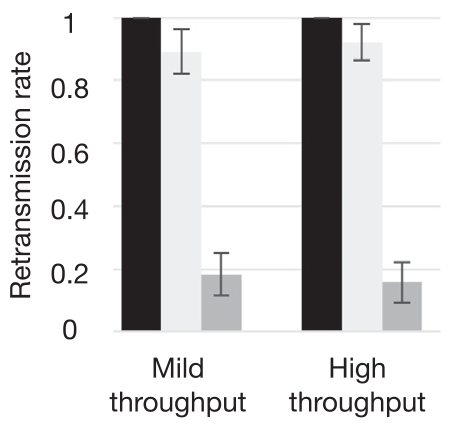 Figure: Delivery rate vs. Retransmission ratio across different strategies. Note the trade-offs between Reliability (top) and Efficiency (bottom).
Critical Analysis & Conclusion
Padoc is a significant step forward because it respects the People-Centric paradigm. It doesn't require users to "root" their phones or have PhDs in networking.
Takeaways:
- Design for Context: Padoc’s success in Mozambique shows that technology works best when it mimics existing social structures (like a classroom or a local NGO team).
- Limitations: The reliance on iOS is both a strength (stability) and a weakness (accessibility in Android-heavy developing markets). Furthermore, while multi-hop works, the "warm-up" cost for routing can be high in extremely volatile networks.
Future Outlook: By open-sourcing Padoc and Heya, the researchers have provided the community with more than just a paper—they’ve provided a toolkit for digital resilience. As privacy concerns and censorship increase globally, proximity-based, infrastructure-independent networking is no longer a niche research area; it is a necessity.
Notes: This work was partly funded by the Hasler Stiftung and remains a foundational example of bridging academic MANET research with real-world humanitarian application.