
PALM: Breaking the Scalability Bottleneck in Conceptual Link Mining
PALM: A Parallel Mining Algorithm for Extracting Maximal Frequent Conceptual Links from Social Networks
The paper introduces PALM (Parallel Mining), an optimized parallelized algorithm designed to extract Maximal Frequent Conceptual Links (MFCL) from social networks. By combining network topology with node attributes and leveraging Formal Concept Analysis, PALM achieves high-performance clustering of links in large-scale datasets.
Executive Summary
TL;DR: Social network analysis is evolving from simple node partitions to complex "conceptual links" that combine connectivity with shared user attributes. However, extracting these links is computationally expensive. This paper presents PALM, a parallelized algorithm that leverages lattice theory to prune the search space, achieving an 80% reduction in processing time for large-scale link mining tasks.
Positioning: While most clustering focuses on "Who is connected to whom," PALM tackles "Why are they connected" by identifying frequent attribute patterns across links. It transforms a theoretically sound but slow process into a scalable tool for real-world social network mining.
The Core Problem: Why Attribute-Aware Clustering Fails to Scale
Social networks are no longer just graphs; they are attributed graphs. Identifying a "community" based only on proximity (e.g., modularity) ignores the rich context of why users interact. Conceptual Linked Mining (from the authors' previous work) sought to solve this by using node properties (e.g., "Professionals from Paris calling Young users in Lyon").
However, the search space for these links is combinatorial. For every attribute added, the potential matches grow exponentially. The original sequential approach, MFCLMin, spent most of its time checking redundant candidates that couldn't possibly be "maximal" or "frequent," making it unusable for a network with half a million links.
Methodology: The Power of the Lattice
The researchers' key insight is that the space of conceptual links isn't just a list—it's a Concept Lattice.
1. The Lattice Intuition
The authors prove a Downward-closure property: If a specific conceptual link is frequent, its sub-links (less specific versions) must also be frequent. Conversely, if a link is infrequent, all its super-links (more specific versions) are guaranteed to be infrequent.
2. Parallelizing the Search (PALM Architecture)
Instead of a single-threaded search, PALM splits the workload into four critical phases:
- Parallel 1-itemset Generation: Scans node attributes concurrently across multiple threads.
- Lattice Preservation: Saves the structure of the lattice so that when joining itemsets to form candidates, the algorithm only looks at relevant branches.
- Threaded Frequency Evaluation: Distributes the "link-counting" task across CPU cores.
(Note: Refer to Algorithm 1 and 4 in the paper for the parallel multithreading logic across lattice branches).
Experimental Proof: Real-World Telecommunication Data
The algorithm was tested on a massive dataset: 246,000 subscribers and 510,000 calls.
Key Findings:
- Linear vs. Power Scaling: While runtime grows linearly with the number of links, it follows a power function as attributes increase. PALM significantly lowers the exponent of this growth.
- The "Core" Advantage: By moving from a single thread to 16 cores, the gain in processing time reaches 80%.
- Stability: Interestingly, the time-saving gain (approx. 75%) remains stable even as the network size increases, proving PALM’s robustness for large datasets.
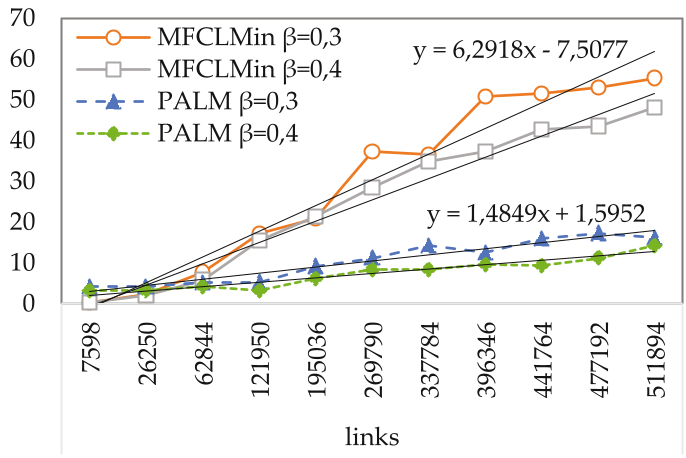 The figure above illustrates how PALM (lower lines) maintains significantly lower latency compared to MFCLMin as network size grows.
Critical Insight & Conclusion
The PALM algorithm succeeds because it doesn't just "go faster"—it works smarter by using the mathematical properties of Formal Concept Analysis. By realizing that the search space is a lattice, the authors could safely "prune" (ignore) massive sections of the graph that didn't meet statistical thresholds.
Takeaway for Practitioners: If you are working with attributed graphs (recommendation systems, fraud detection, or telco analysis), parallelizing your mining tasks is not enough. You must first map your problem to a structure (like a lattice) to eliminate redundant computation.
Future Outlook: The next step for this technology is moving beyond a single machine's CPU cores into distributed "Big Data" environments like Hadoop or Spark, where the "Divide and Conquer" strategy of PALM can be applied to billions of links.